

an electrical field of three million V/cm (which is impossible to produce). The net
result is that electric fields are used to provide energy to the particles in the beam,
while magnetic fields are used to guide, bend, and focus the particles.
2.2 The Linear Accelerator
The first requirement is to generate a stream of high-energy particles for filling the
storage ring. In the early days of particle accelerators, all of the energy was added in
a single step by application of a high dc voltage across a vacuum gap. However,
acceleration by static voltages is limited by arcing and the breakdown of materials.
Although the arcing made for good science fiction movies, machine physicists
eventually turned to ac acceleration by radio frequency fields. The components of
an ac linear accelerator involve a particle source, a power source, and an accelerating
structure.
2.2.1 Particle Sources and Bunchers
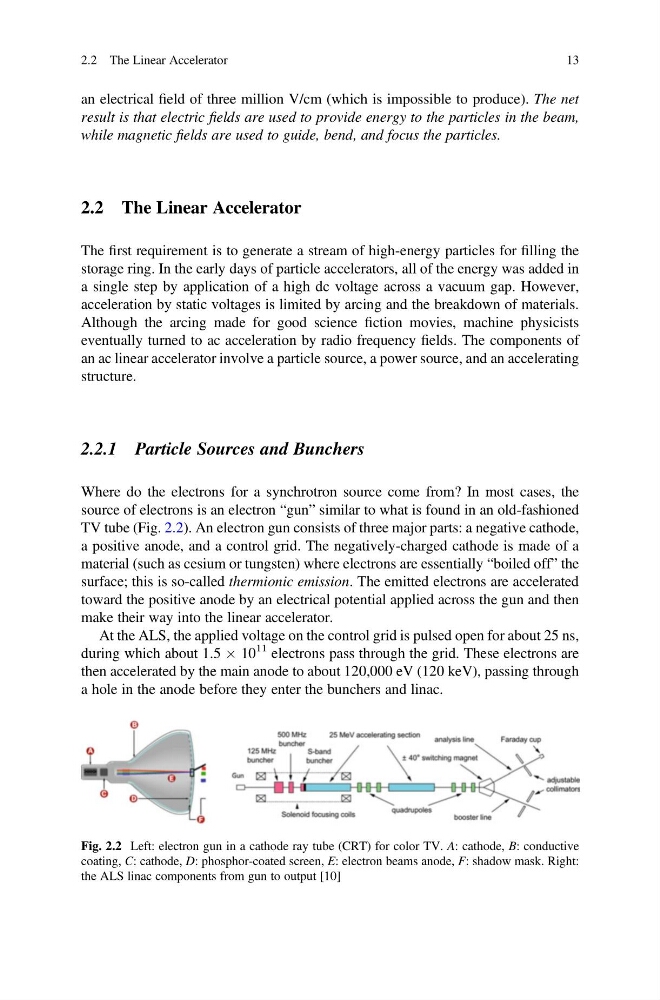
Where do the electrons for a synchrotron source come from? In most cases, the
source of electrons is an electron “gun” similar to what is found in an old-fashioned
TV tube (Fig. 2.2). An electron gun consists of three major parts: a negative cathode,
a positive anode, and a control grid. The negatively-charged cathode is made of a
material (such as cesium or tungsten) where electrons are essentially “boiled off” the
surface; this is so-called thermionic emission. The emitted electrons are accelerated
toward the positive anode by an electrical potential applied across the gun and then
make their way into the linear accelerator.
At the ALS, the applied voltage on the control grid is pulsed open for about 25 ns,
during which about 1.5 Â 10
11 electrons pass through the grid. These electrons are
then accelerated by the main anode to about 120,000 eV (120 keV), passing through
a hole in the anode before they enter the bunchers and linac.
Fig. 2.2 Left: electron gun in a cathode ray tube (CRT) for color TV. A: cathode, B: conductive
coating, C: cathode, D: phosphor-coated screen, E: electron beams anode, F: shadow mask. Right:
the ALS linac components from gun to output [10]
2.2 The Linear Accelerator
13
result is that electric fields are used to provide energy to the particles in the beam,
while magnetic fields are used to guide, bend, and focus the particles.
2.2 The Linear Accelerator
The first requirement is to generate a stream of high-energy particles for filling the
storage ring. In the early days of particle accelerators, all of the energy was added in
a single step by application of a high dc voltage across a vacuum gap. However,
acceleration by static voltages is limited by arcing and the breakdown of materials.
Although the arcing made for good science fiction movies, machine physicists
eventually turned to ac acceleration by radio frequency fields. The components of
an ac linear accelerator involve a particle source, a power source, and an accelerating
structure.
2.2.1 Particle Sources and Bunchers
Where do the electrons for a synchrotron source come from? In most cases, the
source of electrons is an electron “gun” similar to what is found in an old-fashioned
TV tube (Fig. 2.2). An electron gun consists of three major parts: a negative cathode,
a positive anode, and a control grid. The negatively-charged cathode is made of a
material (such as cesium or tungsten) where electrons are essentially “boiled off” the
surface; this is so-called thermionic emission. The emitted electrons are accelerated
toward the positive anode by an electrical potential applied across the gun and then
make their way into the linear accelerator.
At the ALS, the applied voltage on the control grid is pulsed open for about 25 ns,
during which about 1.5 Â 10
11 electrons pass through the grid. These electrons are
then accelerated by the main anode to about 120,000 eV (120 keV), passing through
a hole in the anode before they enter the bunchers and linac.
Fig. 2.2 Left: electron gun in a cathode ray tube (CRT) for color TV. A: cathode, B: conductive
coating, C: cathode, D: phosphor-coated screen, E: electron beams anode, F: shadow mask. Right:
the ALS linac components from gun to output [10]
2.2 The Linear Accelerator
13