

Since electrons have to arrive at the linear accelerator or synchrotron within
certain time intervals to be properly accelerated, the continuous or partially bunched
electron stream from a gun is usually put into bunches by various prebunchers. For
example, the ALS linac has three sections that sequentially divide the beam into
0.125, 0.5, and ~3 GHz bunches (Fig. 2.2).
Pulsed laser electron sources can be considerably brighter than conventional
electron guns. In these devices, a high-intensity laser is focused onto a “photocathode.” The light causes photoemission from a very small spot, resulting in a much
lower emittance source, which is critical for free electron lasers (Chap. 12).
2.2.2 RF Power and Waveguides
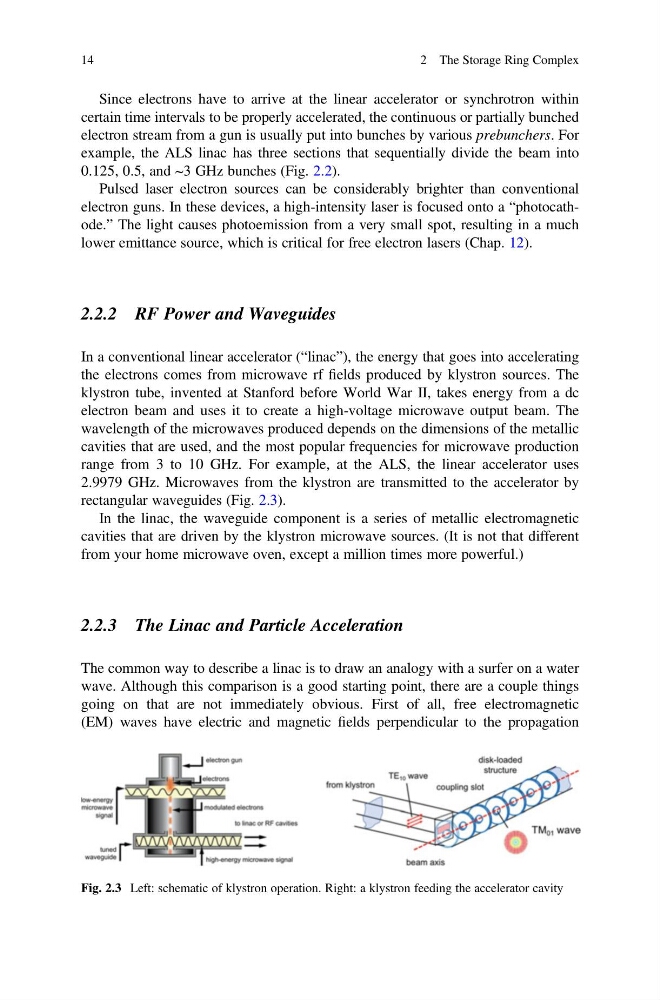
In a conventional linear accelerator (“linac”), the energy that goes into accelerating
the electrons comes from microwave rf fields produced by klystron sources. The
klystron tube, invented at Stanford before World War II, takes energy from a dc
electron beam and uses it to create a high-voltage microwave output beam. The
wavelength of the microwaves produced depends on the dimensions of the metallic
cavities that are used, and the most popular frequencies for microwave production
range from 3 to 10 GHz. For example, at the ALS, the linear accelerator uses
2.9979 GHz. Microwaves from the klystron are transmitted to the accelerator by
rectangular waveguides (Fig. 2.3).
In the linac, the waveguide component is a series of metallic electromagnetic
cavities that are driven by the klystron microwave sources. (It is not that different
from your home microwave oven, except a million times more powerful.)
2.2.3 The Linac and Particle Acceleration
The common way to describe a linac is to draw an analogy with a surfer on a water
wave. Although this comparison is a good starting point, there are a couple things
going on that are not immediately obvious. First of all, free electromagnetic
(EM) waves have electric and magnetic fields perpendicular to the propagation
Fig. 2.3 Left: schematic of klystron operation. Right: a klystron feeding the accelerator cavity
14
2 The Storage Ring Complex
certain time intervals to be properly accelerated, the continuous or partially bunched
electron stream from a gun is usually put into bunches by various prebunchers. For
example, the ALS linac has three sections that sequentially divide the beam into
0.125, 0.5, and ~3 GHz bunches (Fig. 2.2).
Pulsed laser electron sources can be considerably brighter than conventional
electron guns. In these devices, a high-intensity laser is focused onto a “photocathode.” The light causes photoemission from a very small spot, resulting in a much
lower emittance source, which is critical for free electron lasers (Chap. 12).
2.2.2 RF Power and Waveguides
In a conventional linear accelerator (“linac”), the energy that goes into accelerating
the electrons comes from microwave rf fields produced by klystron sources. The
klystron tube, invented at Stanford before World War II, takes energy from a dc
electron beam and uses it to create a high-voltage microwave output beam. The
wavelength of the microwaves produced depends on the dimensions of the metallic
cavities that are used, and the most popular frequencies for microwave production
range from 3 to 10 GHz. For example, at the ALS, the linear accelerator uses
2.9979 GHz. Microwaves from the klystron are transmitted to the accelerator by
rectangular waveguides (Fig. 2.3).
In the linac, the waveguide component is a series of metallic electromagnetic
cavities that are driven by the klystron microwave sources. (It is not that different
from your home microwave oven, except a million times more powerful.)
2.2.3 The Linac and Particle Acceleration
The common way to describe a linac is to draw an analogy with a surfer on a water
wave. Although this comparison is a good starting point, there are a couple things
going on that are not immediately obvious. First of all, free electromagnetic
(EM) waves have electric and magnetic fields perpendicular to the propagation
Fig. 2.3 Left: schematic of klystron operation. Right: a klystron feeding the accelerator cavity
14
2 The Storage Ring Complex