

2.1 How to Accelerate and Steer Charged Particles: The
Lorentz Force
In order to create our relativistic charged particle beam circulating around our
storage ring, we need to apply forces to (1) provide and replenish the particles’
energy and (2) bend them in a circle and also to keep them focused. The Lorentz
force equation describes how charged particles in accelerators interact with electric
(E
!
) or magnetic (B
!
) fields, and the net Lorentz force F
!
on a particle with charge
q and velocity v
! is given by (in SI units):
F
! ¼ q E
! þ ν
! Â B
!
ð2:1Þ
It is important to note that the force and acceleration from an electric field are
along the direction of that field, while the force and acceleration from the applied
magnetic field are perpendicular to both the field and the particle motion. Since the
change in energy of the particle is given by the force times the change in position
parallel to that force (Eq. 2.2), only the electric field imparts energy to the particle:
ΔE kin ¼
Z
F
! Á d s
!
ð2:2Þ
ΔE kin ¼ q
Z
E
! Á d s
!
ð2:3Þ
In principle an electric field could also be used to steer the particles (as in a
cathode ray tube). However, in practice, for relativistic charged particles, the force
from a magnetic field of 1 Tesla (which is easy to produce) is about the same as from
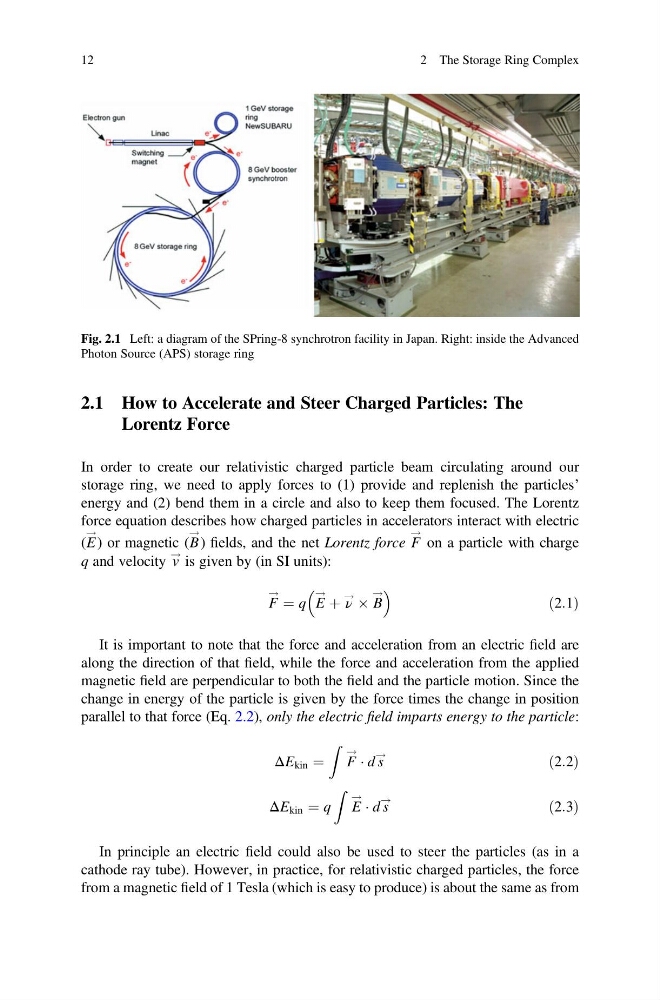
Fig. 2.1 Left: a diagram of the SPring-8 synchrotron facility in Japan. Right: inside the Advanced
Photon Source (APS) storage ring
12
2 The Storage Ring Complex
Lorentz Force
In order to create our relativistic charged particle beam circulating around our
storage ring, we need to apply forces to (1) provide and replenish the particles’
energy and (2) bend them in a circle and also to keep them focused. The Lorentz
force equation describes how charged particles in accelerators interact with electric
(E
!
) or magnetic (B
!
) fields, and the net Lorentz force F
!
on a particle with charge
q and velocity v
! is given by (in SI units):
F
! ¼ q E
! þ ν
! Â B
!
ð2:1Þ
It is important to note that the force and acceleration from an electric field are
along the direction of that field, while the force and acceleration from the applied
magnetic field are perpendicular to both the field and the particle motion. Since the
change in energy of the particle is given by the force times the change in position
parallel to that force (Eq. 2.2), only the electric field imparts energy to the particle:
ΔE kin ¼
Z
F
! Á d s
!
ð2:2Þ
ΔE kin ¼ q
Z
E
! Á d s
!
ð2:3Þ
In principle an electric field could also be used to steer the particles (as in a
cathode ray tube). However, in practice, for relativistic charged particles, the force
from a magnetic field of 1 Tesla (which is easy to produce) is about the same as from
Fig. 2.1 Left: a diagram of the SPring-8 synchrotron facility in Japan. Right: inside the Advanced
Photon Source (APS) storage ring
12
2 The Storage Ring Complex