

A semi-rigorous calculation of the Auger electron energy would involve consideration of the initial state configuration with one core vacancy and the final state
configuration with a second vacancy:
E
atom a
ð Þ ! E
atom bc
ð Þ
ð11:13Þ
where (a) represents an atom with a vacancy in shell A and (bc) represents the same
atom with vacancies in shells B and C. With two vacancies in the final state, there are
invariably multiplet splittings to account for. Of course, if there is a partially filled
valence shell, then there will be a variety of additional multiplet interactions for both
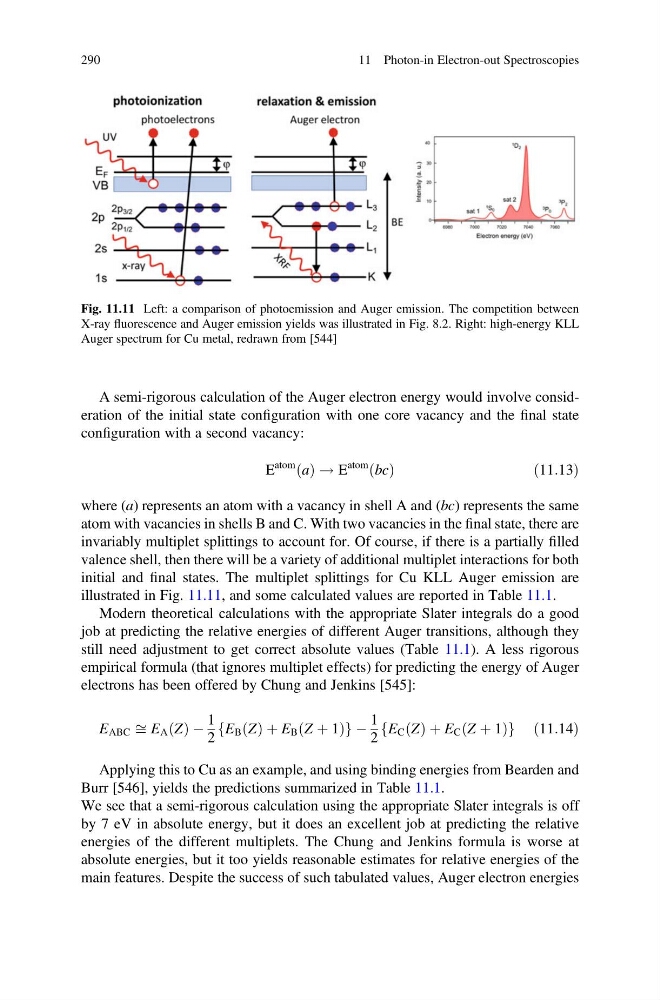
initial and final states. The multiplet splittings for Cu KLL Auger emission are
illustrated in Fig. 11.11, and some calculated values are reported in Table 11.1.
Modern theoretical calculations with the appropriate Slater integrals do a good
job at predicting the relative energies of different Auger transitions, although they
still need adjustment to get correct absolute values (Table 11.1). A less rigorous
empirical formula (that ignores multiplet effects) for predicting the energy of Auger
electrons has been offered by Chung and Jenkins [545]:
E ABC ffi E A Z
ð Þ À
1
2
E B Z
ð Þ þ E B Z þ 1
ð
Þ
f
g À
1
2
E C Z
ð Þ þ E C Z þ 1
ð
Þ
f
g ð11:14Þ
Applying this to Cu as an example, and using binding energies from Bearden and
Burr [546], yields the predictions summarized in Table 11.1.
We see that a semi-rigorous calculation using the appropriate Slater integrals is off
by 7 eV in absolute energy, but it does an excellent job at predicting the relative
energies of the different multiplets. The Chung and Jenkins formula is worse at
absolute energies, but it too yields reasonable estimates for relative energies of the
main features. Despite the success of such tabulated values, Auger electron energies
Fig. 11.11 Left: a comparison of photoemission and Auger emission. The competition between
X-ray fluorescence and Auger emission yields was illustrated in Fig. 8.2. Right: high-energy KLL
Auger spectrum for Cu metal, redrawn from [544]
290
11 Photon-in Electron-out Spectroscopies
configuration with a second vacancy:
E
atom a
ð Þ ! E
atom bc
ð Þ
ð11:13Þ
where (a) represents an atom with a vacancy in shell A and (bc) represents the same
atom with vacancies in shells B and C. With two vacancies in the final state, there are
invariably multiplet splittings to account for. Of course, if there is a partially filled
valence shell, then there will be a variety of additional multiplet interactions for both
initial and final states. The multiplet splittings for Cu KLL Auger emission are
illustrated in Fig. 11.11, and some calculated values are reported in Table 11.1.
Modern theoretical calculations with the appropriate Slater integrals do a good
job at predicting the relative energies of different Auger transitions, although they
still need adjustment to get correct absolute values (Table 11.1). A less rigorous
empirical formula (that ignores multiplet effects) for predicting the energy of Auger
electrons has been offered by Chung and Jenkins [545]:
E ABC ffi E A Z
ð Þ À
1
2
E B Z
ð Þ þ E B Z þ 1
ð
Þ
f
g À
1
2
E C Z
ð Þ þ E C Z þ 1
ð
Þ
f
g ð11:14Þ
Applying this to Cu as an example, and using binding energies from Bearden and
Burr [546], yields the predictions summarized in Table 11.1.
We see that a semi-rigorous calculation using the appropriate Slater integrals is off
by 7 eV in absolute energy, but it does an excellent job at predicting the relative
energies of the different multiplets. The Chung and Jenkins formula is worse at
absolute energies, but it too yields reasonable estimates for relative energies of the
main features. Despite the success of such tabulated values, Auger electron energies
Fig. 11.11 Left: a comparison of photoemission and Auger emission. The competition between
X-ray fluorescence and Auger emission yields was illustrated in Fig. 8.2. Right: high-energy KLL
Auger spectrum for Cu metal, redrawn from [544]
290
11 Photon-in Electron-out Spectroscopies