

11.7 Auger Electron Spectroscopy (AES)
When an atom is excited by an X-ray, it is promoted to an excited state with a core
vacancy. Filling the core hole with a higher-level electron releases energy, and
Auger electron emission is the process that competes with X-ray fluorescence for
disposing of that energy. In the Auger process, instead of relaxing by emission of a
photon, the atom ejects an electron (Fig. 11.11). “Auger Emission Spectroscopy” or
“AES” records the energies of these electrons with the same instrumentation used for
XPS. Because the energies of the levels are almost fixed, Auger electron energies are
approximately fixed, and they can be extracted from published tables [543]. This is
in contrast to absolute photoelectron energies, which track the energy of the exciting
X-ray. Pierre Auger observed his eponymous effect in 1923, but in fact Lise Meitner
had observed “Auger emission” a year earlier [523, 524].
There are three electron energy levels involved in an Auger transition, and the
nomenclature for labeling these events reflects those levels. Supposing that the initial
vacancy is in the A shell, the level filling that vacancy is the B shell, and the
promoted electron is in the C shell, then the Auger electron and associated transition
are labeled ABC. For example, a common case is to ionize a 1s electron, fill the
vacancy with a 2p electron, and promote a second 2p electron into the continuum.
This would be a KLL Auger transition, with additional subscripts for the type of 2p
electron promoted. Valence electrons can also be promoted; they acquire the label
V. For example, exciting Si at its L 2,3 edge leads to ejection of a core electron, filling
the vacancy with a valence electron, and ejection of a valence electron to shed the
extra energy—hence described as an L 2,3 VV process.
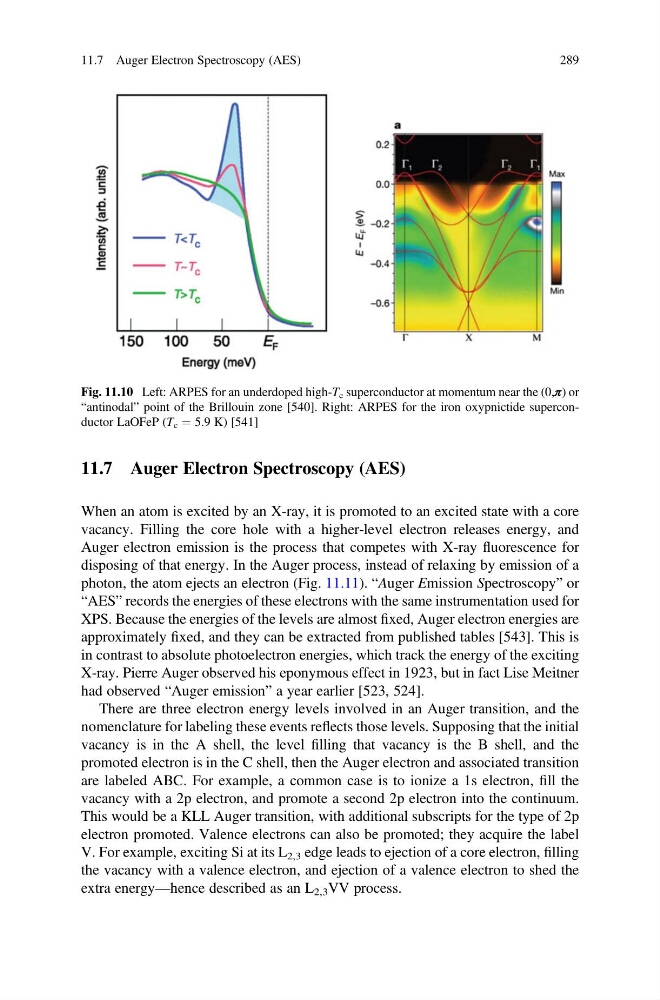
Fig. 11.10 Left: ARPES for an underdoped high-T c superconductor at momentum near the (0,π) or
“antinodal” point of the Brillouin zone [540]. Right: ARPES for the iron oxypnictide superconductor LaOFeP (T c ¼ 5.9 K) [541]
11.7 Auger Electron Spectroscopy (AES)
289
When an atom is excited by an X-ray, it is promoted to an excited state with a core
vacancy. Filling the core hole with a higher-level electron releases energy, and
Auger electron emission is the process that competes with X-ray fluorescence for
disposing of that energy. In the Auger process, instead of relaxing by emission of a
photon, the atom ejects an electron (Fig. 11.11). “Auger Emission Spectroscopy” or
“AES” records the energies of these electrons with the same instrumentation used for
XPS. Because the energies of the levels are almost fixed, Auger electron energies are
approximately fixed, and they can be extracted from published tables [543]. This is
in contrast to absolute photoelectron energies, which track the energy of the exciting
X-ray. Pierre Auger observed his eponymous effect in 1923, but in fact Lise Meitner
had observed “Auger emission” a year earlier [523, 524].
There are three electron energy levels involved in an Auger transition, and the
nomenclature for labeling these events reflects those levels. Supposing that the initial
vacancy is in the A shell, the level filling that vacancy is the B shell, and the
promoted electron is in the C shell, then the Auger electron and associated transition
are labeled ABC. For example, a common case is to ionize a 1s electron, fill the
vacancy with a 2p electron, and promote a second 2p electron into the continuum.
This would be a KLL Auger transition, with additional subscripts for the type of 2p
electron promoted. Valence electrons can also be promoted; they acquire the label
V. For example, exciting Si at its L 2,3 edge leads to ejection of a core electron, filling
the vacancy with a valence electron, and ejection of a valence electron to shed the
extra energy—hence described as an L 2,3 VV process.
Fig. 11.10 Left: ARPES for an underdoped high-T c superconductor at momentum near the (0,π) or
“antinodal” point of the Brillouin zone [540]. Right: ARPES for the iron oxypnictide superconductor LaOFeP (T c ¼ 5.9 K) [541]
11.7 Auger Electron Spectroscopy (AES)
289