

For a free electron in vacuum, the modulus of the wave vector K
! ¼ p
! =ħ is given
by:
K ¼
ffiffiffiffiffiffiffiffiffiffiffiffiffiffiffi ffi
2m e E kin
p
ħ
ð11:7Þ
and referenced to the surface, the parallel (K
!
k ¼ K
!
x þ K
!
y ) and perpendicular
(K
!
⊥ ¼ K
!
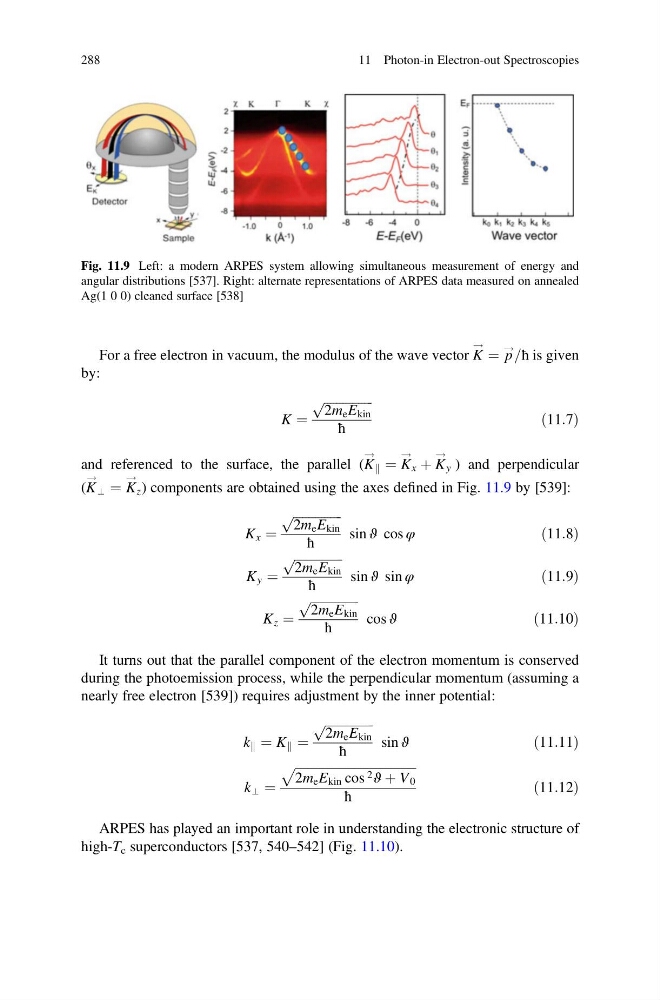
z ) components are obtained using the axes defined in Fig. 11.9 by [539]:
K x ¼
ffiffiffiffiffiffiffiffiffiffiffiffiffiffiffi ffi
2m e E kin
p
ħ
sin ϑ cos φ
ð11:8Þ
K y ¼
ffiffiffiffiffiffiffiffiffiffiffiffiffiffiffi ffi
2m e E kin
p
ħ
sin ϑ sin φ
ð11:9Þ
K z ¼
ffiffiffiffiffiffiffiffiffiffiffiffiffiffiffi ffi
2m e E kin
p
ħ
cos ϑ
ð11:10Þ
It turns out that the parallel component of the electron momentum is conserved
during the photoemission process, while the perpendicular momentum (assuming a
nearly free electron [539]) requires adjustment by the inner potential:
k k ¼ K k ¼
ffiffiffiffiffiffiffiffiffiffiffiffiffiffiffi ffi
2m e E kin
p
ħ
sin ϑ
ð11:11Þ
k ⊥ ¼
ffiffiffiffiffiffiffiffiffiffiffiffiffiffiffiffiffiffiffiffiffiffiffiffiffiffiffiffiffiffiffiffiffiffiffiffiffiffiffi
2m e E kin cos 2 ϑ þ V 0
p
ħ
ð11:12Þ
ARPES has played an important role in understanding the electronic structure of
high-T c superconductors [537, 540–542] (Fig. 11.10).
Fig. 11.9 Left: a modern ARPES system allowing simultaneous measurement of energy and
angular distributions [537]. Right: alternate representations of ARPES data measured on annealed
Ag(1 0 0) cleaned surface [538]
288
11 Photon-in Electron-out Spectroscopies
! ¼ p
! =ħ is given
by:
K ¼
ffiffiffiffiffiffiffiffiffiffiffiffiffiffiffi ffi
2m e E kin
p
ħ
ð11:7Þ
and referenced to the surface, the parallel (K
!
k ¼ K
!
x þ K
!
y ) and perpendicular
(K
!
⊥ ¼ K
!
z ) components are obtained using the axes defined in Fig. 11.9 by [539]:
K x ¼
ffiffiffiffiffiffiffiffiffiffiffiffiffiffiffi ffi
2m e E kin
p
ħ
sin ϑ cos φ
ð11:8Þ
K y ¼
ffiffiffiffiffiffiffiffiffiffiffiffiffiffiffi ffi
2m e E kin
p
ħ
sin ϑ sin φ
ð11:9Þ
K z ¼
ffiffiffiffiffiffiffiffiffiffiffiffiffiffiffi ffi
2m e E kin
p
ħ
cos ϑ
ð11:10Þ
It turns out that the parallel component of the electron momentum is conserved
during the photoemission process, while the perpendicular momentum (assuming a
nearly free electron [539]) requires adjustment by the inner potential:
k k ¼ K k ¼
ffiffiffiffiffiffiffiffiffiffiffiffiffiffiffi ffi
2m e E kin
p
ħ
sin ϑ
ð11:11Þ
k ⊥ ¼
ffiffiffiffiffiffiffiffiffiffiffiffiffiffiffiffiffiffiffiffiffiffiffiffiffiffiffiffiffiffiffiffiffiffiffiffiffiffiffi
2m e E kin cos 2 ϑ þ V 0
p
ħ
ð11:12Þ
ARPES has played an important role in understanding the electronic structure of
high-T c superconductors [537, 540–542] (Fig. 11.10).
Fig. 11.9 Left: a modern ARPES system allowing simultaneous measurement of energy and
angular distributions [537]. Right: alternate representations of ARPES data measured on annealed
Ag(1 0 0) cleaned surface [538]
288
11 Photon-in Electron-out Spectroscopies