

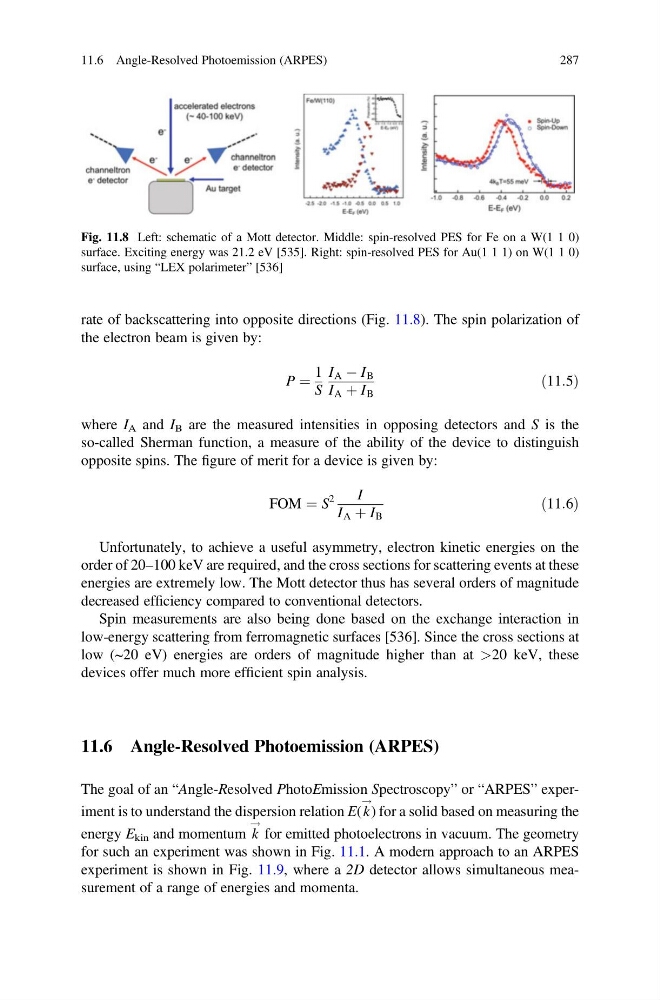
rate of backscattering into opposite directions (Fig. 11.8). The spin polarization of
the electron beam is given by:
P ¼
1
S
I A À I B
I A þ I B
ð11:5Þ
where I A and I B are the measured intensities in opposing detectors and S is the
so-called Sherman function, a measure of the ability of the device to distinguish
opposite spins. The figure of merit for a device is given by:
FOM ¼ S
2
I
I A þ I B
ð11:6Þ
Unfortunately, to achieve a useful asymmetry, electron kinetic energies on the
order of 20–100 keV are required, and the cross sections for scattering events at these
energies are extremely low. The Mott detector thus has several orders of magnitude
decreased efficiency compared to conventional detectors.
Spin measurements are also being done based on the exchange interaction in
low-energy scattering from ferromagnetic surfaces [536]. Since the cross sections at
low (~20 eV) energies are orders of magnitude higher than at >20 keV, these
devices offer much more efficient spin analysis.
11.6 Angle-Resolved Photoemission (ARPES)
The goal of an “Angle-Resolved PhotoEmission Spectroscopy” or “ARPES” experiment is to understand the dispersion relation E( k
!
) for a solid based on measuring the
energy E kin and momentum k
!
for emitted photoelectrons in vacuum. The geometry
for such an experiment was shown in Fig. 11.1. A modern approach to an ARPES
experiment is shown in Fig. 11.9, where a 2D detector allows simultaneous measurement of a range of energies and momenta.
Fig. 11.8 Left: schematic of a Mott detector. Middle: spin-resolved PES for Fe on a W(1 1 0)
surface. Exciting energy was 21.2 eV [535]. Right: spin-resolved PES for Au(1 1 1) on W(1 1 0)
surface, using “LEX polarimeter” [536]
11.6 Angle-Resolved Photoemission (ARPES)
287
the electron beam is given by:
P ¼
1
S
I A À I B
I A þ I B
ð11:5Þ
where I A and I B are the measured intensities in opposing detectors and S is the
so-called Sherman function, a measure of the ability of the device to distinguish
opposite spins. The figure of merit for a device is given by:
FOM ¼ S
2
I
I A þ I B
ð11:6Þ
Unfortunately, to achieve a useful asymmetry, electron kinetic energies on the
order of 20–100 keV are required, and the cross sections for scattering events at these
energies are extremely low. The Mott detector thus has several orders of magnitude
decreased efficiency compared to conventional detectors.
Spin measurements are also being done based on the exchange interaction in
low-energy scattering from ferromagnetic surfaces [536]. Since the cross sections at
low (~20 eV) energies are orders of magnitude higher than at >20 keV, these
devices offer much more efficient spin analysis.
11.6 Angle-Resolved Photoemission (ARPES)
The goal of an “Angle-Resolved PhotoEmission Spectroscopy” or “ARPES” experiment is to understand the dispersion relation E( k
!
) for a solid based on measuring the
energy E kin and momentum k
!
for emitted photoelectrons in vacuum. The geometry
for such an experiment was shown in Fig. 11.1. A modern approach to an ARPES
experiment is shown in Fig. 11.9, where a 2D detector allows simultaneous measurement of a range of energies and momenta.
Fig. 11.8 Left: schematic of a Mott detector. Middle: spin-resolved PES for Fe on a W(1 1 0)
surface. Exciting energy was 21.2 eV [535]. Right: spin-resolved PES for Au(1 1 1) on W(1 1 0)
surface, using “LEX polarimeter” [536]
11.6 Angle-Resolved Photoemission (ARPES)
287