

11.4 Ambient Pressure X-ray Photoelectron Spectroscopy
(APXPS)
Despite the enormous power of XPS, scientists have always been concerned about
the “pressure gap” between UHV surface science and the nature of surface under
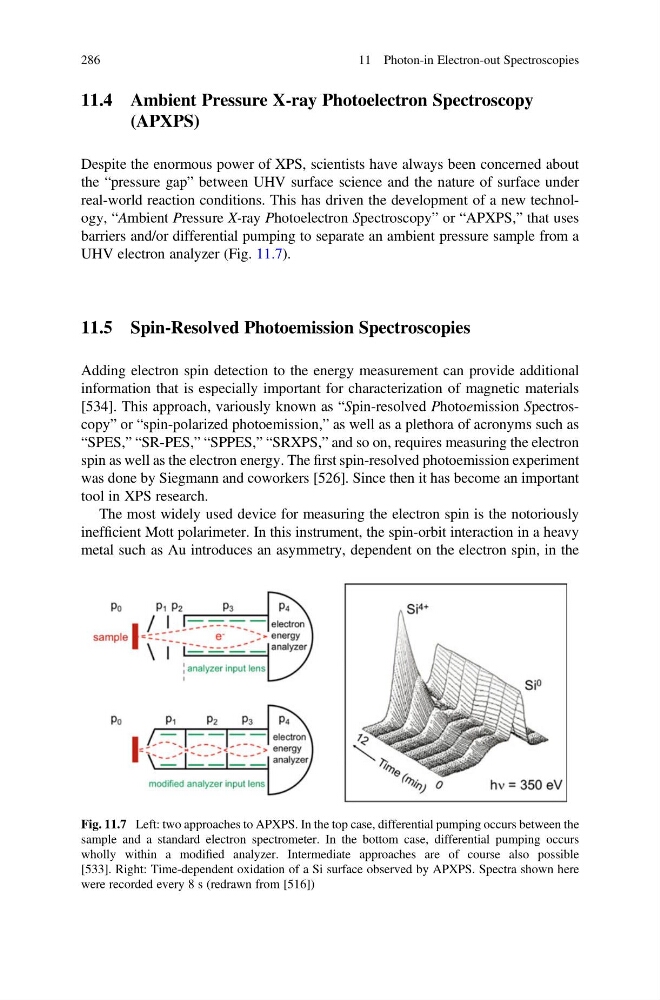
real-world reaction conditions. This has driven the development of a new technology, “Ambient Pressure X-ray Photoelectron Spectroscopy” or “APXPS,” that uses
barriers and/or differential pumping to separate an ambient pressure sample from a
UHV electron analyzer (Fig. 11.7).
11.5 Spin-Resolved Photoemission Spectroscopies
Adding electron spin detection to the energy measurement can provide additional
information that is especially important for characterization of magnetic materials
[534]. This approach, variously known as “Spin-resolved Photoemission Spectroscopy” or “spin-polarized photoemission,” as well as a plethora of acronyms such as
“SPES,” “SR-PES,” “SPPES,” “SRXPS,” and so on, requires measuring the electron
spin as well as the electron energy. The first spin-resolved photoemission experiment
was done by Siegmann and coworkers [526]. Since then it has become an important
tool in XPS research.
The most widely used device for measuring the electron spin is the notoriously
inefficient Mott polarimeter. In this instrument, the spin-orbit interaction in a heavy
metal such as Au introduces an asymmetry, dependent on the electron spin, in the
Fig. 11.7 Left: two approaches to APXPS. In the top case, differential pumping occurs between the
sample and a standard electron spectrometer. In the bottom case, differential pumping occurs
wholly within a modified analyzer. Intermediate approaches are of course also possible
[533]. Right: Time-dependent oxidation of a Si surface observed by APXPS. Spectra shown here
were recorded every 8 s (redrawn from [516])
286
11 Photon-in Electron-out Spectroscopies
(APXPS)
Despite the enormous power of XPS, scientists have always been concerned about
the “pressure gap” between UHV surface science and the nature of surface under
real-world reaction conditions. This has driven the development of a new technology, “Ambient Pressure X-ray Photoelectron Spectroscopy” or “APXPS,” that uses
barriers and/or differential pumping to separate an ambient pressure sample from a
UHV electron analyzer (Fig. 11.7).
11.5 Spin-Resolved Photoemission Spectroscopies
Adding electron spin detection to the energy measurement can provide additional
information that is especially important for characterization of magnetic materials
[534]. This approach, variously known as “Spin-resolved Photoemission Spectroscopy” or “spin-polarized photoemission,” as well as a plethora of acronyms such as
“SPES,” “SR-PES,” “SPPES,” “SRXPS,” and so on, requires measuring the electron
spin as well as the electron energy. The first spin-resolved photoemission experiment
was done by Siegmann and coworkers [526]. Since then it has become an important
tool in XPS research.
The most widely used device for measuring the electron spin is the notoriously
inefficient Mott polarimeter. In this instrument, the spin-orbit interaction in a heavy
metal such as Au introduces an asymmetry, dependent on the electron spin, in the
Fig. 11.7 Left: two approaches to APXPS. In the top case, differential pumping occurs between the
sample and a standard electron spectrometer. In the bottom case, differential pumping occurs
wholly within a modified analyzer. Intermediate approaches are of course also possible
[533]. Right: Time-dependent oxidation of a Si surface observed by APXPS. Spectra shown here
were recorded every 8 s (redrawn from [516])
286
11 Photon-in Electron-out Spectroscopies