

A Selective History of Photoemission and Auger Spectroscopies
1877—Hertz observes photoemission [510].
1905—Einstein explains photoelectric effect in terms of quantized
photons [511].
1922—Meitner and Auger discover core-hole relaxation via electron emission
[523] [524].
1957—Siegbahn publishes first “modern” XPS (for Cu) showing discrete
lines [525].
1969—Siegmann reports first spin-resolved photoemission spectrum for Gd
metal [526].
1974—Lindau and Pianetta conduct first synchrotron XPS for Au using
SSRP [517].
2017—Takagi et al. demonstrate ambient pressure HAXPS at 1 atm at Spring8 [527].
11.3 Hard X-ray Photoelectron Spectroscopy (HAXPS)
The higher flux of high-energy photons available from third-generation synchrotron
sources has contributed toward XPS becoming a bulk-sensitive technique. This is
achieved by using incident photon energies of 3–10 keV (or higher). Another key
development for using higher energies was commercialization of electron spectrometers capable of reliable operation with retarding voltages in the multi-keV range.
The use of “Hard X-ray Photoelectron Spectroscopy” (“HAXPS”) brings two benefits. First, the photon penetration is much deeper than with soft X-rays.
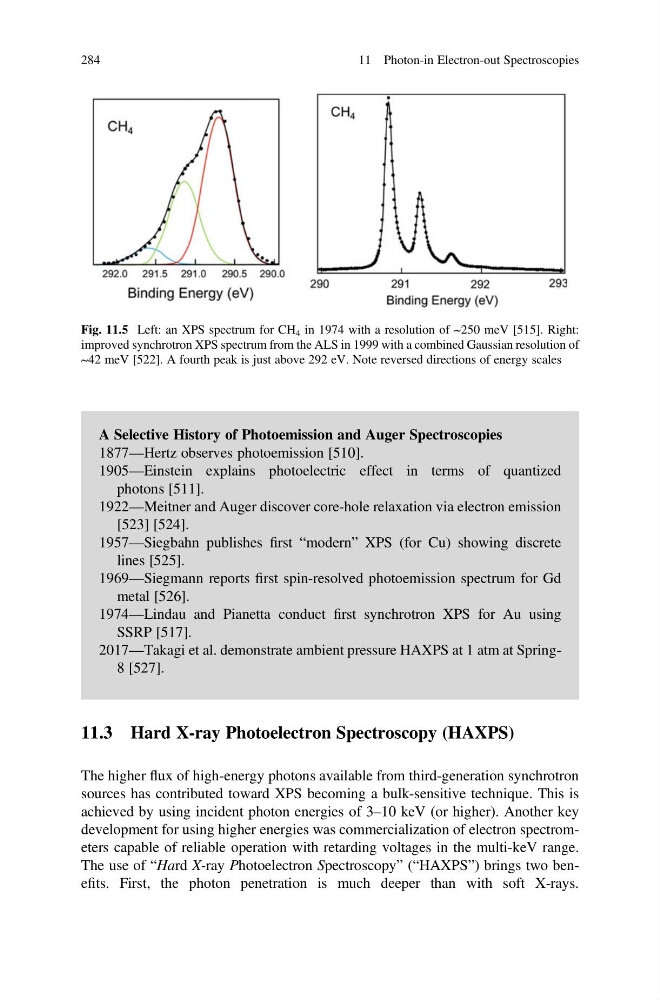
Fig. 11.5 Left: an XPS spectrum for CH 4 in 1974 with a resolution of ~250 meV [515]. Right:
improved synchrotron XPS spectrum from the ALS in 1999 with a combined Gaussian resolution of
~42 meV [522]. A fourth peak is just above 292 eV. Note reversed directions of energy scales
284
11 Photon-in Electron-out Spectroscopies
1877—Hertz observes photoemission [510].
1905—Einstein explains photoelectric effect in terms of quantized
photons [511].
1922—Meitner and Auger discover core-hole relaxation via electron emission
[523] [524].
1957—Siegbahn publishes first “modern” XPS (for Cu) showing discrete
lines [525].
1969—Siegmann reports first spin-resolved photoemission spectrum for Gd
metal [526].
1974—Lindau and Pianetta conduct first synchrotron XPS for Au using
SSRP [517].
2017—Takagi et al. demonstrate ambient pressure HAXPS at 1 atm at Spring8 [527].
11.3 Hard X-ray Photoelectron Spectroscopy (HAXPS)
The higher flux of high-energy photons available from third-generation synchrotron
sources has contributed toward XPS becoming a bulk-sensitive technique. This is
achieved by using incident photon energies of 3–10 keV (or higher). Another key
development for using higher energies was commercialization of electron spectrometers capable of reliable operation with retarding voltages in the multi-keV range.
The use of “Hard X-ray Photoelectron Spectroscopy” (“HAXPS”) brings two benefits. First, the photon penetration is much deeper than with soft X-rays.
Fig. 11.5 Left: an XPS spectrum for CH 4 in 1974 with a resolution of ~250 meV [515]. Right:
improved synchrotron XPS spectrum from the ALS in 1999 with a combined Gaussian resolution of
~42 meV [522]. A fourth peak is just above 292 eV. Note reversed directions of energy scales
284
11 Photon-in Electron-out Spectroscopies