

11.2 X-ray Photoelectron Spectroscopy (XPS)
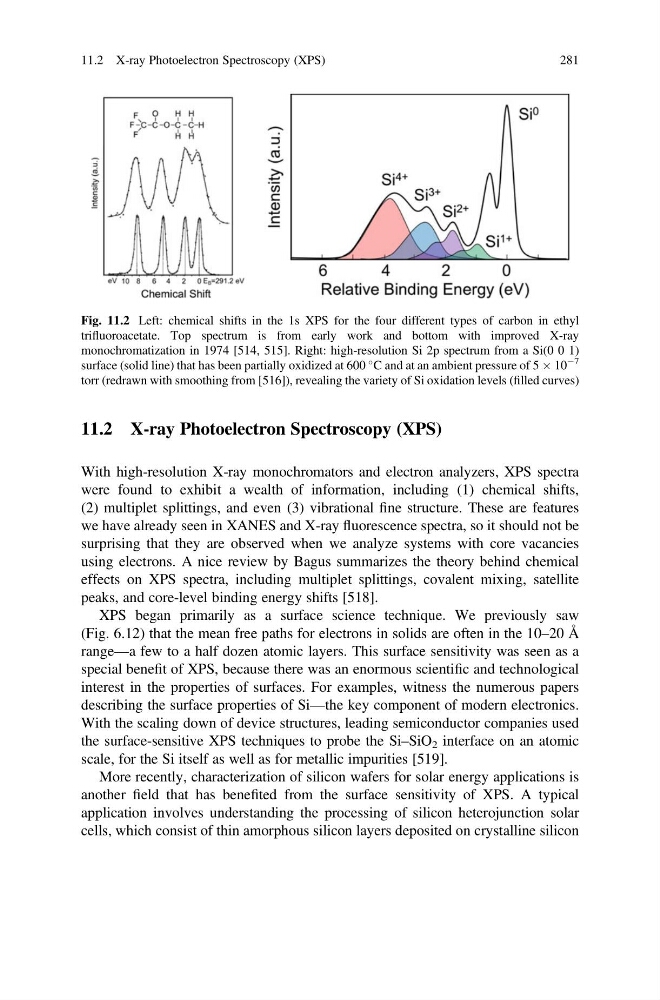
With high-resolution X-ray monochromators and electron analyzers, XPS spectra
were found to exhibit a wealth of information, including (1) chemical shifts,
(2) multiplet splittings, and even (3) vibrational fine structure. These are features
we have already seen in XANES and X-ray fluorescence spectra, so it should not be
surprising that they are observed when we analyze systems with core vacancies
using electrons. A nice review by Bagus summarizes the theory behind chemical
effects on XPS spectra, including multiplet splittings, covalent mixing, satellite
peaks, and core-level binding energy shifts [518].
XPS began primarily as a surface science technique. We previously saw
(Fig. 6.12) that the mean free paths for electrons in solids are often in the 10–20 Å
range—a few to a half dozen atomic layers. This surface sensitivity was seen as a
special benefit of XPS, because there was an enormous scientific and technological
interest in the properties of surfaces. For examples, witness the numerous papers
describing the surface properties of Si—the key component of modern electronics.
With the scaling down of device structures, leading semiconductor companies used
the surface-sensitive XPS techniques to probe the Si–SiO 2 interface on an atomic
scale, for the Si itself as well as for metallic impurities [519].
More recently, characterization of silicon wafers for solar energy applications is
another field that has benefited from the surface sensitivity of XPS. A typical
application involves understanding the processing of silicon heterojunction solar
cells, which consist of thin amorphous silicon layers deposited on crystalline silicon
Fig. 11.2 Left: chemical shifts in the 1s XPS for the four different types of carbon in ethyl
trifluoroacetate. Top spectrum is from early work and bottom with improved X-ray
monochromatization in 1974 [514, 515]. Right: high-resolution Si 2p spectrum from a Si(0 0 1)
surface (solid line) that has been partially oxidized at 600
C and at an ambient pressure of 5 Â 10
À7
torr (redrawn with smoothing from [516]), revealing the variety of Si oxidation levels (filled curves)
11.2 X-ray Photoelectron Spectroscopy (XPS)
281
With high-resolution X-ray monochromators and electron analyzers, XPS spectra
were found to exhibit a wealth of information, including (1) chemical shifts,
(2) multiplet splittings, and even (3) vibrational fine structure. These are features
we have already seen in XANES and X-ray fluorescence spectra, so it should not be
surprising that they are observed when we analyze systems with core vacancies
using electrons. A nice review by Bagus summarizes the theory behind chemical
effects on XPS spectra, including multiplet splittings, covalent mixing, satellite
peaks, and core-level binding energy shifts [518].
XPS began primarily as a surface science technique. We previously saw
(Fig. 6.12) that the mean free paths for electrons in solids are often in the 10–20 Å
range—a few to a half dozen atomic layers. This surface sensitivity was seen as a
special benefit of XPS, because there was an enormous scientific and technological
interest in the properties of surfaces. For examples, witness the numerous papers
describing the surface properties of Si—the key component of modern electronics.
With the scaling down of device structures, leading semiconductor companies used
the surface-sensitive XPS techniques to probe the Si–SiO 2 interface on an atomic
scale, for the Si itself as well as for metallic impurities [519].
More recently, characterization of silicon wafers for solar energy applications is
another field that has benefited from the surface sensitivity of XPS. A typical
application involves understanding the processing of silicon heterojunction solar
cells, which consist of thin amorphous silicon layers deposited on crystalline silicon
Fig. 11.2 Left: chemical shifts in the 1s XPS for the four different types of carbon in ethyl
trifluoroacetate. Top spectrum is from early work and bottom with improved X-ray
monochromatization in 1974 [514, 515]. Right: high-resolution Si 2p spectrum from a Si(0 0 1)
surface (solid line) that has been partially oxidized at 600
C and at an ambient pressure of 5 Â 10
À7
torr (redrawn with smoothing from [516]), revealing the variety of Si oxidation levels (filled curves)
11.2 X-ray Photoelectron Spectroscopy (XPS)
281