

convolution with the resolution function. In PHOENIX, the single-phonon contribution is obtained by a so-called Fourier log method. This exploits the so-called
convolution theorem—the Fourier transform of a convolution is the product of the
individual Fourier transforms.
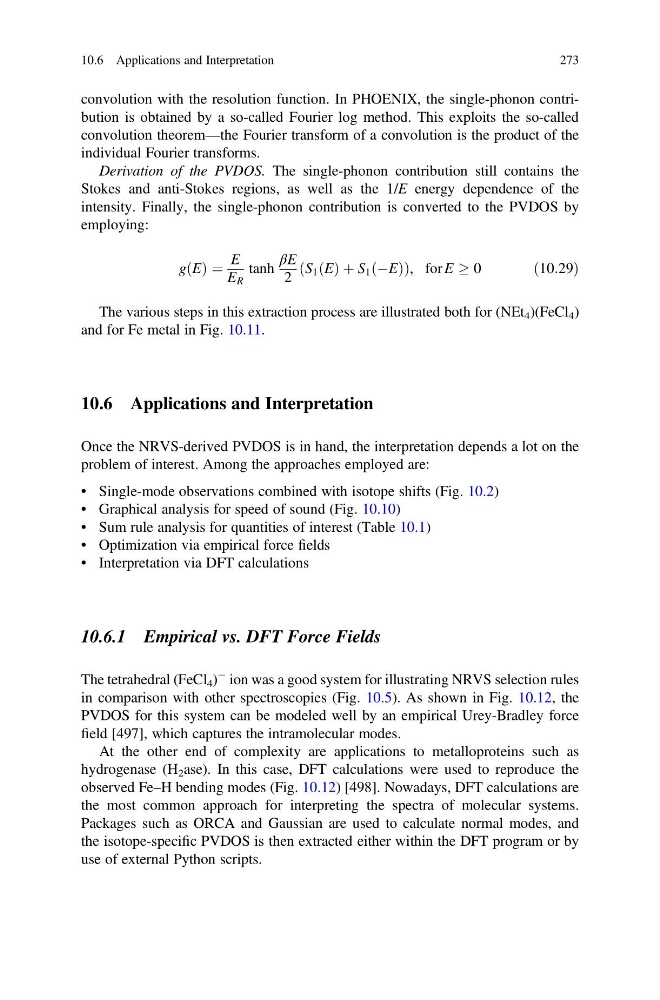
Derivation of the PVDOS. The single-phonon contribution still contains the
Stokes and anti-Stokes regions, as well as the 1/E energy dependence of the
intensity. Finally, the single-phonon contribution is converted to the PVDOS by
employing:
g E
ð Þ ¼
E
E R
tanh
βE
2
S 1 E
ð Þ þ S 1 ÀE
ð Þ
ð
Þ , for E ! 0
ð10:29Þ
The various steps in this extraction process are illustrated both for (NEt 4 )(FeCl 4 )
and for Fe metal in Fig. 10.11.
10.6 Applications and Interpretation
Once the NRVS-derived PVDOS is in hand, the interpretation depends a lot on the
problem of interest. Among the approaches employed are:
• Single-mode observations combined with isotope shifts (Fig. 10.2)
• Graphical analysis for speed of sound (Fig. 10.10)
• Sum rule analysis for quantities of interest (Table 10.1)
• Optimization via empirical force fields
• Interpretation via DFT calculations
10.6.1 Empirical vs. DFT Force Fields
The tetrahedral (FeCl 4 )
À ion was a good system for illustrating NRVS selection rules
in comparison with other spectroscopies (Fig. 10.5). As shown in Fig. 10.12, the
PVDOS for this system can be modeled well by an empirical Urey-Bradley force
field [497], which captures the intramolecular modes.
At the other end of complexity are applications to metalloproteins such as
hydrogenase (H 2 ase). In this case, DFT calculations were used to reproduce the
observed Fe–H bending modes (Fig. 10.12) [498]. Nowadays, DFT calculations are
the most common approach for interpreting the spectra of molecular systems.
Packages such as ORCA and Gaussian are used to calculate normal modes, and
the isotope-specific PVDOS is then extracted either within the DFT program or by
use of external Python scripts.
10.6 Applications and Interpretation
273
convolution theorem—the Fourier transform of a convolution is the product of the
individual Fourier transforms.
Derivation of the PVDOS. The single-phonon contribution still contains the
Stokes and anti-Stokes regions, as well as the 1/E energy dependence of the
intensity. Finally, the single-phonon contribution is converted to the PVDOS by
employing:
g E
ð Þ ¼
E
E R
tanh
βE
2
S 1 E
ð Þ þ S 1 ÀE
ð Þ
ð
Þ , for E ! 0
ð10:29Þ
The various steps in this extraction process are illustrated both for (NEt 4 )(FeCl 4 )
and for Fe metal in Fig. 10.11.
10.6 Applications and Interpretation
Once the NRVS-derived PVDOS is in hand, the interpretation depends a lot on the
problem of interest. Among the approaches employed are:
• Single-mode observations combined with isotope shifts (Fig. 10.2)
• Graphical analysis for speed of sound (Fig. 10.10)
• Sum rule analysis for quantities of interest (Table 10.1)
• Optimization via empirical force fields
• Interpretation via DFT calculations
10.6.1 Empirical vs. DFT Force Fields
The tetrahedral (FeCl 4 )
À ion was a good system for illustrating NRVS selection rules
in comparison with other spectroscopies (Fig. 10.5). As shown in Fig. 10.12, the
PVDOS for this system can be modeled well by an empirical Urey-Bradley force
field [497], which captures the intramolecular modes.
At the other end of complexity are applications to metalloproteins such as
hydrogenase (H 2 ase). In this case, DFT calculations were used to reproduce the
observed Fe–H bending modes (Fig. 10.12) [498]. Nowadays, DFT calculations are
the most common approach for interpreting the spectra of molecular systems.
Packages such as ORCA and Gaussian are used to calculate normal modes, and
the isotope-specific PVDOS is then extracted either within the DFT program or by
use of external Python scripts.
10.6 Applications and Interpretation
273