

10.6.2 Minerals under Pressure
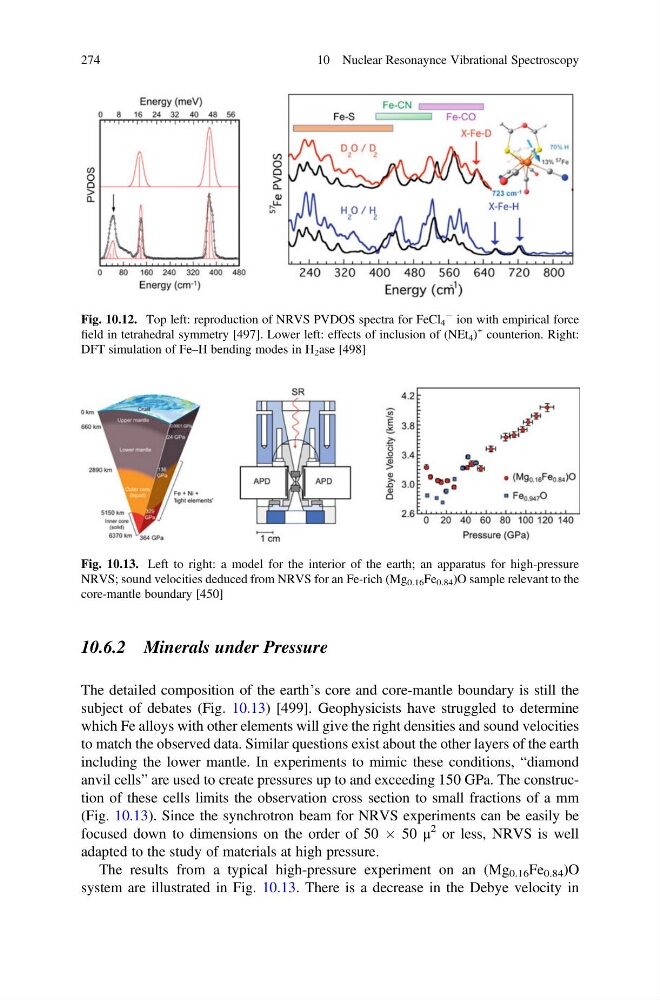
The detailed composition of the earth’s core and core-mantle boundary is still the
subject of debates (Fig. 10.13) [499]. Geophysicists have struggled to determine
which Fe alloys with other elements will give the right densities and sound velocities
to match the observed data. Similar questions exist about the other layers of the earth
including the lower mantle. In experiments to mimic these conditions, “diamond
anvil cells” are used to create pressures up to and exceeding 150 GPa. The construction of these cells limits the observation cross section to small fractions of a mm
(Fig. 10.13). Since the synchrotron beam for NRVS experiments can be easily be
focused down to dimensions on the order of 50 Â 50 μ
2 or less, NRVS is well
adapted to the study of materials at high pressure.
The results from a typical high-pressure experiment on an (Mg 0.16 Fe 0.84 )O
system are illustrated in Fig. 10.13. There is a decrease in the Debye velocity in
Fig. 10.12. Top left: reproduction of NRVS PVDOS spectra for FeCl 4
À ion with empirical force
field in tetrahedral symmetry [497]. Lower left: effects of inclusion of (NEt 4 )
+ counterion. Right:
DFT simulation of Fe–H bending modes in H 2 ase [498]
Fig. 10.13. Left to right: a model for the interior of the earth; an apparatus for high-pressure
NRVS; sound velocities deduced from NRVS for an Fe-rich (Mg 0.16 Fe 0.84 )O sample relevant to the
core-mantle boundary [450]
274
10 Nuclear Resonaynce Vibrational Spectroscopy
The detailed composition of the earth’s core and core-mantle boundary is still the
subject of debates (Fig. 10.13) [499]. Geophysicists have struggled to determine
which Fe alloys with other elements will give the right densities and sound velocities
to match the observed data. Similar questions exist about the other layers of the earth
including the lower mantle. In experiments to mimic these conditions, “diamond
anvil cells” are used to create pressures up to and exceeding 150 GPa. The construction of these cells limits the observation cross section to small fractions of a mm
(Fig. 10.13). Since the synchrotron beam for NRVS experiments can be easily be
focused down to dimensions on the order of 50 Â 50 μ
2 or less, NRVS is well
adapted to the study of materials at high pressure.
The results from a typical high-pressure experiment on an (Mg 0.16 Fe 0.84 )O
system are illustrated in Fig. 10.13. There is a decrease in the Debye velocity in
Fig. 10.12. Top left: reproduction of NRVS PVDOS spectra for FeCl 4
À ion with empirical force
field in tetrahedral symmetry [497]. Lower left: effects of inclusion of (NEt 4 )
+ counterion. Right:
DFT simulation of Fe–H bending modes in H 2 ase [498]
Fig. 10.13. Left to right: a model for the interior of the earth; an apparatus for high-pressure
NRVS; sound velocities deduced from NRVS for an Fe-rich (Mg 0.16 Fe 0.84 )O sample relevant to the
core-mantle boundary [450]
274
10 Nuclear Resonaynce Vibrational Spectroscopy