

10.3 Partial Vibrational Density of States (PVDOS)
Treatment
The discrete, isolated NRVS features seen in the (NEt 4 )(FeCl 4 ) spectrum are the
exception. Instead, there are often a large number of unresolved modes. In addition,
along with localized “optical” modes, all samples will also have a set of “acoustic”
modes that involve motion of the entire unit cell and form a low-energy continuum.
For (NEt 4 )(FeCl 4 ) such modes are seen below 100 cm
À1 . Although for many
chemical and biological applications the acoustic modes are not of keen interest,
they contain information about properties such as the speed of sound in a sample that
is of critical importance to geophysicists [489]. We thus need a way to describe the
NRVS for the more general case where there is a continuous distribution of phonon
energies.
In the NRVS literature, this is done using a continuous “partial vibrational density
of states” or “PVDOS”, commonly written as D(E) or g(E) and D E, b k
or g E, b k
if the directional dependence of the PVDOS is retained. This weighted vibrational
density of states can be written as:
D j E, b k
¼
X
α
b k Á e
!
jα
2 ℒ E À E α
ð
Þ
ð10:14Þ
Fig. 10.7. Relevant angles
for NRVS intensity (left) of
a stretching mode and
EXAFS intensity (right)
from a neighboring atom
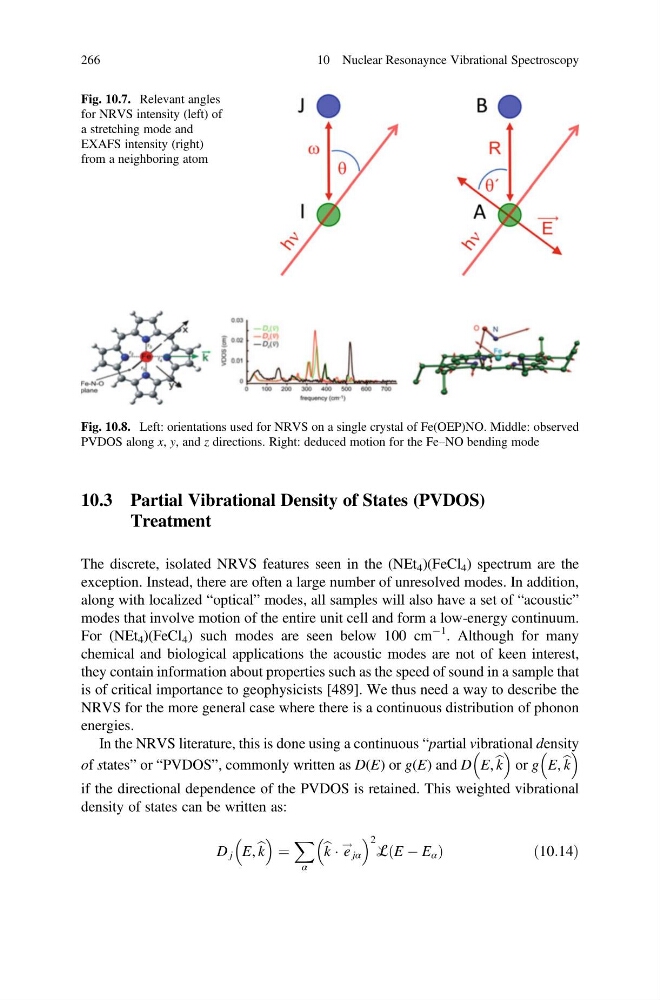
Fig. 10.8. Left: orientations used for NRVS on a single crystal of Fe(OEP)NO. Middle: observed
PVDOS along x, y, and z directions. Right: deduced motion for the Fe–NO bending mode
266
10 Nuclear Resonaynce Vibrational Spectroscopy
Treatment
The discrete, isolated NRVS features seen in the (NEt 4 )(FeCl 4 ) spectrum are the
exception. Instead, there are often a large number of unresolved modes. In addition,
along with localized “optical” modes, all samples will also have a set of “acoustic”
modes that involve motion of the entire unit cell and form a low-energy continuum.
For (NEt 4 )(FeCl 4 ) such modes are seen below 100 cm
À1 . Although for many
chemical and biological applications the acoustic modes are not of keen interest,
they contain information about properties such as the speed of sound in a sample that
is of critical importance to geophysicists [489]. We thus need a way to describe the
NRVS for the more general case where there is a continuous distribution of phonon
energies.
In the NRVS literature, this is done using a continuous “partial vibrational density
of states” or “PVDOS”, commonly written as D(E) or g(E) and D E, b k
or g E, b k
if the directional dependence of the PVDOS is retained. This weighted vibrational
density of states can be written as:
D j E, b k
¼
X
α
b k Á e
!
jα
2 ℒ E À E α
ð
Þ
ð10:14Þ
Fig. 10.7. Relevant angles
for NRVS intensity (left) of
a stretching mode and
EXAFS intensity (right)
from a neighboring atom
Fig. 10.8. Left: orientations used for NRVS on a single crystal of Fe(OEP)NO. Middle: observed
PVDOS along x, y, and z directions. Right: deduced motion for the Fe–NO bending mode
266
10 Nuclear Resonaynce Vibrational Spectroscopy