

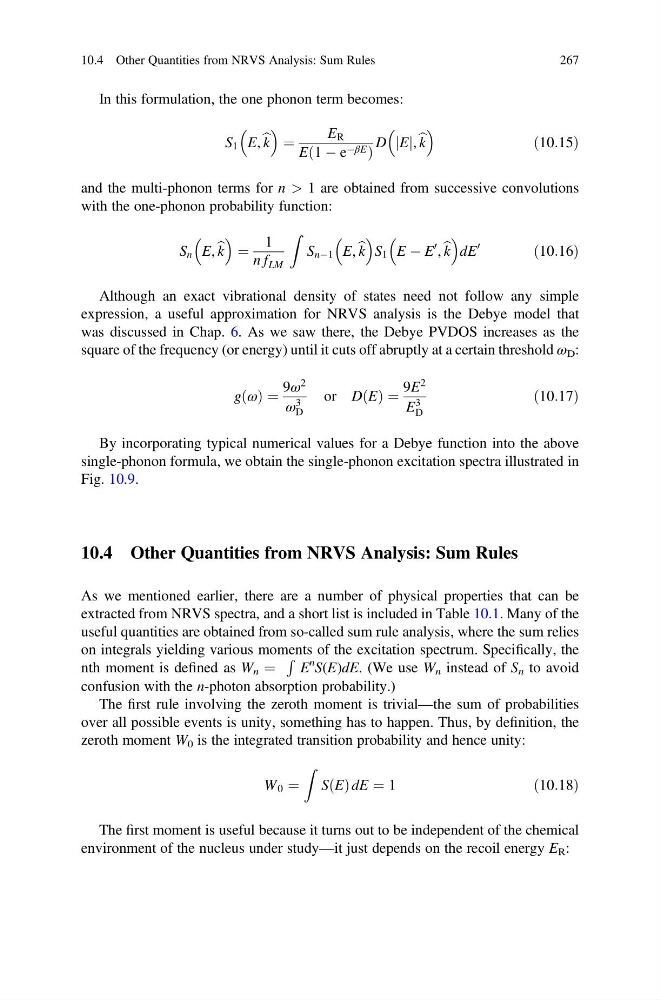
In this formulation, the one phonon term becomes:
S 1 E, b k
¼
E R
E 1 À e ÀβE
ð
Þ
D jEj, b k
ð10:15Þ
and the multi-phonon terms for n > 1 are obtained from successive convolutions
with the one-phonon probability function:
S n E, b k
¼
1
n f LM
Z
S nÀ1 E, b k
S 1 E À E
0 , b k
dE
0
ð10:16Þ
Although an exact vibrational density of states need not follow any simple
expression, a useful approximation for NRVS analysis is the Debye model that
was discussed in Chap. 6. As we saw there, the Debye PVDOS increases as the
square of the frequency (or energy) until it cuts off abruptly at a certain threshold ω D :
g ω
ð Þ ¼
9ω
2
ω
3
D
or D E
ð Þ ¼
9E
2
E
3
D
ð10:17Þ
By incorporating typical numerical values for a Debye function into the above
single-phonon formula, we obtain the single-phonon excitation spectra illustrated in
Fig. 10.9.
10.4 Other Quantities from NRVS Analysis: Sum Rules
As we mentioned earlier, there are a number of physical properties that can be
extracted from NRVS spectra, and a short list is included in Table 10.1. Many of the
useful quantities are obtained from so-called sum rule analysis, where the sum relies
on integrals yielding various moments of the excitation spectrum. Specifically, the
nth moment is defined as W n ¼
R
E
n S(E)dE. (We use W n instead of S n to avoid
confusion with the n-photon absorption probability.)
The first rule involving the zeroth moment is trivial—the sum of probabilities
over all possible events is unity, something has to happen. Thus, by definition, the
zeroth moment W 0 is the integrated transition probability and hence unity:
W 0 ¼
Z
S E
ð ÞdE ¼ 1
ð10:18Þ
The first moment is useful because it turns out to be independent of the chemical
environment of the nucleus under study—it just depends on the recoil energy E R :
10.4 Other Quantities from NRVS Analysis: Sum Rules
267
S 1 E, b k
¼
E R
E 1 À e ÀβE
ð
Þ
D jEj, b k
ð10:15Þ
and the multi-phonon terms for n > 1 are obtained from successive convolutions
with the one-phonon probability function:
S n E, b k
¼
1
n f LM
Z
S nÀ1 E, b k
S 1 E À E
0 , b k
dE
0
ð10:16Þ
Although an exact vibrational density of states need not follow any simple
expression, a useful approximation for NRVS analysis is the Debye model that
was discussed in Chap. 6. As we saw there, the Debye PVDOS increases as the
square of the frequency (or energy) until it cuts off abruptly at a certain threshold ω D :
g ω
ð Þ ¼
9ω
2
ω
3
D
or D E
ð Þ ¼
9E
2
E
3
D
ð10:17Þ
By incorporating typical numerical values for a Debye function into the above
single-phonon formula, we obtain the single-phonon excitation spectra illustrated in
Fig. 10.9.
10.4 Other Quantities from NRVS Analysis: Sum Rules
As we mentioned earlier, there are a number of physical properties that can be
extracted from NRVS spectra, and a short list is included in Table 10.1. Many of the
useful quantities are obtained from so-called sum rule analysis, where the sum relies
on integrals yielding various moments of the excitation spectrum. Specifically, the
nth moment is defined as W n ¼
R
E
n S(E)dE. (We use W n instead of S n to avoid
confusion with the n-photon absorption probability.)
The first rule involving the zeroth moment is trivial—the sum of probabilities
over all possible events is unity, something has to happen. Thus, by definition, the
zeroth moment W 0 is the integrated transition probability and hence unity:
W 0 ¼
Z
S E
ð ÞdE ¼ 1
ð10:18Þ
The first moment is useful because it turns out to be independent of the chemical
environment of the nucleus under study—it just depends on the recoil energy E R :
10.4 Other Quantities from NRVS Analysis: Sum Rules
267