

approximation used for the single-phonon approximation, the contribution ϕ αα of the
overtone transition, n α ! n α + 2, at energy 2v α is given by [487]:
ϕ αα ¼
9
10
ϕ
2
α
f LM
ð10:11Þ
To assess the relative intensity of the first overtone band, divide the above by ϕ α ,
yielding a relative intensity of 0.9ϕ α /f LM . Assuming an arbitrary value of ϕ α ¼ 0.002
and a favorable f LM ¼ 0.5, we see the overtone intensity is less than 1% of the
fundamental intensity.
With the same approximations, a similar expression can be derived for the
strength ϕ αβ of the combination band, n α ! n α + 1, n β ! n β + 1, at energy v α þ
v β , with angle ξ αβ between displacements for the resonant nucleus in the given
normal modes [487]:
ϕ αβ ¼
3
5
ϕ α Á ϕ β
f LM
1 þ 2 cos
2
ξ αβ
À
Á
ð10:12Þ
10.2.4 Orientation Dependence
Although most NRVS experiments are conducted on powder or solution samples,
there is extra information to be gained when oriented or single-crystal samples are
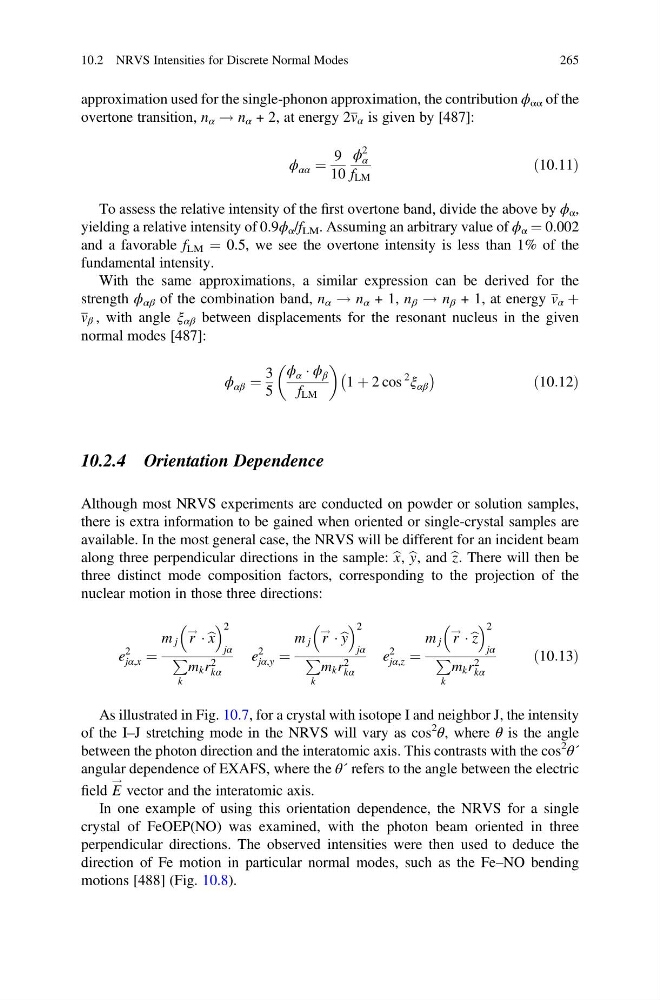
available. In the most general case, the NRVS will be different for an incident beam
along three perpendicular directions in the sample: b x, b y, and b z. There will then be
three distinct mode composition factors, corresponding to the projection of the
nuclear motion in those three directions:
e
2
jα,x ¼
m j r
! Á b x
2
jα
P
k
m k r 2
kα
e
2
jα,y ¼
m j r
! Á b y
2
jα
P
k
m k r 2
kα
e
2
jα,z ¼
m j r
! Á b z
2
jα
P
k
m k r 2
kα
ð10:13Þ
As illustrated in Fig. 10.7, for a crystal with isotope I and neighbor J, the intensity
of the I–J stretching mode in the NRVS will vary as cos
2
θ, where θ is the angle
between the photon direction and the interatomic axis. This contrasts with the cos
2
θ´
angular dependence of EXAFS, where the θ´ refers to the angle between the electric
field E
!
vector and the interatomic axis.
In one example of using this orientation dependence, the NRVS for a single
crystal of FeOEP(NO) was examined, with the photon beam oriented in three
perpendicular directions. The observed intensities were then used to deduce the
direction of Fe motion in particular normal modes, such as the Fe–NO bending
motions [488] (Fig. 10.8).
10.2 NRVS Intensities for Discrete Normal Modes
265
overtone transition, n α ! n α + 2, at energy 2v α is given by [487]:
ϕ αα ¼
9
10
ϕ
2
α
f LM
ð10:11Þ
To assess the relative intensity of the first overtone band, divide the above by ϕ α ,
yielding a relative intensity of 0.9ϕ α /f LM . Assuming an arbitrary value of ϕ α ¼ 0.002
and a favorable f LM ¼ 0.5, we see the overtone intensity is less than 1% of the
fundamental intensity.
With the same approximations, a similar expression can be derived for the
strength ϕ αβ of the combination band, n α ! n α + 1, n β ! n β + 1, at energy v α þ
v β , with angle ξ αβ between displacements for the resonant nucleus in the given
normal modes [487]:
ϕ αβ ¼
3
5
ϕ α Á ϕ β
f LM
1 þ 2 cos
2
ξ αβ
À
Á
ð10:12Þ
10.2.4 Orientation Dependence
Although most NRVS experiments are conducted on powder or solution samples,
there is extra information to be gained when oriented or single-crystal samples are
available. In the most general case, the NRVS will be different for an incident beam
along three perpendicular directions in the sample: b x, b y, and b z. There will then be
three distinct mode composition factors, corresponding to the projection of the
nuclear motion in those three directions:
e
2
jα,x ¼
m j r
! Á b x
2
jα
P
k
m k r 2
kα
e
2
jα,y ¼
m j r
! Á b y
2
jα
P
k
m k r 2
kα
e
2
jα,z ¼
m j r
! Á b z
2
jα
P
k
m k r 2
kα
ð10:13Þ
As illustrated in Fig. 10.7, for a crystal with isotope I and neighbor J, the intensity
of the I–J stretching mode in the NRVS will vary as cos
2
θ, where θ is the angle
between the photon direction and the interatomic axis. This contrasts with the cos
2
θ´
angular dependence of EXAFS, where the θ´ refers to the angle between the electric
field E
!
vector and the interatomic axis.
In one example of using this orientation dependence, the NRVS for a single
crystal of FeOEP(NO) was examined, with the photon beam oriented in three
perpendicular directions. The observed intensities were then used to deduce the
direction of Fe motion in particular normal modes, such as the Fe–NO bending
motions [488] (Fig. 10.8).
10.2 NRVS Intensities for Discrete Normal Modes
265