

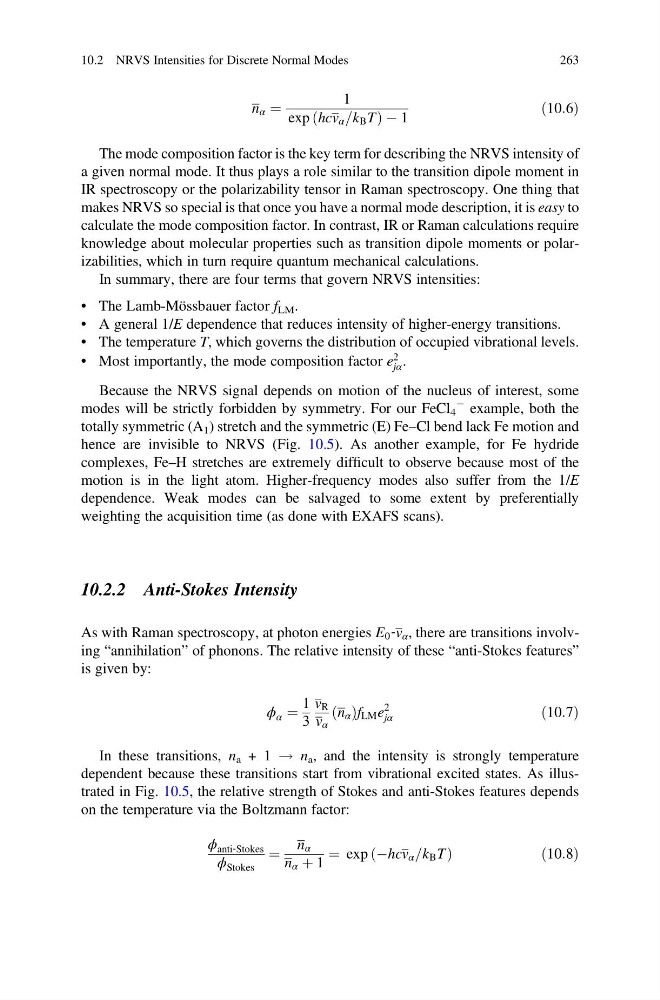
n α ¼
1
exp hcv α =k B T
ð
ÞÀ1
ð10:6Þ
The mode composition factor is the key term for describing the NRVS intensity of
a given normal mode. It thus plays a role similar to the transition dipole moment in
IR spectroscopy or the polarizability tensor in Raman spectroscopy. One thing that
makes NRVS so special is that once you have a normal mode description, it is easy to
calculate the mode composition factor. In contrast, IR or Raman calculations require
knowledge about molecular properties such as transition dipole moments or polarizabilities, which in turn require quantum mechanical calculations.
In summary, there are four terms that govern NRVS intensities:
• The Lamb-Mössbauer factor f LM .
• A general 1/E dependence that reduces intensity of higher-energy transitions.
• The temperature T, which governs the distribution of occupied vibrational levels.
• Most importantly, the mode composition factor e
2
jα .
Because the NRVS signal depends on motion of the nucleus of interest, some
modes will be strictly forbidden by symmetry. For our FeCl 4
À example, both the
totally symmetric (A 1 ) stretch and the symmetric (E) Fe–Cl bend lack Fe motion and
hence are invisible to NRVS (Fig. 10.5). As another example, for Fe hydride
complexes, Fe–H stretches are extremely difficult to observe because most of the
motion is in the light atom. Higher-frequency modes also suffer from the 1/E
dependence. Weak modes can be salvaged to some extent by preferentially
weighting the acquisition time (as done with EXAFS scans).
10.2.2 Anti-Stokes Intensity
As with Raman spectroscopy, at photon energies E 0 ‐v α , there are transitions involving “annihilation” of phonons. The relative intensity of these “anti-Stokes features”
is given by:
ϕ α ¼
1
3
v R
v α
n α
ð Þf LM e
2
jα
ð10:7Þ
In these transitions, n a + 1 ! n a , and the intensity is strongly temperature
dependent because these transitions start from vibrational excited states. As illustrated in Fig. 10.5, the relative strength of Stokes and anti-Stokes features depends
on the temperature via the Boltzmann factor:
ϕ anti‐Stokes
ϕ Stokes
¼
n α
n α þ 1
¼ exp Àhcv α =k B T
ð
Þ
ð 10:8Þ
10.2 NRVS Intensities for Discrete Normal Modes
263
1
exp hcv α =k B T
ð
ÞÀ1
ð10:6Þ
The mode composition factor is the key term for describing the NRVS intensity of
a given normal mode. It thus plays a role similar to the transition dipole moment in
IR spectroscopy or the polarizability tensor in Raman spectroscopy. One thing that
makes NRVS so special is that once you have a normal mode description, it is easy to
calculate the mode composition factor. In contrast, IR or Raman calculations require
knowledge about molecular properties such as transition dipole moments or polarizabilities, which in turn require quantum mechanical calculations.
In summary, there are four terms that govern NRVS intensities:
• The Lamb-Mössbauer factor f LM .
• A general 1/E dependence that reduces intensity of higher-energy transitions.
• The temperature T, which governs the distribution of occupied vibrational levels.
• Most importantly, the mode composition factor e
2
jα .
Because the NRVS signal depends on motion of the nucleus of interest, some
modes will be strictly forbidden by symmetry. For our FeCl 4
À example, both the
totally symmetric (A 1 ) stretch and the symmetric (E) Fe–Cl bend lack Fe motion and
hence are invisible to NRVS (Fig. 10.5). As another example, for Fe hydride
complexes, Fe–H stretches are extremely difficult to observe because most of the
motion is in the light atom. Higher-frequency modes also suffer from the 1/E
dependence. Weak modes can be salvaged to some extent by preferentially
weighting the acquisition time (as done with EXAFS scans).
10.2.2 Anti-Stokes Intensity
As with Raman spectroscopy, at photon energies E 0 ‐v α , there are transitions involving “annihilation” of phonons. The relative intensity of these “anti-Stokes features”
is given by:
ϕ α ¼
1
3
v R
v α
n α
ð Þf LM e
2
jα
ð10:7Þ
In these transitions, n a + 1 ! n a , and the intensity is strongly temperature
dependent because these transitions start from vibrational excited states. As illustrated in Fig. 10.5, the relative strength of Stokes and anti-Stokes features depends
on the temperature via the Boltzmann factor:
ϕ anti‐Stokes
ϕ Stokes
¼
n α
n α þ 1
¼ exp Àhcv α =k B T
ð
Þ
ð 10:8Þ
10.2 NRVS Intensities for Discrete Normal Modes
263