

The normalized excitation probability can then be rewritten as [481]:
S v
ð Þ ¼ f LM ℒ 0 v
ð Þ þ
X
Δn α
f
g
ϕ Δn α
f
g ℒ v v À
X
α
Δn α v α
!
ð10:3Þ
In the above expression, ϕ{Δn α } refers to the fractional area (integrated probability) corresponding to a transition from initial population n α to final population
n α + Δn α . In the particular case of the FeCl 4
À ion, α would range from 1 ! 4, with
appropriate factors to account for the degeneracies.
The NRVS effect depends on the amount of nuclear motion in a particular normal
mode or phonon. The critical term that captures this is the “mode composition
factor,” e
2
jα , which is the fraction of kinetic energy in normal mode α associated
with motion of nucleus j with mass m j and mean square displacements r
2
jα [482]:
e
2
jα ¼
m j r
2
jα
P
k
m k r 2
kα
ð10:4Þ
For a randomly oriented sample, and a nuclear transition with recoil energy v R
and Lamb-Mössbauer factor f LM , an expression that captures the properties that
govern NRVS intensity for a fundamental transition from n α ! n α +1 is [481]:
ϕ α ¼
1
3
v R
v α
n α þ 1
ð
Þf LM e
2
jα
ð10:5Þ
The term n α is the mean occupation number for mode α and is given by
Boltzmann statistics:
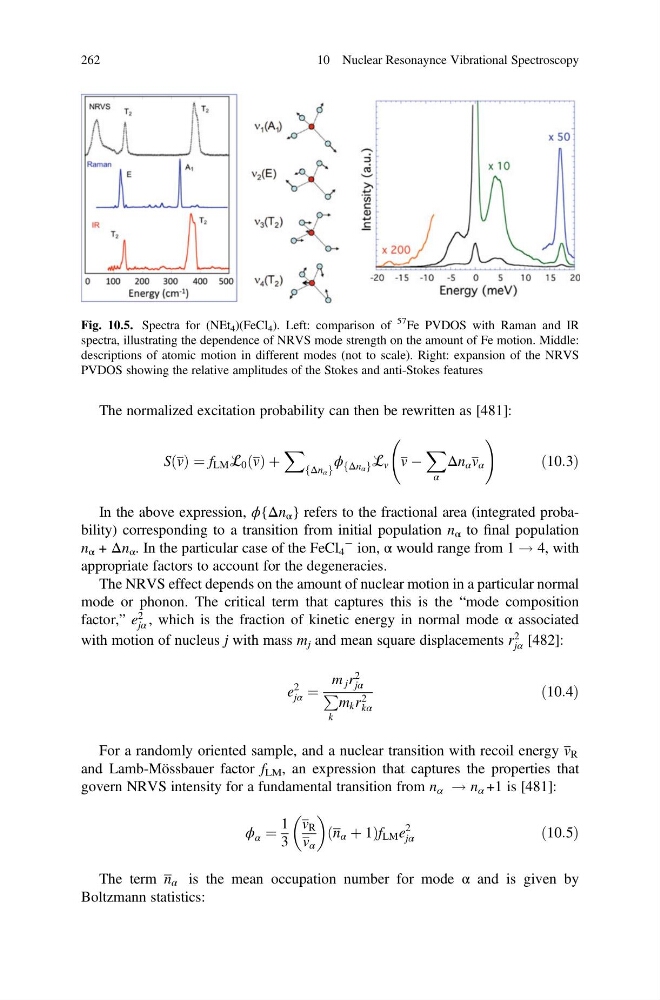
Fig. 10.5. Spectra for (NEt 4 )(FeCl 4 ). Left: comparison of
57
Fe PVDOS with Raman and IR
spectra, illustrating the dependence of NRVS mode strength on the amount of Fe motion. Middle:
descriptions of atomic motion in different modes (not to scale). Right: expansion of the NRVS
PVDOS showing the relative amplitudes of the Stokes and anti-Stokes features
262
10 Nuclear Resonaynce Vibrational Spectroscopy
S v
ð Þ ¼ f LM ℒ 0 v
ð Þ þ
X
Δn α
f
g
ϕ Δn α
f
g ℒ v v À
X
α
Δn α v α
!
ð10:3Þ
In the above expression, ϕ{Δn α } refers to the fractional area (integrated probability) corresponding to a transition from initial population n α to final population
n α + Δn α . In the particular case of the FeCl 4
À ion, α would range from 1 ! 4, with
appropriate factors to account for the degeneracies.
The NRVS effect depends on the amount of nuclear motion in a particular normal
mode or phonon. The critical term that captures this is the “mode composition
factor,” e
2
jα , which is the fraction of kinetic energy in normal mode α associated
with motion of nucleus j with mass m j and mean square displacements r
2
jα [482]:
e
2
jα ¼
m j r
2
jα
P
k
m k r 2
kα
ð10:4Þ
For a randomly oriented sample, and a nuclear transition with recoil energy v R
and Lamb-Mössbauer factor f LM , an expression that captures the properties that
govern NRVS intensity for a fundamental transition from n α ! n α +1 is [481]:
ϕ α ¼
1
3
v R
v α
n α þ 1
ð
Þf LM e
2
jα
ð10:5Þ
The term n α is the mean occupation number for mode α and is given by
Boltzmann statistics:
Fig. 10.5. Spectra for (NEt 4 )(FeCl 4 ). Left: comparison of
57
Fe PVDOS with Raman and IR
spectra, illustrating the dependence of NRVS mode strength on the amount of Fe motion. Middle:
descriptions of atomic motion in different modes (not to scale). Right: expansion of the NRVS
PVDOS showing the relative amplitudes of the Stokes and anti-Stokes features
262
10 Nuclear Resonaynce Vibrational Spectroscopy