

relatively isolated Fe¼O stretching mode in the 800 cm
À1 region reveals information
about the Fe¼O force constant and thus the type of bonding.
Despite these differences in modes of interpretation, the experiment is always done
in about the same manner.
10.1 The NRVS Experiment
Although the recoil fraction might have an integrated cross section comparable to the
recoil-free fraction, the intensity is spread over tens or hundreds of meV, compared
to tens of neV for the Mössbauer effect. Thus, the absorption cross section at any
particular energy is effectively a million times weaker. So, how is it ever possible to
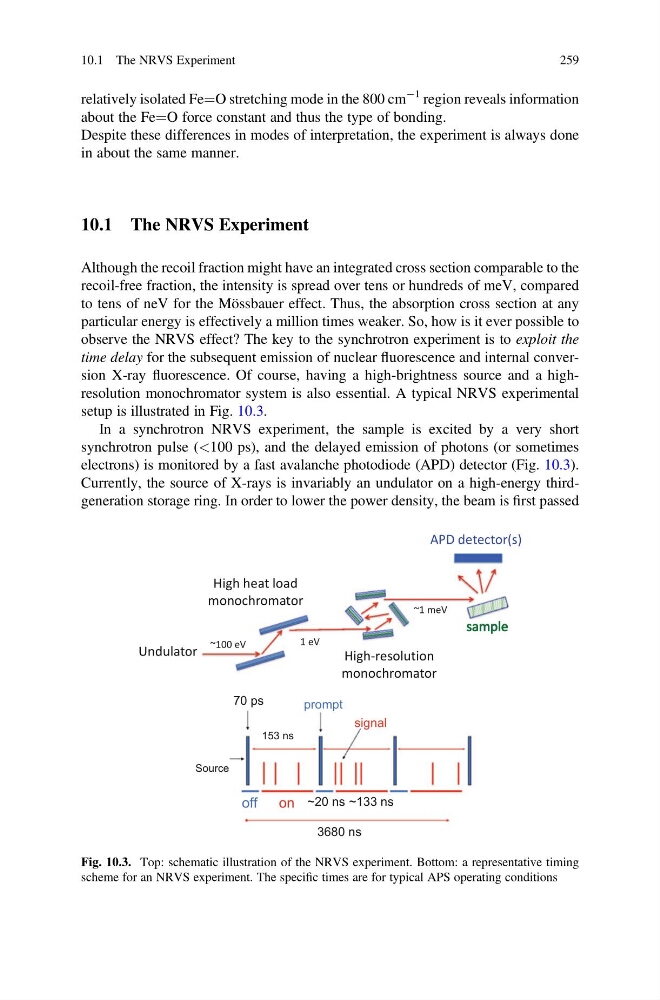
observe the NRVS effect? The key to the synchrotron experiment is to exploit the
time delay for the subsequent emission of nuclear fluorescence and internal conversion X-ray fluorescence. Of course, having a high-brightness source and a highresolution monochromator system is also essential. A typical NRVS experimental
setup is illustrated in Fig. 10.3.
In a synchrotron NRVS experiment, the sample is excited by a very short
synchrotron pulse (<100 ps), and the delayed emission of photons (or sometimes
electrons) is monitored by a fast avalanche photodiode (APD) detector (Fig. 10.3).
Currently, the source of X-rays is invariably an undulator on a high-energy thirdgeneration storage ring. In order to lower the power density, the beam is first passed
High heat load
monochromator
High-resolution
monochromator
APD detector(s)
1 eV
~1 meV
~100 eV
Undulator
70 ps
3680 ns
153 ns
off
~20 ns ~133 ns
on
prompt
Source
signal
Fig. 10.3. Top: schematic illustration of the NRVS experiment. Bottom: a representative timing
scheme for an NRVS experiment. The specific times are for typical APS operating conditions
10.1 The NRVS Experiment
259
À1 region reveals information
about the Fe¼O force constant and thus the type of bonding.
Despite these differences in modes of interpretation, the experiment is always done
in about the same manner.
10.1 The NRVS Experiment
Although the recoil fraction might have an integrated cross section comparable to the
recoil-free fraction, the intensity is spread over tens or hundreds of meV, compared
to tens of neV for the Mössbauer effect. Thus, the absorption cross section at any
particular energy is effectively a million times weaker. So, how is it ever possible to
observe the NRVS effect? The key to the synchrotron experiment is to exploit the
time delay for the subsequent emission of nuclear fluorescence and internal conversion X-ray fluorescence. Of course, having a high-brightness source and a highresolution monochromator system is also essential. A typical NRVS experimental
setup is illustrated in Fig. 10.3.
In a synchrotron NRVS experiment, the sample is excited by a very short
synchrotron pulse (<100 ps), and the delayed emission of photons (or sometimes
electrons) is monitored by a fast avalanche photodiode (APD) detector (Fig. 10.3).
Currently, the source of X-rays is invariably an undulator on a high-energy thirdgeneration storage ring. In order to lower the power density, the beam is first passed
High heat load
monochromator
High-resolution
monochromator
APD detector(s)
1 eV
~1 meV
~100 eV
Undulator
70 ps
3680 ns
153 ns
off
~20 ns ~133 ns
on
prompt
Source
signal
Fig. 10.3. Top: schematic illustration of the NRVS experiment. Bottom: a representative timing
scheme for an NRVS experiment. The specific times are for typical APS operating conditions
10.1 The NRVS Experiment
259