

of states. Analysis of such spectra can provide important geophysical properties such
as the velocity of sound, specific heat, and average force constant. At the other
extreme is the spectrum of an Fe coordination complex with a terminal Fe¼O ligand.
In this case the analysis is much more straightforward, and the frequency of the
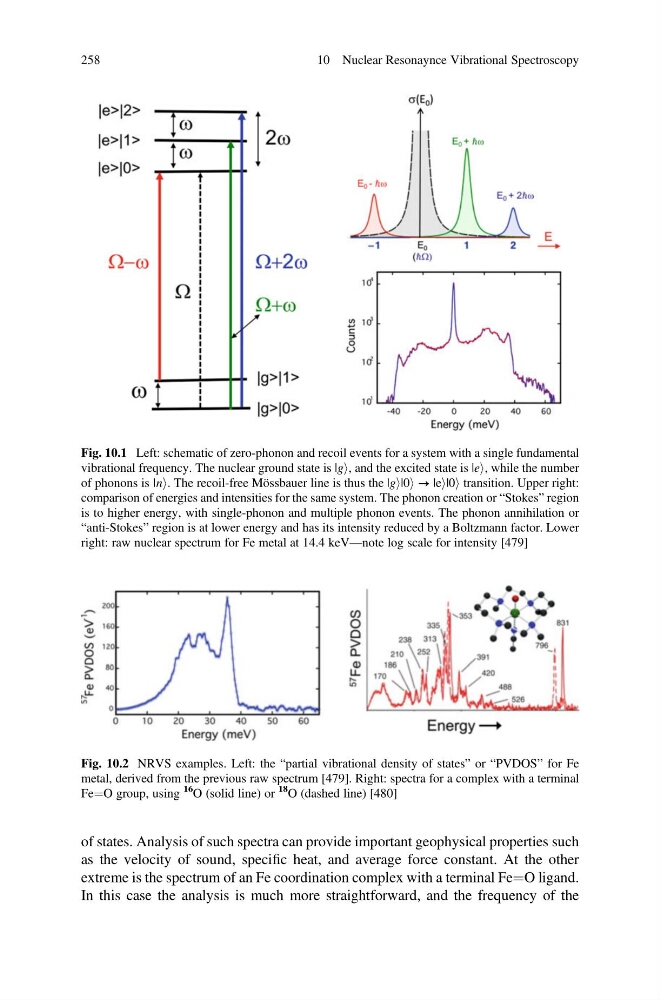
Fig. 10.1 Left: schematic of zero-phonon and recoil events for a system with a single fundamental
vibrational frequency. The nuclear ground state is |gi, and the excited state is |ei, while the number
of phonons is |ni. The recoil-free Mössbauer line is thus the |gi|0i → |ei|0i transition. Upper right:
comparison of energies and intensities for the same system. The phonon creation or “Stokes” region
is to higher energy, with single-phonon and multiple phonon events. The phonon annihilation or
“anti-Stokes” region is at lower energy and has its intensity reduced by a Boltzmann factor. Lower
right: raw nuclear spectrum for Fe metal at 14.4 keV—note log scale for intensity [479]
Fig. 10.2 NRVS examples. Left: the “partial vibrational density of states” or “PVDOS” for Fe
metal, derived from the previous raw spectrum [479]. Right: spectra for a complex with a terminal
Fe¼O group, using
16
O (solid line) or
18
O (dashed line) [480]
258
10 Nuclear Resonaynce Vibrational Spectroscopy
as the velocity of sound, specific heat, and average force constant. At the other
extreme is the spectrum of an Fe coordination complex with a terminal Fe¼O ligand.
In this case the analysis is much more straightforward, and the frequency of the
Fig. 10.1 Left: schematic of zero-phonon and recoil events for a system with a single fundamental
vibrational frequency. The nuclear ground state is |gi, and the excited state is |ei, while the number
of phonons is |ni. The recoil-free Mössbauer line is thus the |gi|0i → |ei|0i transition. Upper right:
comparison of energies and intensities for the same system. The phonon creation or “Stokes” region
is to higher energy, with single-phonon and multiple phonon events. The phonon annihilation or
“anti-Stokes” region is at lower energy and has its intensity reduced by a Boltzmann factor. Lower
right: raw nuclear spectrum for Fe metal at 14.4 keV—note log scale for intensity [479]
Fig. 10.2 NRVS examples. Left: the “partial vibrational density of states” or “PVDOS” for Fe
metal, derived from the previous raw spectrum [479]. Right: spectra for a complex with a terminal
Fe¼O group, using
16
O (solid line) or
18
O (dashed line) [480]
258
10 Nuclear Resonaynce Vibrational Spectroscopy