

remnants of a Type I supernova that exploded in 1054 CE. At that time it was so
bright it could be seen in the daytime, and Chinese astronomers recorded it as a
“guest star.” Nowadays, at the heart of the nebula is a pulsar or “neutron star,” which
emits high-energy electrons into the surrounding magnetic field of ~10
À4 Gauss. The
electrons have extraordinarily high energies (up to ~1000 TeV), resulting in synchrotron X-rays up to ~100 keV.
Jupiter is also a source of synchrotron radiation, although at much lower energies
(Fig. 1.7). Here, the magnetic field is stronger (~1 Gauss), but the electron energies
are lower (~10 MeV) so that the bulk of the radiation is in the microwave region:
0.1–15 GHz. On a vastly different scale, extragalactic “accretion disks” produce
synchrotron radiation when jets of relativistic particles spiral around magnetic field
lines.
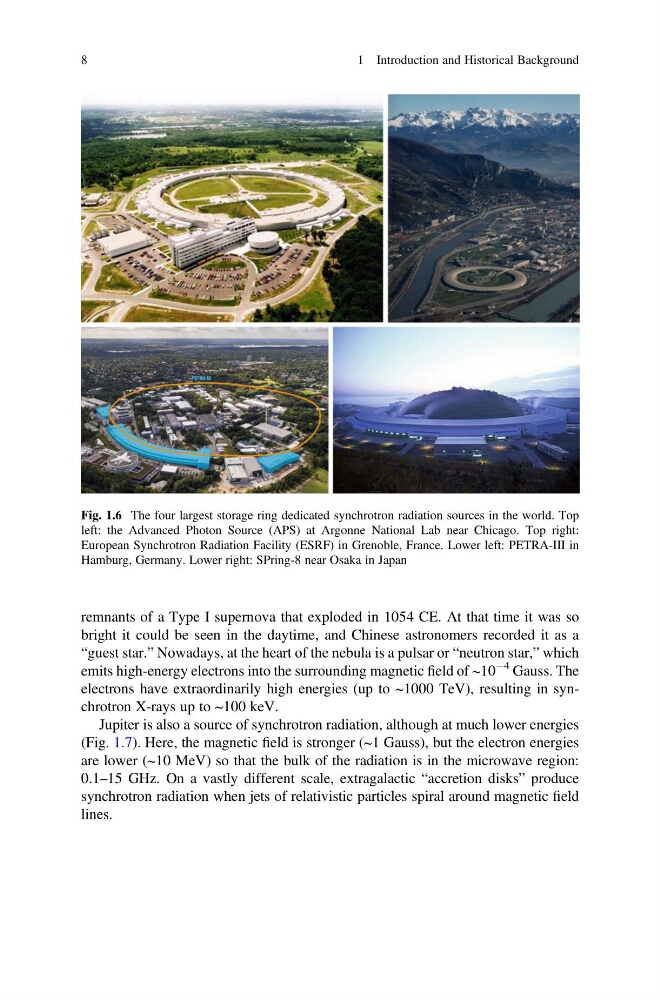
Fig. 1.6 The four largest storage ring dedicated synchrotron radiation sources in the world. Top
left: the Advanced Photon Source (APS) at Argonne National Lab near Chicago. Top right:
European Synchrotron Radiation Facility (ESRF) in Grenoble, France. Lower left: PETRA-III in
Hamburg, Germany. Lower right: SPring-8 near Osaka in Japan
8
1 Introduction and Historical Background
bright it could be seen in the daytime, and Chinese astronomers recorded it as a
“guest star.” Nowadays, at the heart of the nebula is a pulsar or “neutron star,” which
emits high-energy electrons into the surrounding magnetic field of ~10
À4 Gauss. The
electrons have extraordinarily high energies (up to ~1000 TeV), resulting in synchrotron X-rays up to ~100 keV.
Jupiter is also a source of synchrotron radiation, although at much lower energies
(Fig. 1.7). Here, the magnetic field is stronger (~1 Gauss), but the electron energies
are lower (~10 MeV) so that the bulk of the radiation is in the microwave region:
0.1–15 GHz. On a vastly different scale, extragalactic “accretion disks” produce
synchrotron radiation when jets of relativistic particles spiral around magnetic field
lines.
Fig. 1.6 The four largest storage ring dedicated synchrotron radiation sources in the world. Top
left: the Advanced Photon Source (APS) at Argonne National Lab near Chicago. Top right:
European Synchrotron Radiation Facility (ESRF) in Grenoble, France. Lower left: PETRA-III in
Hamburg, Germany. Lower right: SPring-8 near Osaka in Japan
8
1 Introduction and Historical Background