

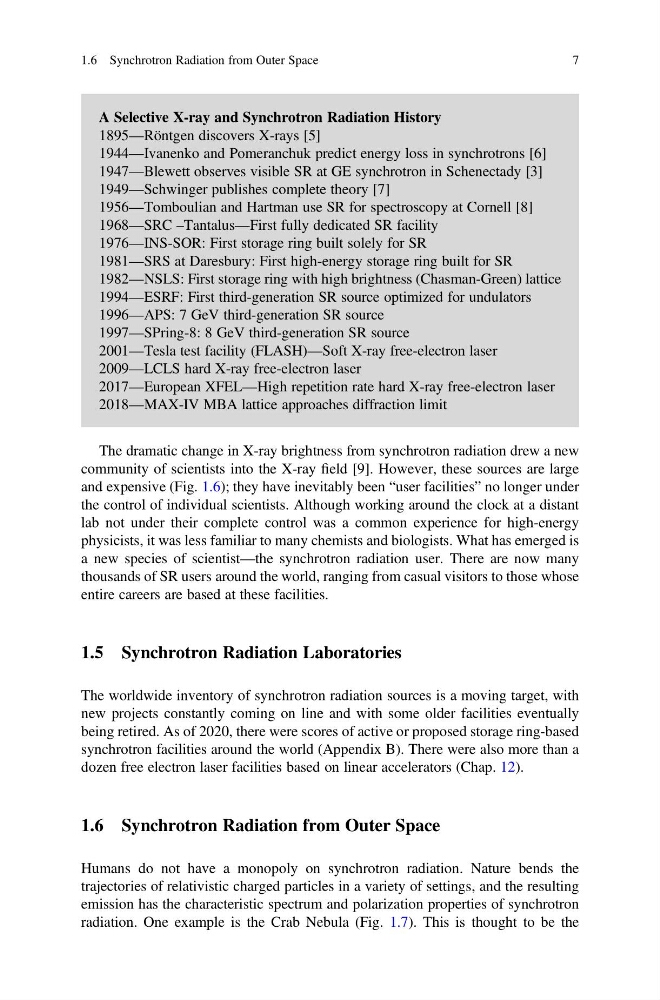
A Selective X-ray and Synchrotron Radiation History
1895—Röntgen discovers X-rays [5]
1944—Ivanenko and Pomeranchuk predict energy loss in synchrotrons [6]
1947—Blewett observes visible SR at GE synchrotron in Schenectady [3]
1949—Schwinger publishes complete theory [7]
1956—Tomboulian and Hartman use SR for spectroscopy at Cornell [8]
1968—SRC –Tantalus—First fully dedicated SR facility
1976—INS-SOR: First storage ring built solely for SR
1981—SRS at Daresbury: First high-energy storage ring built for SR
1982—NSLS: First storage ring with high brightness (Chasman-Green) lattice
1994—ESRF: First third-generation SR source optimized for undulators
1996—APS: 7 GeV third-generation SR source
1997—SPring-8: 8 GeV third-generation SR source
2001—Tesla test facility (FLASH)—Soft X-ray free-electron laser
2009—LCLS hard X-ray free-electron laser
2017—European XFEL—High repetition rate hard X-ray free-electron laser
2018—MAX-IV MBA lattice approaches diffraction limit
The dramatic change in X-ray brightness from synchrotron radiation drew a new
community of scientists into the X-ray field [9]. However, these sources are large
and expensive (Fig. 1.6); they have inevitably been “user facilities” no longer under
the control of individual scientists. Although working around the clock at a distant
lab not under their complete control was a common experience for high-energy
physicists, it was less familiar to many chemists and biologists. What has emerged is
a new species of scientist—the synchrotron radiation user. There are now many
thousands of SR users around the world, ranging from casual visitors to those whose
entire careers are based at these facilities.
1.5 Synchrotron Radiation Laboratories
The worldwide inventory of synchrotron radiation sources is a moving target, with
new projects constantly coming on line and with some older facilities eventually
being retired. As of 2020, there were scores of active or proposed storage ring-based
synchrotron facilities around the world (Appendix B). There were also more than a
dozen free electron laser facilities based on linear accelerators (Chap. 12).
1.6 Synchrotron Radiation from Outer Space
Humans do not have a monopoly on synchrotron radiation. Nature bends the
trajectories of relativistic charged particles in a variety of settings, and the resulting
emission has the characteristic spectrum and polarization properties of synchrotron
radiation. One example is the Crab Nebula (Fig. 1.7). This is thought to be the
1.6 Synchrotron Radiation from Outer Space
7
1895—Röntgen discovers X-rays [5]
1944—Ivanenko and Pomeranchuk predict energy loss in synchrotrons [6]
1947—Blewett observes visible SR at GE synchrotron in Schenectady [3]
1949—Schwinger publishes complete theory [7]
1956—Tomboulian and Hartman use SR for spectroscopy at Cornell [8]
1968—SRC –Tantalus—First fully dedicated SR facility
1976—INS-SOR: First storage ring built solely for SR
1981—SRS at Daresbury: First high-energy storage ring built for SR
1982—NSLS: First storage ring with high brightness (Chasman-Green) lattice
1994—ESRF: First third-generation SR source optimized for undulators
1996—APS: 7 GeV third-generation SR source
1997—SPring-8: 8 GeV third-generation SR source
2001—Tesla test facility (FLASH)—Soft X-ray free-electron laser
2009—LCLS hard X-ray free-electron laser
2017—European XFEL—High repetition rate hard X-ray free-electron laser
2018—MAX-IV MBA lattice approaches diffraction limit
The dramatic change in X-ray brightness from synchrotron radiation drew a new
community of scientists into the X-ray field [9]. However, these sources are large
and expensive (Fig. 1.6); they have inevitably been “user facilities” no longer under
the control of individual scientists. Although working around the clock at a distant
lab not under their complete control was a common experience for high-energy
physicists, it was less familiar to many chemists and biologists. What has emerged is
a new species of scientist—the synchrotron radiation user. There are now many
thousands of SR users around the world, ranging from casual visitors to those whose
entire careers are based at these facilities.
1.5 Synchrotron Radiation Laboratories
The worldwide inventory of synchrotron radiation sources is a moving target, with
new projects constantly coming on line and with some older facilities eventually
being retired. As of 2020, there were scores of active or proposed storage ring-based
synchrotron facilities around the world (Appendix B). There were also more than a
dozen free electron laser facilities based on linear accelerators (Chap. 12).
1.6 Synchrotron Radiation from Outer Space
Humans do not have a monopoly on synchrotron radiation. Nature bends the
trajectories of relativistic charged particles in a variety of settings, and the resulting
emission has the characteristic spectrum and polarization properties of synchrotron
radiation. One example is the Crab Nebula (Fig. 1.7). This is thought to be the
1.6 Synchrotron Radiation from Outer Space
7