

9.6.4 Applications to Dynamics
SRPAC has special merits as a technique when the Lamb-Mössbauer factor becomes
very small or where simplification of hyperfine structure has merits. This is often the
case when a sample is fluctuating over time and one wants to understand the
dynamics. Suppose the nucleus under study is embedded in an environment that
rotates randomly in a sort of Brownian motion with jump or relaxation rate λ. Then
the normal precession of the nucleus around the electric field gradient (EFG) at
frequency Ω will be modified by the stochastic rotation of the EFG itself. In an
analysis of this effect, Sergueev distinguished two extreme cases that depend on the
relative rates λ and Ω [454].
In the slow relaxation case, λ ( Ω, the strength of the SRPAC perturbation factor
G 22 is exponentially damped by the random motions:
G 22 t
ð Þ ffi e
Àλt
Á G
0
ð Þ
22 t
ð Þ
ð9:28Þ
In the fast relaxation case, λ ) Ω, the SRPAC oscillations disappear, and the
perturbation factor becomes a simple exponential:
G 22 t
ð Þ ffi exp À4Ω
2 t=5λ
À
Á
ð9:29Þ
This sensitivity to angular motion allows SRPAC to characterize rotational
dynamics with timescales of picoseconds to microseconds. As one example,
57 Fe
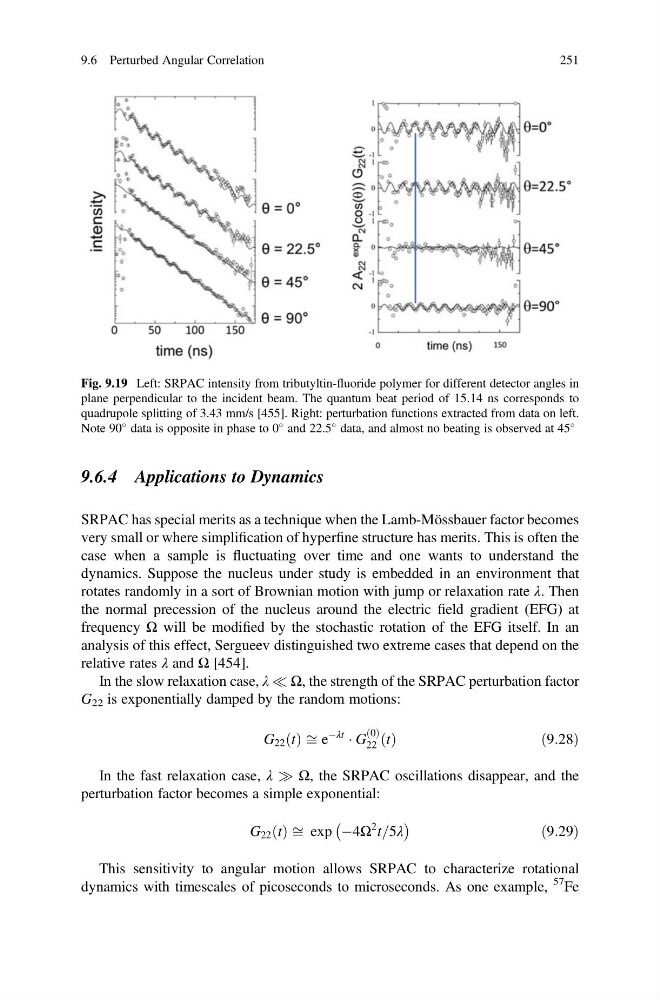
Fig. 9.19 Left: SRPAC intensity from tributyltin-fluoride polymer for different detector angles in
plane perpendicular to the incident beam. The quantum beat period of 15.14 ns corresponds to
quadrupole splitting of 3.43 mm/s [455]. Right: perturbation functions extracted from data on left.
Note 90
data is opposite in phase to 0
and 22.5
data, and almost no beating is observed at 45
9.6 Perturbed Angular Correlation
251
SRPAC has special merits as a technique when the Lamb-Mössbauer factor becomes
very small or where simplification of hyperfine structure has merits. This is often the
case when a sample is fluctuating over time and one wants to understand the
dynamics. Suppose the nucleus under study is embedded in an environment that
rotates randomly in a sort of Brownian motion with jump or relaxation rate λ. Then
the normal precession of the nucleus around the electric field gradient (EFG) at
frequency Ω will be modified by the stochastic rotation of the EFG itself. In an
analysis of this effect, Sergueev distinguished two extreme cases that depend on the
relative rates λ and Ω [454].
In the slow relaxation case, λ ( Ω, the strength of the SRPAC perturbation factor
G 22 is exponentially damped by the random motions:
G 22 t
ð Þ ffi e
Àλt
Á G
0
ð Þ
22 t
ð Þ
ð9:28Þ
In the fast relaxation case, λ ) Ω, the SRPAC oscillations disappear, and the
perturbation factor becomes a simple exponential:
G 22 t
ð Þ ffi exp À4Ω
2 t=5λ
À
Á
ð9:29Þ
This sensitivity to angular motion allows SRPAC to characterize rotational
dynamics with timescales of picoseconds to microseconds. As one example,
57 Fe
Fig. 9.19 Left: SRPAC intensity from tributyltin-fluoride polymer for different detector angles in
plane perpendicular to the incident beam. The quantum beat period of 15.14 ns corresponds to
quadrupole splitting of 3.43 mm/s [455]. Right: perturbation functions extracted from data on left.
Note 90
data is opposite in phase to 0
and 22.5
data, and almost no beating is observed at 45
9.6 Perturbed Angular Correlation
251