

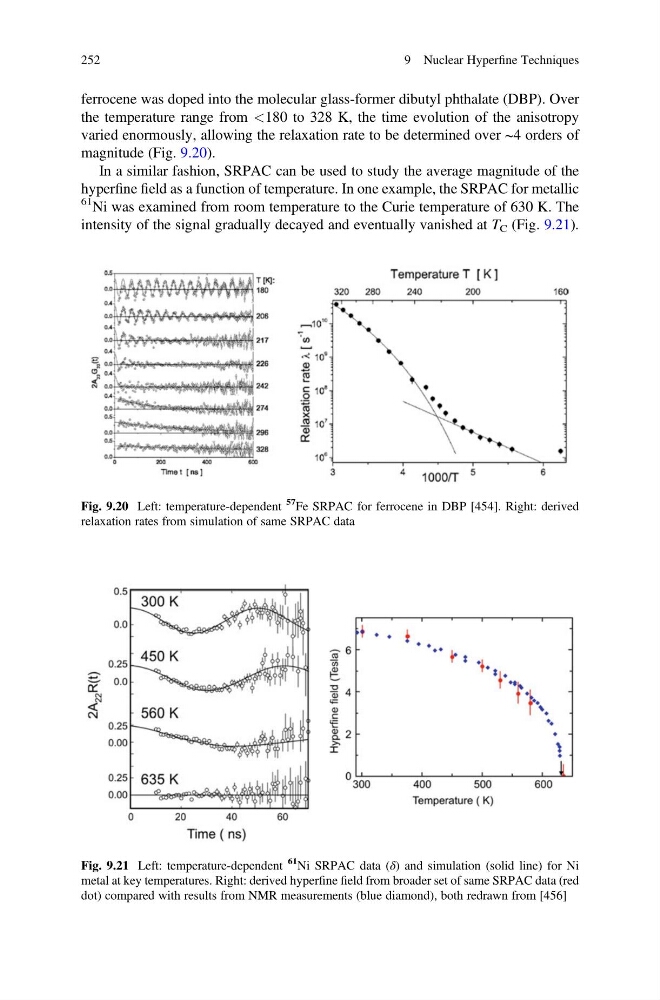
ferrocene was doped into the molecular glass-former dibutyl phthalate (DBP). Over
the temperature range from <180 to 328 K, the time evolution of the anisotropy
varied enormously, allowing the relaxation rate to be determined over ~4 orders of
magnitude (Fig. 9.20).
In a similar fashion, SRPAC can be used to study the average magnitude of the
hyperfine field as a function of temperature. In one example, the SRPAC for metallic
61 Ni was examined from room temperature to the Curie temperature of 630 K. The
intensity of the signal gradually decayed and eventually vanished at T C (Fig. 9.21).
Fig. 9.20 Left: temperature-dependent
57
Fe SRPAC for ferrocene in DBP [454]. Right: derived
relaxation rates from simulation of same SRPAC data
Fig. 9.21 Left: temperature-dependent
61
Ni SRPAC data (δ) and simulation (solid line) for Ni
metal at key temperatures. Right: derived hyperfine field from broader set of same SRPAC data (red
dot) compared with results from NMR measurements (blue diamond), both redrawn from [456]
252
9 Nuclear Hyperfine Techniques
the temperature range from <180 to 328 K, the time evolution of the anisotropy
varied enormously, allowing the relaxation rate to be determined over ~4 orders of
magnitude (Fig. 9.20).
In a similar fashion, SRPAC can be used to study the average magnitude of the
hyperfine field as a function of temperature. In one example, the SRPAC for metallic
61 Ni was examined from room temperature to the Curie temperature of 630 K. The
intensity of the signal gradually decayed and eventually vanished at T C (Fig. 9.21).
Fig. 9.20 Left: temperature-dependent
57
Fe SRPAC for ferrocene in DBP [454]. Right: derived
relaxation rates from simulation of same SRPAC data
Fig. 9.21 Left: temperature-dependent
61
Ni SRPAC data (δ) and simulation (solid line) for Ni
metal at key temperatures. Right: derived hyperfine field from broader set of same SRPAC data (red
dot) compared with results from NMR measurements (blue diamond), both redrawn from [456]
252
9 Nuclear Hyperfine Techniques