

9.6 Perturbed Angular Correlation
Angular correlation (AC) experiments depend on the production and decay of
oriented nuclei. In contrast with NMR, in which a strong magnetic field creates a
difference in spin populations, in the angular correlation measurement the oriented
nuclei are selected “after the fact.” In a conventional time-dependent perturbed
angular correlation (“TDPAC”) experiment, the “fact” is emission of a γ-ray,
while in the synchrotron experiment, synchrotron radiation perturbed angular correlation or “SRPAC”, the “fact” is an absorption event.
9.6.1 γ-γ Angular Correlations
In both TDPAC and SRPAC, the experiments work because the emission and
absorption of γ-rays are usually anisotropic with respect to the nuclear spin axis.
The general case for a nucleus decaying with successive emission of two γ-rays is
developed in a classic article by Frauenfelder and Steffen [451]. The equations take
an entire page, but for randomly oriented samples, the complicated angular momentum algebra can be simplified to the following equation for the time and angle
correlation between two emitted photons:
W θ, t
ð Þ / e
Àt=τ 0
X
k
A k γ 1
ð ÞA k γ 2
ð ÞG kk t
ð ÞP k cos θ
ð
Þ
ð9:20Þ
where τ 0 is the intermediate state lifetime, θ and t are the angle and time between two
successive γ-rays, A k (γ 1 ) and A k (γ 2 ) are, respectively, “orientation coefficients” and
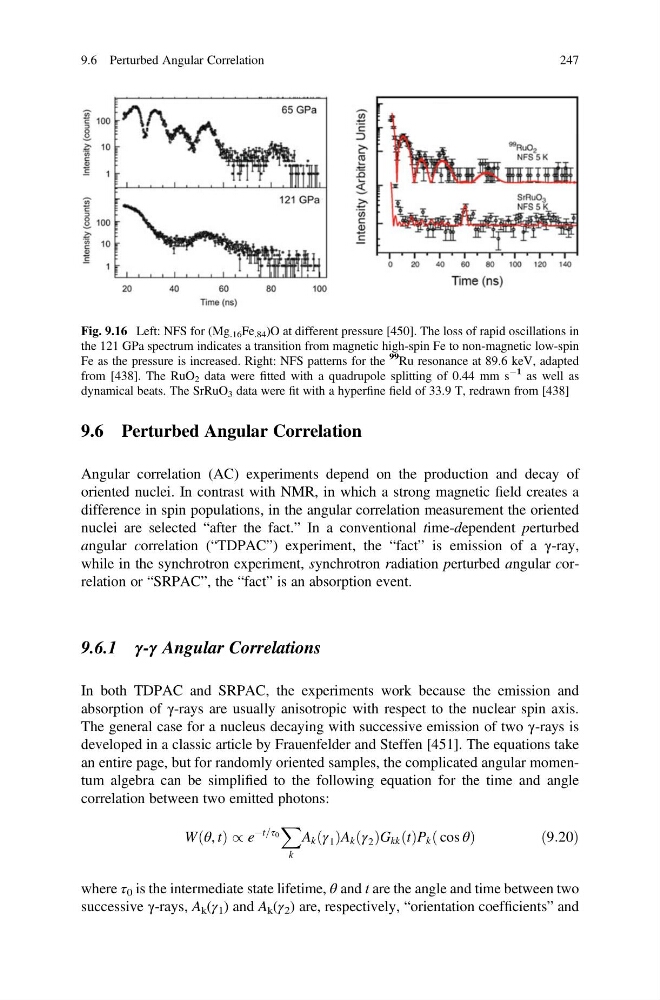
Fig. 9.16 Left: NFS for (Mg .16 Fe .84 )O at different pressure [450]. The loss of rapid oscillations in
the 121 GPa spectrum indicates a transition from magnetic high-spin Fe to non-magnetic low-spin
Fe as the pressure is increased. Right: NFS patterns for the
99
Ru resonance at 89.6 keV, adapted
from [438]. The RuO 2 data were fitted with a quadrupole splitting of 0.44 mm s
À1 as well as
dynamical beats. The SrRuO 3 data were fit with a hyperfine field of 33.9 T, redrawn from [438]
9.6 Perturbed Angular Correlation
247
Angular correlation (AC) experiments depend on the production and decay of
oriented nuclei. In contrast with NMR, in which a strong magnetic field creates a
difference in spin populations, in the angular correlation measurement the oriented
nuclei are selected “after the fact.” In a conventional time-dependent perturbed
angular correlation (“TDPAC”) experiment, the “fact” is emission of a γ-ray,
while in the synchrotron experiment, synchrotron radiation perturbed angular correlation or “SRPAC”, the “fact” is an absorption event.
9.6.1 γ-γ Angular Correlations
In both TDPAC and SRPAC, the experiments work because the emission and
absorption of γ-rays are usually anisotropic with respect to the nuclear spin axis.
The general case for a nucleus decaying with successive emission of two γ-rays is
developed in a classic article by Frauenfelder and Steffen [451]. The equations take
an entire page, but for randomly oriented samples, the complicated angular momentum algebra can be simplified to the following equation for the time and angle
correlation between two emitted photons:
W θ, t
ð Þ / e
Àt=τ 0
X
k
A k γ 1
ð ÞA k γ 2
ð ÞG kk t
ð ÞP k cos θ
ð
Þ
ð9:20Þ
where τ 0 is the intermediate state lifetime, θ and t are the angle and time between two
successive γ-rays, A k (γ 1 ) and A k (γ 2 ) are, respectively, “orientation coefficients” and
Fig. 9.16 Left: NFS for (Mg .16 Fe .84 )O at different pressure [450]. The loss of rapid oscillations in
the 121 GPa spectrum indicates a transition from magnetic high-spin Fe to non-magnetic low-spin
Fe as the pressure is increased. Right: NFS patterns for the
99
Ru resonance at 89.6 keV, adapted
from [438]. The RuO 2 data were fitted with a quadrupole splitting of 0.44 mm s
À1 as well as
dynamical beats. The SrRuO 3 data were fit with a hyperfine field of 33.9 T, redrawn from [438]
9.6 Perturbed Angular Correlation
247