

(Fig. 10.13). Such extremes of pressure can only be achieved over very small
volumes, so the ability to focus SR to micron scale spots is critical for such
experiments. As one example, NFS was used to demonstrate a high-spin to
low-spin magnetic transition in (Mg .16 Fe .84 )O between 85 and 121 GPa (Fig. 9.16).
NFS also shows great potential for investigating properties of high-energy
Mössbauer transitions, some of which do not have convenient radioactive sources.
A recent demonstration was for
99 Ru at 89.6 keV (Fig. 9.16), and other resonances
under 100 keV seem likely candidates, including
156 Gd at 88.97 keV through
183 W
at 99.1 keV.
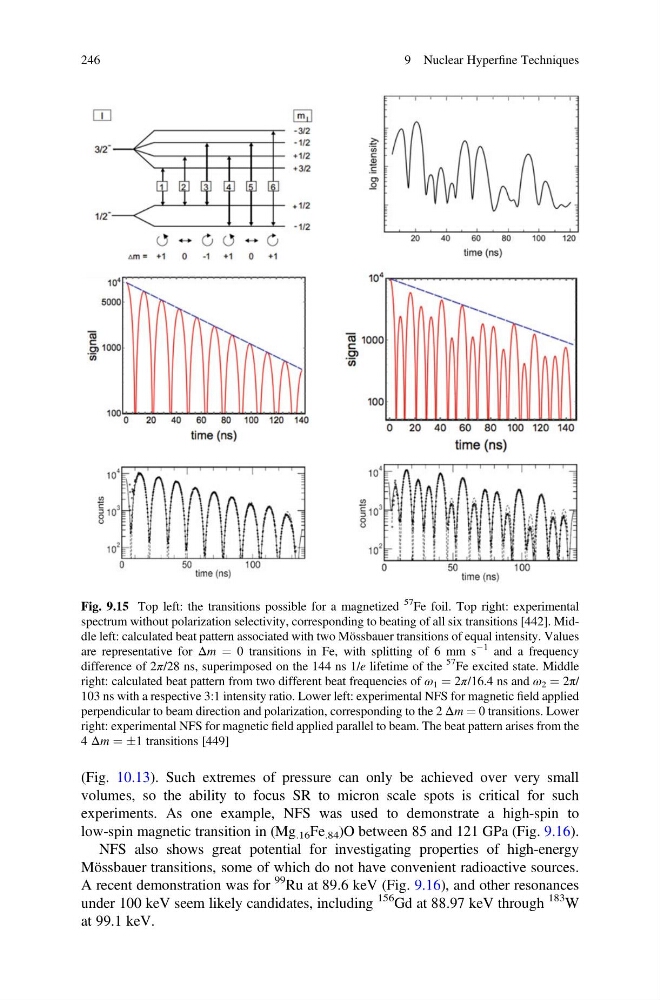
Fig. 9.15 Top left: the transitions possible for a magnetized
57
Fe foil. Top right: experimental
spectrum without polarization selectivity, corresponding to beating of all six transitions [442]. Middle left: calculated beat pattern associated with two Mössbauer transitions of equal intensity. Values
are representative for Δm ¼ 0 transitions in Fe, with splitting of 6 mm s
À1 and a frequency
difference of 2π/28 ns, superimposed on the 144 ns 1/e lifetime of the
57
Fe excited state. Middle
right: calculated beat pattern from two different beat frequencies of ω 1 ¼ 2π/16.4 ns and ω 2 ¼ 2π/
103 ns with a respective 3:1 intensity ratio. Lower left: experimental NFS for magnetic field applied
perpendicular to beam direction and polarization, corresponding to the 2 Δm ¼ 0 transitions. Lower
right: experimental NFS for magnetic field applied parallel to beam. The beat pattern arises from the
4 Δm ¼ Æ1 transitions [449]
246
9 Nuclear Hyperfine Techniques
volumes, so the ability to focus SR to micron scale spots is critical for such
experiments. As one example, NFS was used to demonstrate a high-spin to
low-spin magnetic transition in (Mg .16 Fe .84 )O between 85 and 121 GPa (Fig. 9.16).
NFS also shows great potential for investigating properties of high-energy
Mössbauer transitions, some of which do not have convenient radioactive sources.
A recent demonstration was for
99 Ru at 89.6 keV (Fig. 9.16), and other resonances
under 100 keV seem likely candidates, including
156 Gd at 88.97 keV through
183 W
at 99.1 keV.
Fig. 9.15 Top left: the transitions possible for a magnetized
57
Fe foil. Top right: experimental
spectrum without polarization selectivity, corresponding to beating of all six transitions [442]. Middle left: calculated beat pattern associated with two Mössbauer transitions of equal intensity. Values
are representative for Δm ¼ 0 transitions in Fe, with splitting of 6 mm s
À1 and a frequency
difference of 2π/28 ns, superimposed on the 144 ns 1/e lifetime of the
57
Fe excited state. Middle
right: calculated beat pattern from two different beat frequencies of ω 1 ¼ 2π/16.4 ns and ω 2 ¼ 2π/
103 ns with a respective 3:1 intensity ratio. Lower left: experimental NFS for magnetic field applied
perpendicular to beam direction and polarization, corresponding to the 2 Δm ¼ 0 transitions. Lower
right: experimental NFS for magnetic field applied parallel to beam. The beat pattern arises from the
4 Δm ¼ Æ1 transitions [449]
246
9 Nuclear Hyperfine Techniques