

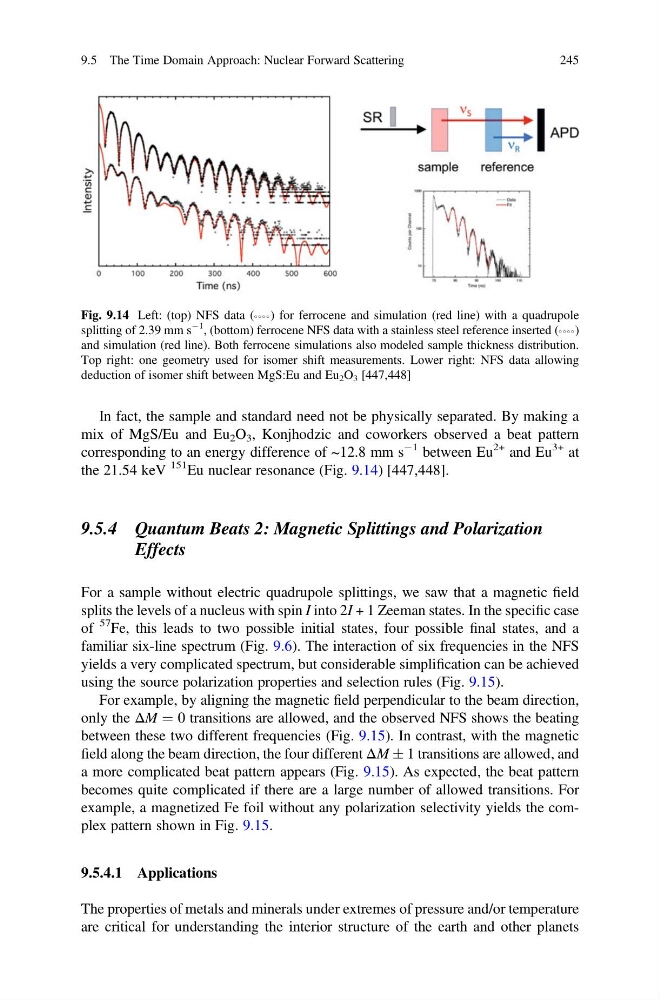
In fact, the sample and standard need not be physically separated. By making a
mix of MgS/Eu and Eu 2 O 3 , Konjhodzic and coworkers observed a beat pattern
corresponding to an energy difference of ~12.8 mm s
À1 between Eu
2+ and Eu
3+ at
the 21.54 keV
151 Eu nuclear resonance (Fig. 9.14) [447,448].
9.5.4 Quantum Beats 2: Magnetic Splittings and Polarization
Effects
For a sample without electric quadrupole splittings, we saw that a magnetic field
splits the levels of a nucleus with spin I into 2I + 1 Zeeman states. In the specific case
of
57 Fe, this leads to two possible initial states, four possible final states, and a
familiar six-line spectrum (Fig. 9.6). The interaction of six frequencies in the NFS
yields a very complicated spectrum, but considerable simplification can be achieved
using the source polarization properties and selection rules (Fig. 9.15).
For example, by aligning the magnetic field perpendicular to the beam direction,
only the ΔM ¼ 0 transitions are allowed, and the observed NFS shows the beating
between these two different frequencies (Fig. 9.15). In contrast, with the magnetic
field along the beam direction, the four different ΔM Æ 1 transitions are allowed, and
a more complicated beat pattern appears (Fig. 9.15). As expected, the beat pattern
becomes quite complicated if there are a large number of allowed transitions. For
example, a magnetized Fe foil without any polarization selectivity yields the complex pattern shown in Fig. 9.15.
9.5.4.1 Applications
The properties of metals and minerals under extremes of pressure and/or temperature
are critical for understanding the interior structure of the earth and other planets
Fig. 9.14 Left: (top) NFS data () for ferrocene and simulation (red line) with a quadrupole
splitting of 2.39 mm s
À1
, (bottom) ferrocene NFS data with a stainless steel reference inserted ()
and simulation (red line). Both ferrocene simulations also modeled sample thickness distribution.
Top right: one geometry used for isomer shift measurements. Lower right: NFS data allowing
deduction of isomer shift between MgS:Eu and Eu 2 O 3 [447,448]
9.5 The Time Domain Approach: Nuclear Forward Scattering
245
mix of MgS/Eu and Eu 2 O 3 , Konjhodzic and coworkers observed a beat pattern
corresponding to an energy difference of ~12.8 mm s
À1 between Eu
2+ and Eu
3+ at
the 21.54 keV
151 Eu nuclear resonance (Fig. 9.14) [447,448].
9.5.4 Quantum Beats 2: Magnetic Splittings and Polarization
Effects
For a sample without electric quadrupole splittings, we saw that a magnetic field
splits the levels of a nucleus with spin I into 2I + 1 Zeeman states. In the specific case
of
57 Fe, this leads to two possible initial states, four possible final states, and a
familiar six-line spectrum (Fig. 9.6). The interaction of six frequencies in the NFS
yields a very complicated spectrum, but considerable simplification can be achieved
using the source polarization properties and selection rules (Fig. 9.15).
For example, by aligning the magnetic field perpendicular to the beam direction,
only the ΔM ¼ 0 transitions are allowed, and the observed NFS shows the beating
between these two different frequencies (Fig. 9.15). In contrast, with the magnetic
field along the beam direction, the four different ΔM Æ 1 transitions are allowed, and
a more complicated beat pattern appears (Fig. 9.15). As expected, the beat pattern
becomes quite complicated if there are a large number of allowed transitions. For
example, a magnetized Fe foil without any polarization selectivity yields the complex pattern shown in Fig. 9.15.
9.5.4.1 Applications
The properties of metals and minerals under extremes of pressure and/or temperature
are critical for understanding the interior structure of the earth and other planets
Fig. 9.14 Left: (top) NFS data () for ferrocene and simulation (red line) with a quadrupole
splitting of 2.39 mm s
À1
, (bottom) ferrocene NFS data with a stainless steel reference inserted ()
and simulation (red line). Both ferrocene simulations also modeled sample thickness distribution.
Top right: one geometry used for isomer shift measurements. Lower right: NFS data allowing
deduction of isomer shift between MgS:Eu and Eu 2 O 3 [447,448]
9.5 The Time Domain Approach: Nuclear Forward Scattering
245