

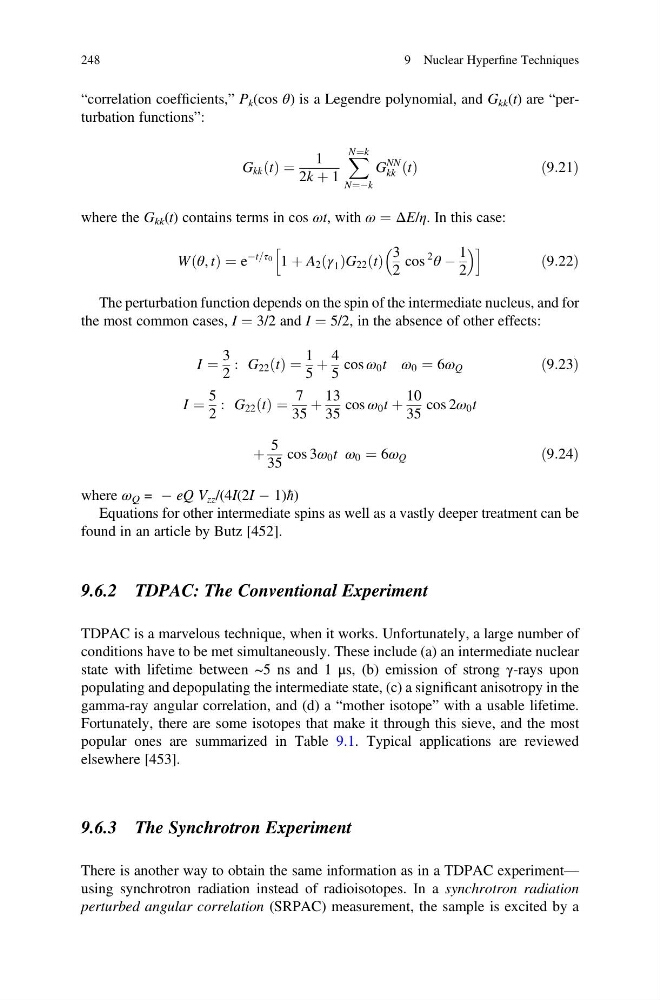
“correlation coefficients,” P k (cos θ) is a Legendre polynomial, and G kk (t) are “perturbation functions”:
G kk t
ð Þ ¼
1
2k þ 1
X N¼k
N¼Àk
G
NN
kk t
ð Þ
ð9:21Þ
where the G kk (t) contains terms in cos ωt, with ω ¼ ΔE/η. In this case:
W θ, t
ð Þ ¼ e
Àt=τ 0 1 þ A 2 γ 1
ð ÞG 22 t
ð Þ
3
2
cos
2
θ À
1
2
h
i
ð9:22Þ
The perturbation function depends on the spin of the intermediate nucleus, and for
the most common cases, I ¼ 3/2 and I ¼ 5/2, in the absence of other effects:
I ¼
3
2
: G 22 t
ð Þ ¼
1
5
þ
4
5
cos ω 0 t ω 0 ¼ 6ω Q
ð9:23Þ
I ¼
5
2
: G 22 t
ð Þ ¼
7
35
þ
13
35
cos ω 0 t þ
10
35
cos 2ω 0 t
þ
5
35
cos 3ω 0 t ω 0 ¼ 6ω Q
ð9:24Þ
where ω Q = À eQ V zz /(4I(2I À 1)ħ)
Equations for other intermediate spins as well as a vastly deeper treatment can be
found in an article by Butz [452].
9.6.2 TDPAC: The Conventional Experiment
TDPAC is a marvelous technique, when it works. Unfortunately, a large number of
conditions have to be met simultaneously. These include (a) an intermediate nuclear
state with lifetime between ~5 ns and 1 μs, (b) emission of strong γ-rays upon
populating and depopulating the intermediate state, (c) a significant anisotropy in the
gamma-ray angular correlation, and (d) a “mother isotope” with a usable lifetime.
Fortunately, there are some isotopes that make it through this sieve, and the most
popular ones are summarized in Table 9.1. Typical applications are reviewed
elsewhere [453].
9.6.3 The Synchrotron Experiment
There is another way to obtain the same information as in a TDPAC experiment—
using synchrotron radiation instead of radioisotopes. In a synchrotron radiation
perturbed angular correlation (SRPAC) measurement, the sample is excited by a
248
9 Nuclear Hyperfine Techniques
G kk t
ð Þ ¼
1
2k þ 1
X N¼k
N¼Àk
G
NN
kk t
ð Þ
ð9:21Þ
where the G kk (t) contains terms in cos ωt, with ω ¼ ΔE/η. In this case:
W θ, t
ð Þ ¼ e
Àt=τ 0 1 þ A 2 γ 1
ð ÞG 22 t
ð Þ
3
2
cos
2
θ À
1
2
h
i
ð9:22Þ
The perturbation function depends on the spin of the intermediate nucleus, and for
the most common cases, I ¼ 3/2 and I ¼ 5/2, in the absence of other effects:
I ¼
3
2
: G 22 t
ð Þ ¼
1
5
þ
4
5
cos ω 0 t ω 0 ¼ 6ω Q
ð9:23Þ
I ¼
5
2
: G 22 t
ð Þ ¼
7
35
þ
13
35
cos ω 0 t þ
10
35
cos 2ω 0 t
þ
5
35
cos 3ω 0 t ω 0 ¼ 6ω Q
ð9:24Þ
where ω Q = À eQ V zz /(4I(2I À 1)ħ)
Equations for other intermediate spins as well as a vastly deeper treatment can be
found in an article by Butz [452].
9.6.2 TDPAC: The Conventional Experiment
TDPAC is a marvelous technique, when it works. Unfortunately, a large number of
conditions have to be met simultaneously. These include (a) an intermediate nuclear
state with lifetime between ~5 ns and 1 μs, (b) emission of strong γ-rays upon
populating and depopulating the intermediate state, (c) a significant anisotropy in the
gamma-ray angular correlation, and (d) a “mother isotope” with a usable lifetime.
Fortunately, there are some isotopes that make it through this sieve, and the most
popular ones are summarized in Table 9.1. Typical applications are reviewed
elsewhere [453].
9.6.3 The Synchrotron Experiment
There is another way to obtain the same information as in a TDPAC experiment—
using synchrotron radiation instead of radioisotopes. In a synchrotron radiation
perturbed angular correlation (SRPAC) measurement, the sample is excited by a
248
9 Nuclear Hyperfine Techniques