

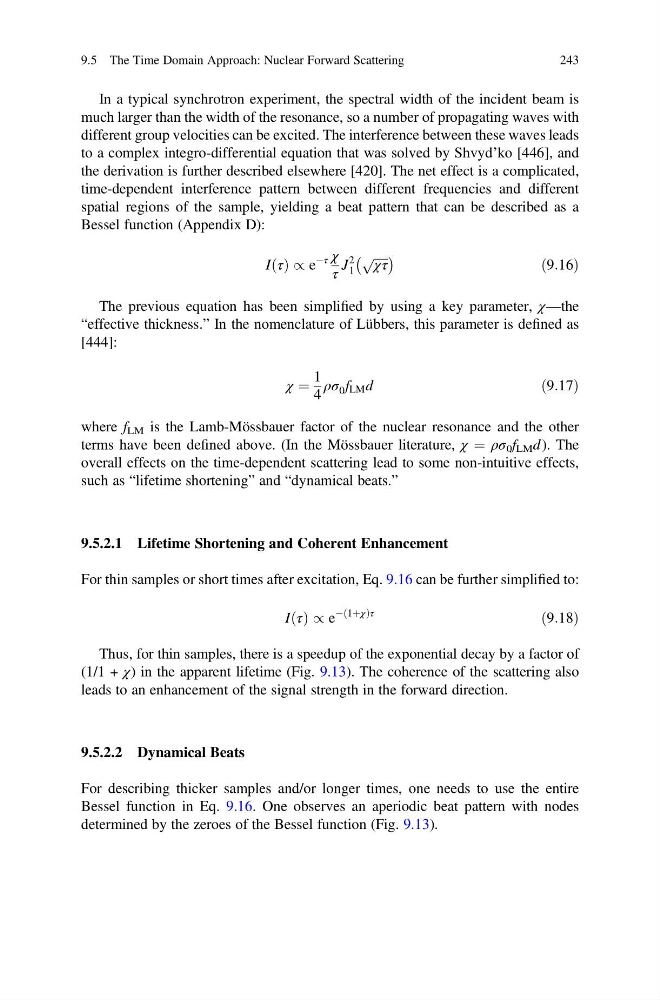
In a typical synchrotron experiment, the spectral width of the incident beam is
much larger than the width of the resonance, so a number of propagating waves with
different group velocities can be excited. The interference between these waves leads
to a complex integro-differential equation that was solved by Shvyd’ko [446], and
the derivation is further described elsewhere [420]. The net effect is a complicated,
time-dependent interference pattern between different frequencies and different
spatial regions of the sample, yielding a beat pattern that can be described as a
Bessel function (Appendix D):
I τ
ð Þ / e
Àτ χ
τ
J
2
1
ffiffiffiffi ffi
χτ
p
À
Á
ð9:16Þ
The previous equation has been simplified by using a key parameter, χ—the
“effective thickness.” In the nomenclature of Lübbers, this parameter is defined as
[444]:
χ ¼
1
4
ρσ 0 f LM d
ð9:17Þ
where f LM is the Lamb-Mössbauer factor of the nuclear resonance and the other
terms have been defined above. (In the Mössbauer literature, χ ¼ ρσ 0 f LM d). The
overall effects on the time-dependent scattering lead to some non-intuitive effects,
such as “lifetime shortening” and “dynamical beats.”
9.5.2.1 Lifetime Shortening and Coherent Enhancement
For thin samples or short times after excitation, Eq. 9.16 can be further simplified to:
I τ
ð Þ / e
À 1þχ
ð
Þτ
ð9:18Þ
Thus, for thin samples, there is a speedup of the exponential decay by a factor of
(1/1 + χ) in the apparent lifetime (Fig. 9.13). The coherence of the scattering also
leads to an enhancement of the signal strength in the forward direction.
9.5.2.2 Dynamical Beats
For describing thicker samples and/or longer times, one needs to use the entire
Bessel function in Eq. 9.16. One observes an aperiodic beat pattern with nodes
determined by the zeroes of the Bessel function (Fig. 9.13).
9.5 The Time Domain Approach: Nuclear Forward Scattering
243
much larger than the width of the resonance, so a number of propagating waves with
different group velocities can be excited. The interference between these waves leads
to a complex integro-differential equation that was solved by Shvyd’ko [446], and
the derivation is further described elsewhere [420]. The net effect is a complicated,
time-dependent interference pattern between different frequencies and different
spatial regions of the sample, yielding a beat pattern that can be described as a
Bessel function (Appendix D):
I τ
ð Þ / e
Àτ χ
τ
J
2
1
ffiffiffiffi ffi
χτ
p
À
Á
ð9:16Þ
The previous equation has been simplified by using a key parameter, χ—the
“effective thickness.” In the nomenclature of Lübbers, this parameter is defined as
[444]:
χ ¼
1
4
ρσ 0 f LM d
ð9:17Þ
where f LM is the Lamb-Mössbauer factor of the nuclear resonance and the other
terms have been defined above. (In the Mössbauer literature, χ ¼ ρσ 0 f LM d). The
overall effects on the time-dependent scattering lead to some non-intuitive effects,
such as “lifetime shortening” and “dynamical beats.”
9.5.2.1 Lifetime Shortening and Coherent Enhancement
For thin samples or short times after excitation, Eq. 9.16 can be further simplified to:
I τ
ð Þ / e
À 1þχ
ð
Þτ
ð9:18Þ
Thus, for thin samples, there is a speedup of the exponential decay by a factor of
(1/1 + χ) in the apparent lifetime (Fig. 9.13). The coherence of the scattering also
leads to an enhancement of the signal strength in the forward direction.
9.5.2.2 Dynamical Beats
For describing thicker samples and/or longer times, one needs to use the entire
Bessel function in Eq. 9.16. One observes an aperiodic beat pattern with nodes
determined by the zeroes of the Bessel function (Fig. 9.13).
9.5 The Time Domain Approach: Nuclear Forward Scattering
243