

in work by Smirnov [442] and discussed in theses by Baron [443] and Lübbers [444]
and in a book by Röhlsberger [445]. In this model, the incident X-ray beam is
described as an electromagnetic wave packet with “radiation amplitude” A which
consists of a band of spectral components broader than the nuclear linewidth
[442]. At first we will describe the sample as having a single nuclear resonance,
described by a complex index of refraction e n.
Then, as a function of distance z through the sample:
A z
ð Þ ¼ A 0 e
ik 0 ~ nz
ð9:12Þ
For a nuclear transition, the index of refraction e n is given by:
e n ω
ð Þ ffi 1 þ
2πρ
k
2
f n
ð9:13Þ
where for simplicity we omit the electronic contribution. In turn, the scattering
amplitude f n can be written as:
f n ¼ f n
0
þ if n
00
¼
f 0 x
x 2 þ 1
þ i
f 0
x 2 þ 1
ð9:14Þ
where x ¼ 2(E À E 0 )/Γ 0 is the deviation from exact resonance in units of the natural
linewidth Γ 0 and f 0 is proportional to the oscillator strength of the transition:
f 0 ¼
f LM
2k 0
2I e þ 1
2I g þ 1
1
1 þ α
ð9:15Þ
Here, f LM is the Lamb-Mössbauer factor, I g and I e are respectively the nuclear spins
for the ground state and excited state, and α is the internal conversion coefficient.
Exactly on resonance, the scattering amplitude is purely imaginary, and the
scattered wave interferes destructively with the incident wave. This gives rise to
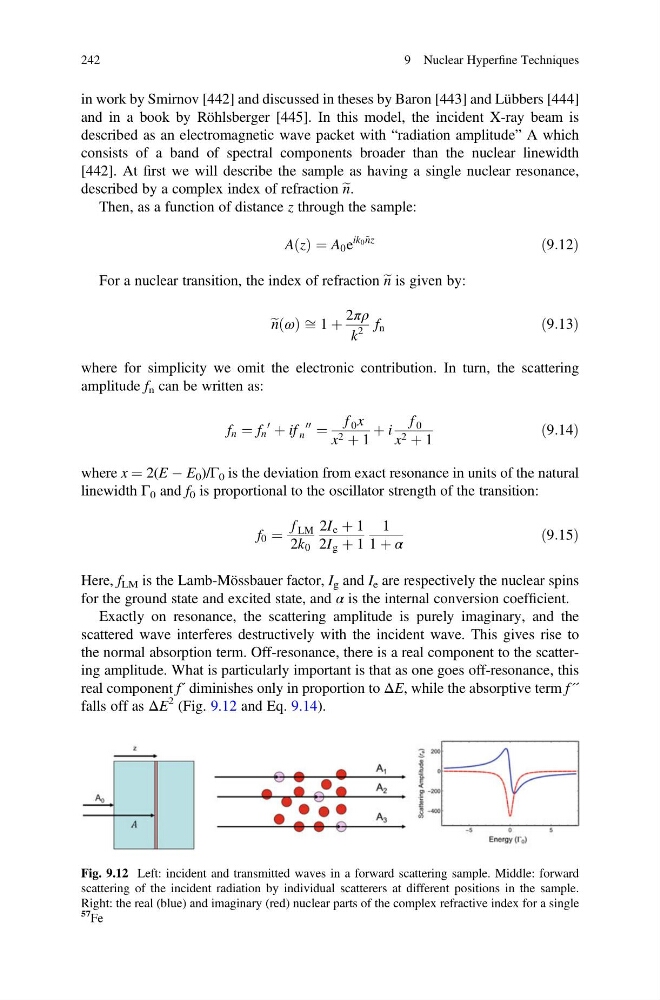
the normal absorption term. Off-resonance, there is a real component to the scattering amplitude. What is particularly important is that as one goes off-resonance, this
real component f´ diminishes only in proportion to ΔE, while the absorptive term f´´
falls off as ΔE
2 (Fig. 9.12 and Eq. 9.14).
Fig. 9.12 Left: incident and transmitted waves in a forward scattering sample. Middle: forward
scattering of the incident radiation by individual scatterers at different positions in the sample.
Right: the real (blue) and imaginary (red) nuclear parts of the complex refractive index for a single
57
Fe
242
9 Nuclear Hyperfine Techniques
and in a book by Röhlsberger [445]. In this model, the incident X-ray beam is
described as an electromagnetic wave packet with “radiation amplitude” A which
consists of a band of spectral components broader than the nuclear linewidth
[442]. At first we will describe the sample as having a single nuclear resonance,
described by a complex index of refraction e n.
Then, as a function of distance z through the sample:
A z
ð Þ ¼ A 0 e
ik 0 ~ nz
ð9:12Þ
For a nuclear transition, the index of refraction e n is given by:
e n ω
ð Þ ffi 1 þ
2πρ
k
2
f n
ð9:13Þ
where for simplicity we omit the electronic contribution. In turn, the scattering
amplitude f n can be written as:
f n ¼ f n
0
þ if n
00
¼
f 0 x
x 2 þ 1
þ i
f 0
x 2 þ 1
ð9:14Þ
where x ¼ 2(E À E 0 )/Γ 0 is the deviation from exact resonance in units of the natural
linewidth Γ 0 and f 0 is proportional to the oscillator strength of the transition:
f 0 ¼
f LM
2k 0
2I e þ 1
2I g þ 1
1
1 þ α
ð9:15Þ
Here, f LM is the Lamb-Mössbauer factor, I g and I e are respectively the nuclear spins
for the ground state and excited state, and α is the internal conversion coefficient.
Exactly on resonance, the scattering amplitude is purely imaginary, and the
scattered wave interferes destructively with the incident wave. This gives rise to
the normal absorption term. Off-resonance, there is a real component to the scattering amplitude. What is particularly important is that as one goes off-resonance, this
real component f´ diminishes only in proportion to ΔE, while the absorptive term f´´
falls off as ΔE
2 (Fig. 9.12 and Eq. 9.14).
Fig. 9.12 Left: incident and transmitted waves in a forward scattering sample. Middle: forward
scattering of the incident radiation by individual scatterers at different positions in the sample.
Right: the real (blue) and imaginary (red) nuclear parts of the complex refractive index for a single
57
Fe
242
9 Nuclear Hyperfine Techniques