

radioactive source emitting into 4π steradians. This is particularly useful for surface
studies. As an example, Mibu and coworkers obtained a beautiful energy-domain
spectrum for a monatomic layer of
57 Fe at a the Fe/Cr interface in a Fe/Cr bilayer
(Fig. 9.10) [434].
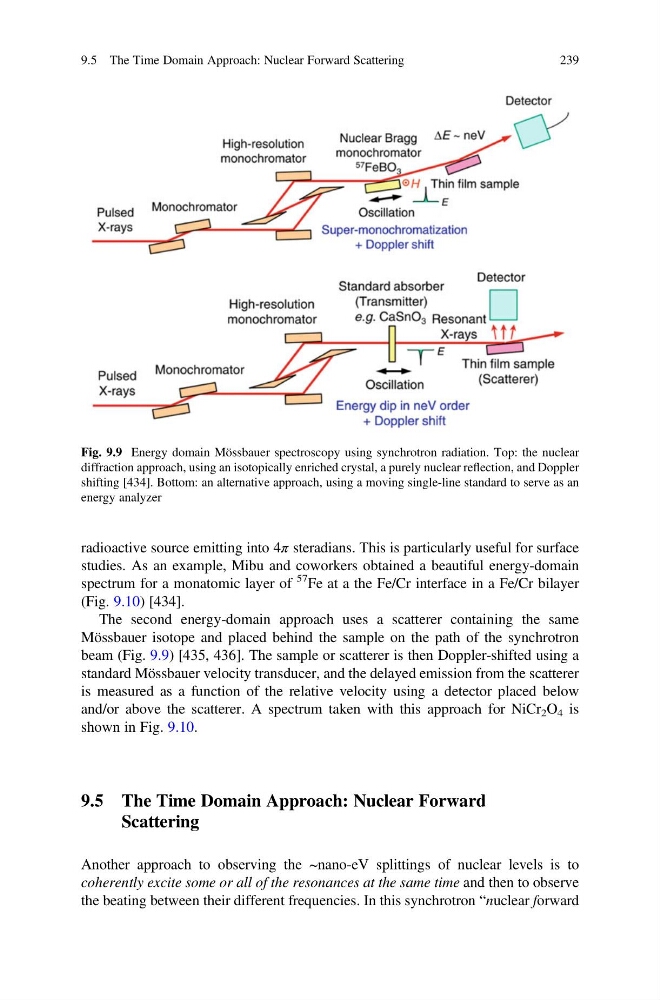
The second energy-domain approach uses a scatterer containing the same
Mössbauer isotope and placed behind the sample on the path of the synchrotron
beam (Fig. 9.9) [435, 436]. The sample or scatterer is then Doppler-shifted using a
standard Mössbauer velocity transducer, and the delayed emission from the scatterer
is measured as a function of the relative velocity using a detector placed below
and/or above the scatterer. A spectrum taken with this approach for NiCr 2 O 4 is
shown in Fig. 9.10.
9.5 The Time Domain Approach: Nuclear Forward
Scattering
Another approach to observing the ~nano-eV splittings of nuclear levels is to
coherently excite some or all of the resonances at the same time and then to observe
the beating between their different frequencies. In this synchrotron “nuclear forward
Fig. 9.9 Energy domain Mössbauer spectroscopy using synchrotron radiation. Top: the nuclear
diffraction approach, using an isotopically enriched crystal, a purely nuclear reflection, and Doppler
shifting [434]. Bottom: an alternative approach, using a moving single-line standard to serve as an
energy analyzer
9.5 The Time Domain Approach: Nuclear Forward Scattering
239
studies. As an example, Mibu and coworkers obtained a beautiful energy-domain
spectrum for a monatomic layer of
57 Fe at a the Fe/Cr interface in a Fe/Cr bilayer
(Fig. 9.10) [434].
The second energy-domain approach uses a scatterer containing the same
Mössbauer isotope and placed behind the sample on the path of the synchrotron
beam (Fig. 9.9) [435, 436]. The sample or scatterer is then Doppler-shifted using a
standard Mössbauer velocity transducer, and the delayed emission from the scatterer
is measured as a function of the relative velocity using a detector placed below
and/or above the scatterer. A spectrum taken with this approach for NiCr 2 O 4 is
shown in Fig. 9.10.
9.5 The Time Domain Approach: Nuclear Forward
Scattering
Another approach to observing the ~nano-eV splittings of nuclear levels is to
coherently excite some or all of the resonances at the same time and then to observe
the beating between their different frequencies. In this synchrotron “nuclear forward
Fig. 9.9 Energy domain Mössbauer spectroscopy using synchrotron radiation. Top: the nuclear
diffraction approach, using an isotopically enriched crystal, a purely nuclear reflection, and Doppler
shifting [434]. Bottom: an alternative approach, using a moving single-line standard to serve as an
energy analyzer
9.5 The Time Domain Approach: Nuclear Forward Scattering
239