

The essence of the laboratory experiment is to create and vary a Doppler shift
between the sample and source. Nowadays, most instruments use an electronically
controlled voltage feeding a drive coil similar to a loudspeaker system. The drive coil
causes motion of the drive tube, upon which is mounted the Mössbauer source. By
varying the voltage input, the devices can run in constant acceleration mode (velocity sawtooth), in sinusoidal motion, or any other desired pattern. For low-energy
Mössbauer experiments such as
57 Fe work, gas-filled proportional counters have
good efficiency and an additional advantage—they do not absorb much of the
background 122 and 136 keV radiation from the typical
57 Co source.
9.4 Synchrotron Mössbauer Spectroscopy: Energy Domain
Approaches
The energy scales for hyperfine splittings, tens of nano-eV, are vastly different from
those normally encountered with X-rays monochromators. For example, the EXAFS
monochromators discussed in Chap. 4 had typical resolutions on the order of 1 eV,
and even the high-resolution monochromators employed for RIXS experiments only
achieve ~1 meV. How can one hope to achieve the extra 6 orders of magnitude
required for Mössbauer spectroscopy? The three most commonly employed
approaches are:
• Build a monochromator based on nuclear diffraction.
• Excite a nuclear resonance in a single-line standard and employ the re-radiated
photons.
• Switch to time domain detection of nuclear forward scattering.
The first approach uses nuclear Bragg diffraction, as illustrated in Fig. 9.9. This
method employs multiple clever tricks to achieve a single line. First of all, as noted
50 years ago by Smirnov, one has to pick a reflection for which electronic diffraction
is strictly forbidden but for which nuclear diffraction is still allowed [432]. In the
case of FeBO 3 , the (3 3 3) reflection is an appropriate choice. Then, to achieve a
single-line nuclear source, one raises the crystal temperature close to the Néel point
(~348 K) to convert from antiferromagnetic to paramagnetic state, and additionally
employing a small (150 Oe) magnetic field, a single-line source is achieved
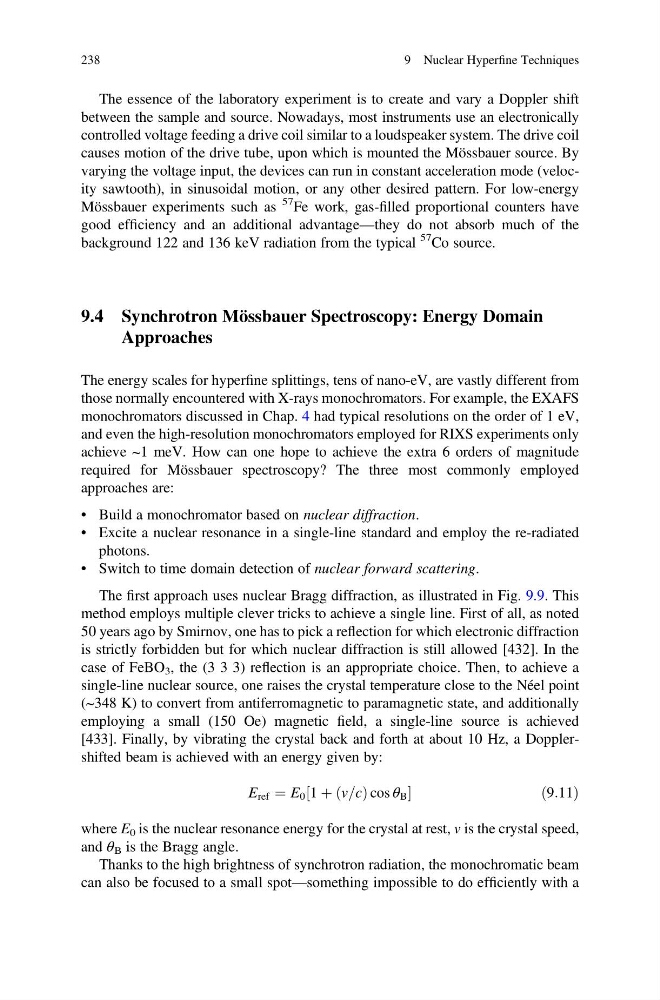
[433]. Finally, by vibrating the crystal back and forth at about 10 Hz, a Dopplershifted beam is achieved with an energy given by:
E ref ¼ E 0 1 þ v=c
ð Þcos θ B
½
ð 9:11Þ
where E 0 is the nuclear resonance energy for the crystal at rest, v is the crystal speed,
and θ B is the Bragg angle.
Thanks to the high brightness of synchrotron radiation, the monochromatic beam
can also be focused to a small spot—something impossible to do efficiently with a
238
9 Nuclear Hyperfine Techniques
between the sample and source. Nowadays, most instruments use an electronically
controlled voltage feeding a drive coil similar to a loudspeaker system. The drive coil
causes motion of the drive tube, upon which is mounted the Mössbauer source. By
varying the voltage input, the devices can run in constant acceleration mode (velocity sawtooth), in sinusoidal motion, or any other desired pattern. For low-energy
Mössbauer experiments such as
57 Fe work, gas-filled proportional counters have
good efficiency and an additional advantage—they do not absorb much of the
background 122 and 136 keV radiation from the typical
57 Co source.
9.4 Synchrotron Mössbauer Spectroscopy: Energy Domain
Approaches
The energy scales for hyperfine splittings, tens of nano-eV, are vastly different from
those normally encountered with X-rays monochromators. For example, the EXAFS
monochromators discussed in Chap. 4 had typical resolutions on the order of 1 eV,
and even the high-resolution monochromators employed for RIXS experiments only
achieve ~1 meV. How can one hope to achieve the extra 6 orders of magnitude
required for Mössbauer spectroscopy? The three most commonly employed
approaches are:
• Build a monochromator based on nuclear diffraction.
• Excite a nuclear resonance in a single-line standard and employ the re-radiated
photons.
• Switch to time domain detection of nuclear forward scattering.
The first approach uses nuclear Bragg diffraction, as illustrated in Fig. 9.9. This
method employs multiple clever tricks to achieve a single line. First of all, as noted
50 years ago by Smirnov, one has to pick a reflection for which electronic diffraction
is strictly forbidden but for which nuclear diffraction is still allowed [432]. In the
case of FeBO 3 , the (3 3 3) reflection is an appropriate choice. Then, to achieve a
single-line nuclear source, one raises the crystal temperature close to the Néel point
(~348 K) to convert from antiferromagnetic to paramagnetic state, and additionally
employing a small (150 Oe) magnetic field, a single-line source is achieved
[433]. Finally, by vibrating the crystal back and forth at about 10 Hz, a Dopplershifted beam is achieved with an energy given by:
E ref ¼ E 0 1 þ v=c
ð Þcos θ B
½
ð 9:11Þ
where E 0 is the nuclear resonance energy for the crystal at rest, v is the crystal speed,
and θ B is the Bragg angle.
Thanks to the high brightness of synchrotron radiation, the monochromatic beam
can also be focused to a small spot—something impossible to do efficiently with a
238
9 Nuclear Hyperfine Techniques