

The fraction of recoil-free events is termed the Lamb-Mossbauer factor f, or
alternatively as the recoil-free fraction or “recoilless fraction”. It is similar to the
Debye-Waller factor that appears in EXAFS. The same simple models that were
used to describe lattice vibrational motion for EXAFS analysis (Chap. 6) can be used
to estimate this loss of intensity. For example, assuming an Einstein solid with
vibrational frequency ω E , incident photon wave vector k γ , and recoil energy E R
yields Lamb-Mössbauer factor:
f ¼ exp À
E R
ħω E
¼ exp Àk
2
γ X
h i
2
ð9:10Þ
where hXi
2 is the mean square motion of the resonant nucleus.
9.3.4 The Conventional Mössbauer Experiment
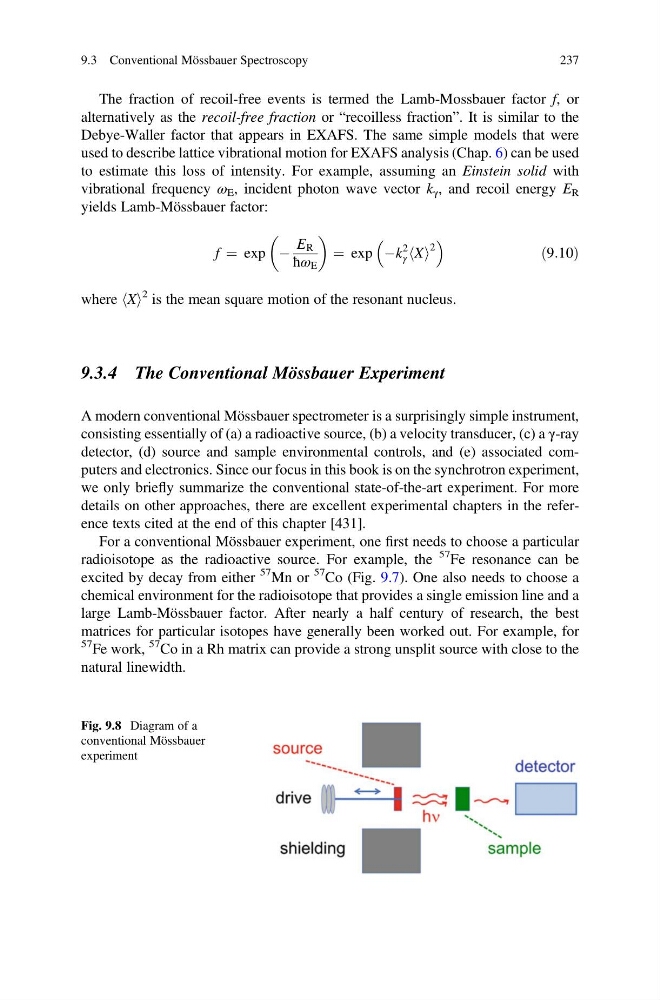
A modern conventional Mössbauer spectrometer is a surprisingly simple instrument,
consisting essentially of (a) a radioactive source, (b) a velocity transducer, (c) a γ-ray
detector, (d) source and sample environmental controls, and (e) associated computers and electronics. Since our focus in this book is on the synchrotron experiment,
we only briefly summarize the conventional state-of-the-art experiment. For more
details on other approaches, there are excellent experimental chapters in the reference texts cited at the end of this chapter [431].
For a conventional Mössbauer experiment, one first needs to choose a particular
radioisotope as the radioactive source. For example, the
57 Fe resonance can be
excited by decay from either
57 Mn or
57 Co (Fig. 9.7). One also needs to choose a
chemical environment for the radioisotope that provides a single emission line and a
large Lamb-Mössbauer factor. After nearly a half century of research, the best
matrices for particular isotopes have generally been worked out. For example, for
57 Fe work,
57 Co in a Rh matrix can provide a strong unsplit source with close to the
natural linewidth.
Fig. 9.8 Diagram of a
conventional Mössbauer
experiment
9.3 Conventional Mössbauer Spectroscopy
237
alternatively as the recoil-free fraction or “recoilless fraction”. It is similar to the
Debye-Waller factor that appears in EXAFS. The same simple models that were
used to describe lattice vibrational motion for EXAFS analysis (Chap. 6) can be used
to estimate this loss of intensity. For example, assuming an Einstein solid with
vibrational frequency ω E , incident photon wave vector k γ , and recoil energy E R
yields Lamb-Mössbauer factor:
f ¼ exp À
E R
ħω E
¼ exp Àk
2
γ X
h i
2
ð9:10Þ
where hXi
2 is the mean square motion of the resonant nucleus.
9.3.4 The Conventional Mössbauer Experiment
A modern conventional Mössbauer spectrometer is a surprisingly simple instrument,
consisting essentially of (a) a radioactive source, (b) a velocity transducer, (c) a γ-ray
detector, (d) source and sample environmental controls, and (e) associated computers and electronics. Since our focus in this book is on the synchrotron experiment,
we only briefly summarize the conventional state-of-the-art experiment. For more
details on other approaches, there are excellent experimental chapters in the reference texts cited at the end of this chapter [431].
For a conventional Mössbauer experiment, one first needs to choose a particular
radioisotope as the radioactive source. For example, the
57 Fe resonance can be
excited by decay from either
57 Mn or
57 Co (Fig. 9.7). One also needs to choose a
chemical environment for the radioisotope that provides a single emission line and a
large Lamb-Mössbauer factor. After nearly a half century of research, the best
matrices for particular isotopes have generally been worked out. For example, for
57 Fe work,
57 Co in a Rh matrix can provide a strong unsplit source with close to the
natural linewidth.
Fig. 9.8 Diagram of a
conventional Mössbauer
experiment
9.3 Conventional Mössbauer Spectroscopy
237