

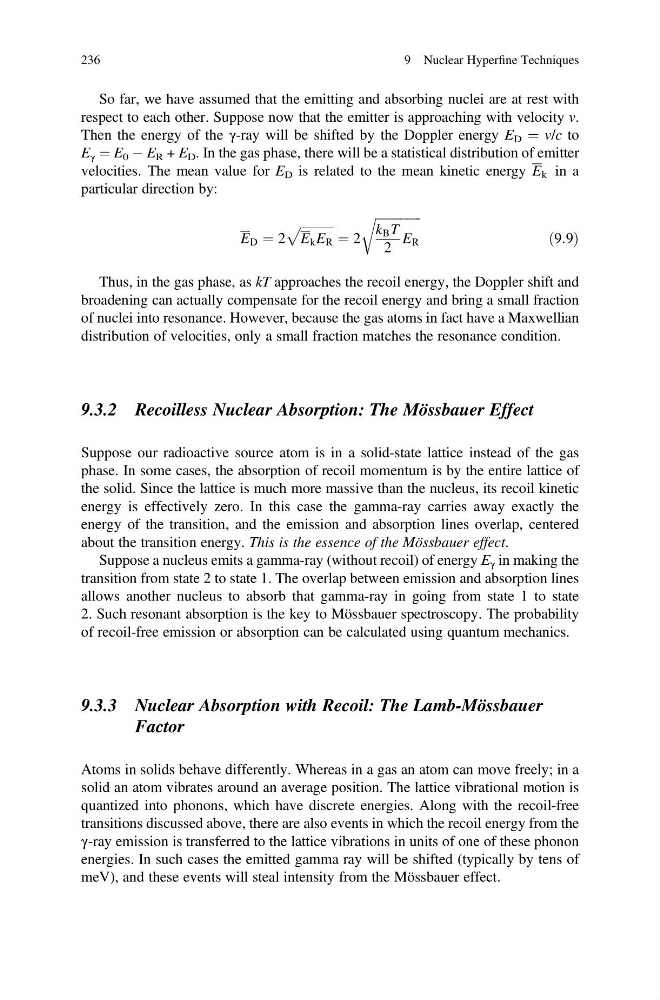
So far, we have assumed that the emitting and absorbing nuclei are at rest with
respect to each other. Suppose now that the emitter is approaching with velocity v.
Then the energy of the γ-ray will be shifted by the Doppler energy E D ¼ v/c to
E γ ¼ E 0 À E R + E D . In the gas phase, there will be a statistical distribution of emitter
velocities. The mean value for E D is related to the mean kinetic energy E k in a
particular direction by:
E D ¼ 2
ffiffiffiffiffiffiffiffiffiffiffi
E k E R
p
¼ 2
ffiffiffiffiffiffiffiffiffiffiffiffiffiffi ffi
k B T
2
E R
r
ð9:9Þ
Thus, in the gas phase, as kT approaches the recoil energy, the Doppler shift and
broadening can actually compensate for the recoil energy and bring a small fraction
of nuclei into resonance. However, because the gas atoms in fact have a Maxwellian
distribution of velocities, only a small fraction matches the resonance condition.
9.3.2 Recoilless Nuclear Absorption: The Mössbauer Effect
Suppose our radioactive source atom is in a solid-state lattice instead of the gas
phase. In some cases, the absorption of recoil momentum is by the entire lattice of
the solid. Since the lattice is much more massive than the nucleus, its recoil kinetic
energy is effectively zero. In this case the gamma-ray carries away exactly the
energy of the transition, and the emission and absorption lines overlap, centered
about the transition energy. This is the essence of the Mössbauer effect.
Suppose a nucleus emits a gamma-ray (without recoil) of energy E γ in making the
transition from state 2 to state 1. The overlap between emission and absorption lines
allows another nucleus to absorb that gamma-ray in going from state 1 to state
2. Such resonant absorption is the key to Mössbauer spectroscopy. The probability
of recoil-free emission or absorption can be calculated using quantum mechanics.
9.3.3 Nuclear Absorption with Recoil: The Lamb-Mössbauer
Factor
Atoms in solids behave differently. Whereas in a gas an atom can move freely; in a
solid an atom vibrates around an average position. The lattice vibrational motion is
quantized into phonons, which have discrete energies. Along with the recoil-free
transitions discussed above, there are also events in which the recoil energy from the
γ-ray emission is transferred to the lattice vibrations in units of one of these phonon
energies. In such cases the emitted gamma ray will be shifted (typically by tens of
meV), and these events will steal intensity from the Mössbauer effect.
236
9 Nuclear Hyperfine Techniques
respect to each other. Suppose now that the emitter is approaching with velocity v.
Then the energy of the γ-ray will be shifted by the Doppler energy E D ¼ v/c to
E γ ¼ E 0 À E R + E D . In the gas phase, there will be a statistical distribution of emitter
velocities. The mean value for E D is related to the mean kinetic energy E k in a
particular direction by:
E D ¼ 2
ffiffiffiffiffiffiffiffiffiffiffi
E k E R
p
¼ 2
ffiffiffiffiffiffiffiffiffiffiffiffiffiffi ffi
k B T
2
E R
r
ð9:9Þ
Thus, in the gas phase, as kT approaches the recoil energy, the Doppler shift and
broadening can actually compensate for the recoil energy and bring a small fraction
of nuclei into resonance. However, because the gas atoms in fact have a Maxwellian
distribution of velocities, only a small fraction matches the resonance condition.
9.3.2 Recoilless Nuclear Absorption: The Mössbauer Effect
Suppose our radioactive source atom is in a solid-state lattice instead of the gas
phase. In some cases, the absorption of recoil momentum is by the entire lattice of
the solid. Since the lattice is much more massive than the nucleus, its recoil kinetic
energy is effectively zero. In this case the gamma-ray carries away exactly the
energy of the transition, and the emission and absorption lines overlap, centered
about the transition energy. This is the essence of the Mössbauer effect.
Suppose a nucleus emits a gamma-ray (without recoil) of energy E γ in making the
transition from state 2 to state 1. The overlap between emission and absorption lines
allows another nucleus to absorb that gamma-ray in going from state 1 to state
2. Such resonant absorption is the key to Mössbauer spectroscopy. The probability
of recoil-free emission or absorption can be calculated using quantum mechanics.
9.3.3 Nuclear Absorption with Recoil: The Lamb-Mössbauer
Factor
Atoms in solids behave differently. Whereas in a gas an atom can move freely; in a
solid an atom vibrates around an average position. The lattice vibrational motion is
quantized into phonons, which have discrete energies. Along with the recoil-free
transitions discussed above, there are also events in which the recoil energy from the
γ-ray emission is transferred to the lattice vibrations in units of one of these phonon
energies. In such cases the emitted gamma ray will be shifted (typically by tens of
meV), and these events will steal intensity from the Mössbauer effect.
236
9 Nuclear Hyperfine Techniques