

We consider first a commonly used nuclear transition, from the ground state to the
first excited state of
57 Fe. The conventional method for observing this is to use a
radioactive source, in which a parent nucleus decays to an excited state of a daughter
nucleus, which in turn decays to the ground state with emission of nuclear fluorescence (γ-rays). In the case of
57 Fe, one could in principle use either
57 Mn or
57 Co as
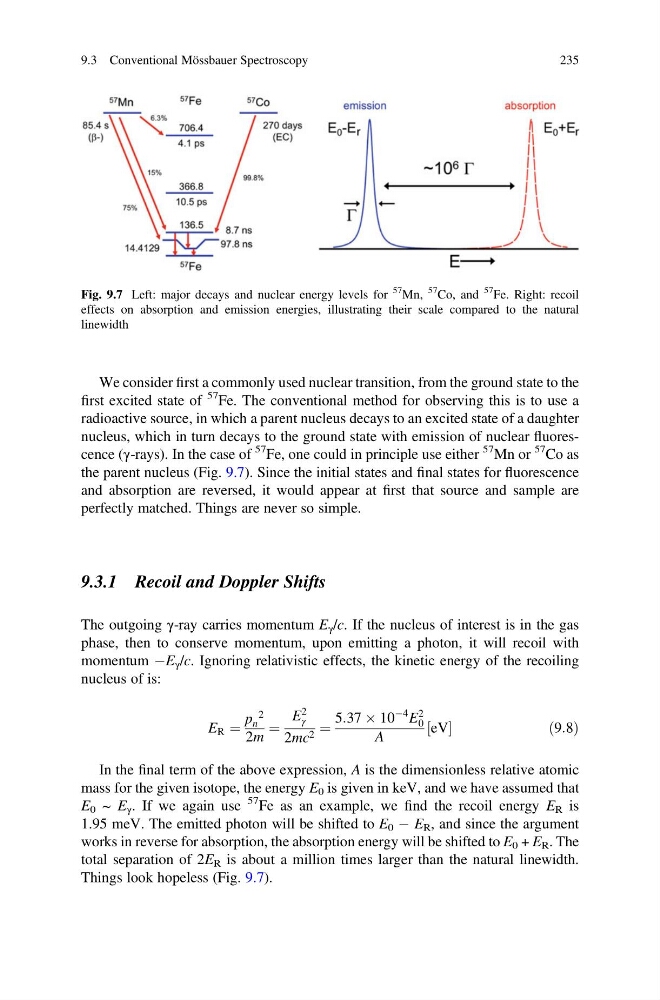
the parent nucleus (Fig. 9.7). Since the initial states and final states for fluorescence
and absorption are reversed, it would appear at first that source and sample are
perfectly matched. Things are never so simple.
9.3.1 Recoil and Doppler Shifts
The outgoing γ-ray carries momentum E γ /c. If the nucleus of interest is in the gas
phase, then to conserve momentum, upon emitting a photon, it will recoil with
momentum ÀE γ /c. Ignoring relativistic effects, the kinetic energy of the recoiling
nucleus of is:
E R ¼
p n
2
2m
¼
E
2
γ
2mc 2 ¼
5:37 Â 10
À4 E
2
0
A
eV
½
ð9:8Þ
In the final term of the above expression, A is the dimensionless relative atomic
mass for the given isotope, the energy E 0 is given in keV, and we have assumed that
E 0 ~ E γ . If we again use
57 Fe as an example, we find the recoil energy E R is
1.95 meV. The emitted photon will be shifted to E 0 À E R , and since the argument
works in reverse for absorption, the absorption energy will be shifted to E 0 + E R . The
total separation of 2E R is about a million times larger than the natural linewidth.
Things look hopeless (Fig. 9.7).
Fig. 9.7 Left: major decays and nuclear energy levels for
57
Mn,
57
Co, and
57
Fe. Right: recoil
effects on absorption and emission energies, illustrating their scale compared to the natural
linewidth
9.3 Conventional Mössbauer Spectroscopy
235
first excited state of
57 Fe. The conventional method for observing this is to use a
radioactive source, in which a parent nucleus decays to an excited state of a daughter
nucleus, which in turn decays to the ground state with emission of nuclear fluorescence (γ-rays). In the case of
57 Fe, one could in principle use either
57 Mn or
57 Co as
the parent nucleus (Fig. 9.7). Since the initial states and final states for fluorescence
and absorption are reversed, it would appear at first that source and sample are
perfectly matched. Things are never so simple.
9.3.1 Recoil and Doppler Shifts
The outgoing γ-ray carries momentum E γ /c. If the nucleus of interest is in the gas
phase, then to conserve momentum, upon emitting a photon, it will recoil with
momentum ÀE γ /c. Ignoring relativistic effects, the kinetic energy of the recoiling
nucleus of is:
E R ¼
p n
2
2m
¼
E
2
γ
2mc 2 ¼
5:37 Â 10
À4 E
2
0
A
eV
½
ð9:8Þ
In the final term of the above expression, A is the dimensionless relative atomic
mass for the given isotope, the energy E 0 is given in keV, and we have assumed that
E 0 ~ E γ . If we again use
57 Fe as an example, we find the recoil energy E R is
1.95 meV. The emitted photon will be shifted to E 0 À E R , and since the argument
works in reverse for absorption, the absorption energy will be shifted to E 0 + E R . The
total separation of 2E R is about a million times larger than the natural linewidth.
Things look hopeless (Fig. 9.7).
Fig. 9.7 Left: major decays and nuclear energy levels for
57
Mn,
57
Co, and
57
Fe. Right: recoil
effects on absorption and emission energies, illustrating their scale compared to the natural
linewidth
9.3 Conventional Mössbauer Spectroscopy
235