

Continuing with our
57 Fe example, the ground state with I ¼ 1/2 and μ g ¼ +0.09
will split into two substates with m I ¼ +1/2 lower, while the excited state with
I ¼ 3/2 and μ e ¼ À0.15 will be split into four substates with m I ¼ À3/2 lowest
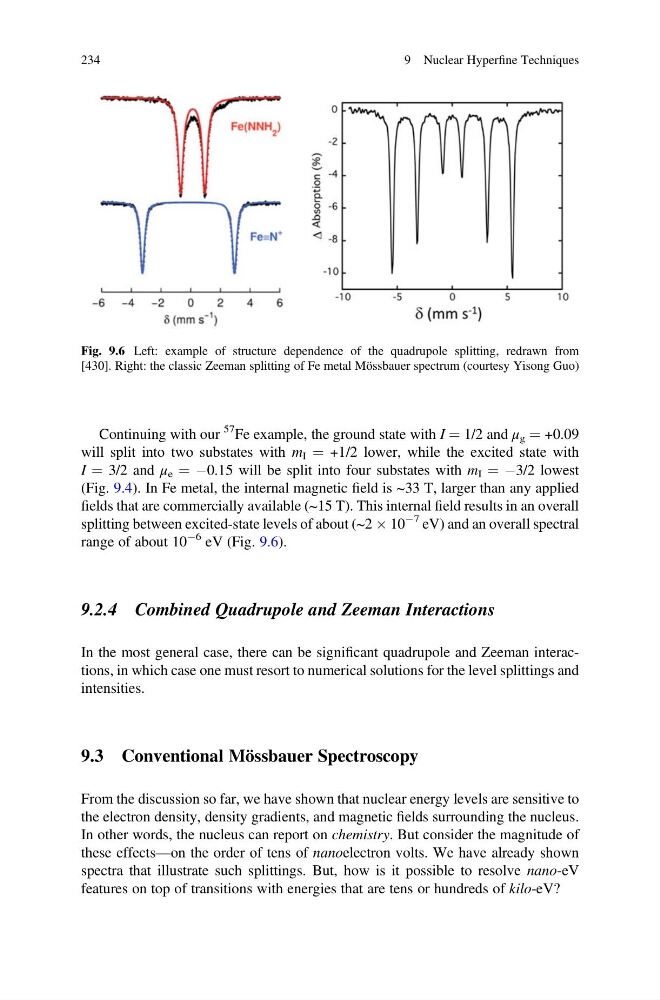
(Fig. 9.4). In Fe metal, the internal magnetic field is ~33 T, larger than any applied
fields that are commercially available (~15 T). This internal field results in an overall
splitting between excited-state levels of about (~2 Â 10
À7 eV) and an overall spectral
range of about 10
À6 eV (Fig. 9.6).
9.2.4 Combined Quadrupole and Zeeman Interactions
In the most general case, there can be significant quadrupole and Zeeman interactions, in which case one must resort to numerical solutions for the level splittings and
intensities.
9.3 Conventional Mössbauer Spectroscopy
From the discussion so far, we have shown that nuclear energy levels are sensitive to
the electron density, density gradients, and magnetic fields surrounding the nucleus.
In other words, the nucleus can report on chemistry. But consider the magnitude of
these effects—on the order of tens of nanoelectron volts. We have already shown
spectra that illustrate such splittings. But, how is it possible to resolve nano-eV
features on top of transitions with energies that are tens or hundreds of kilo-eV?
Fig. 9.6 Left: example of structure dependence of the quadrupole splitting, redrawn from
[430]. Right: the classic Zeeman splitting of Fe metal Mössbauer spectrum (courtesy Yisong Guo)
234
9 Nuclear Hyperfine Techniques
57 Fe example, the ground state with I ¼ 1/2 and μ g ¼ +0.09
will split into two substates with m I ¼ +1/2 lower, while the excited state with
I ¼ 3/2 and μ e ¼ À0.15 will be split into four substates with m I ¼ À3/2 lowest
(Fig. 9.4). In Fe metal, the internal magnetic field is ~33 T, larger than any applied
fields that are commercially available (~15 T). This internal field results in an overall
splitting between excited-state levels of about (~2 Â 10
À7 eV) and an overall spectral
range of about 10
À6 eV (Fig. 9.6).
9.2.4 Combined Quadrupole and Zeeman Interactions
In the most general case, there can be significant quadrupole and Zeeman interactions, in which case one must resort to numerical solutions for the level splittings and
intensities.
9.3 Conventional Mössbauer Spectroscopy
From the discussion so far, we have shown that nuclear energy levels are sensitive to
the electron density, density gradients, and magnetic fields surrounding the nucleus.
In other words, the nucleus can report on chemistry. But consider the magnitude of
these effects—on the order of tens of nanoelectron volts. We have already shown
spectra that illustrate such splittings. But, how is it possible to resolve nano-eV
features on top of transitions with energies that are tens or hundreds of kilo-eV?
Fig. 9.6 Left: example of structure dependence of the quadrupole splitting, redrawn from
[430]. Right: the classic Zeeman splitting of Fe metal Mössbauer spectrum (courtesy Yisong Guo)
234
9 Nuclear Hyperfine Techniques