

9.2.2 Electric Quadrupole Interactions
A nucleus with an electric quadrupole moment will interact with the local electric
field gradient (EFG) to yield a quantized set of energy levels (Fig. 9.4). As an
example, for the
57 Fe excited state with I ¼ 3/2, in an axial EFG, the m I ¼ Æ3/2
levels are raised by eQV zz /4, while the m I ¼ Æ1/2 levels are lowered by eQV zz /4.
Typical values for this splitting between Æ3/2 and Æ 1/2 levels range from 0 in
octahedral complex to >6 mm s
À1 (2.9 Â 10
À7 eV) in Fe complexes with terminal
nitride ligands (Fig. 9.6) [430].
9.2.3 Magnetic Dipole Interactions
The final important hyperfine interaction is between the nuclear magnetic dipole
moment and the local magnetic field. Suppose one has an isotope with μ as the
nuclear magnetic dipole moment, g is the nuclear magnetogyric ratio, in magnetic
field H, I is the nuclear spin operation and MI is the magnetic spin quantum number.
Using β N as the nuclear magneton (3.15 Â 10
À8 eV/Tesla), this yields the following
first-order energy levels:
E M ¼ À
μHm I
I
¼ Àg N β N Hm I
ð9:7Þ
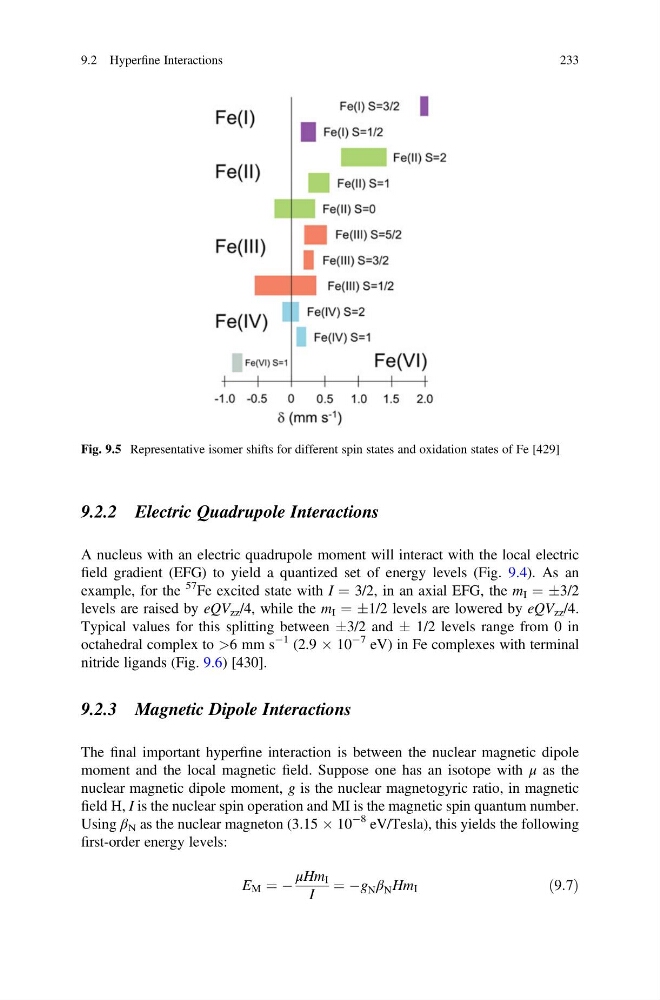
Fig. 9.5 Representative isomer shifts for different spin states and oxidation states of Fe [429]
9.2 Hyperfine Interactions
233
A nucleus with an electric quadrupole moment will interact with the local electric
field gradient (EFG) to yield a quantized set of energy levels (Fig. 9.4). As an
example, for the
57 Fe excited state with I ¼ 3/2, in an axial EFG, the m I ¼ Æ3/2
levels are raised by eQV zz /4, while the m I ¼ Æ1/2 levels are lowered by eQV zz /4.
Typical values for this splitting between Æ3/2 and Æ 1/2 levels range from 0 in
octahedral complex to >6 mm s
À1 (2.9 Â 10
À7 eV) in Fe complexes with terminal
nitride ligands (Fig. 9.6) [430].
9.2.3 Magnetic Dipole Interactions
The final important hyperfine interaction is between the nuclear magnetic dipole
moment and the local magnetic field. Suppose one has an isotope with μ as the
nuclear magnetic dipole moment, g is the nuclear magnetogyric ratio, in magnetic
field H, I is the nuclear spin operation and MI is the magnetic spin quantum number.
Using β N as the nuclear magneton (3.15 Â 10
À8 eV/Tesla), this yields the following
first-order energy levels:
E M ¼ À
μHm I
I
¼ Àg N β N Hm I
ð9:7Þ
Fig. 9.5 Representative isomer shifts for different spin states and oxidation states of Fe [429]
9.2 Hyperfine Interactions
233