

and (2) the nuclear magnetic dipole with the electronic magnetic field. The first of
these interactions gives rise to the nuclear quadrupole splitting, while the second
yields the nuclear Zeeman splitting. A final chemical effect involves sensitivity to the
electron density at the nucleus, which yields the isomer shift.
Why do we care about hyperfine interactions? The details will come later, but the
bottom line is that these perturbations of nuclear energy levels tell us about the
ground-state electronic structure of the molecule containing the isotope under study.
This can provide a fingerprint for properties such as oxidation state, or an insight into
the magnetic properties.
9.2.1 Electric Monopole Interactions: The Isomer Shift
The simplest hyperfine interaction is the electric monopole interaction between the
nuclear charge, which is spread over a finite volume, and the electron density within
that nuclear region. Suppose that the nuclear charge distribution is uniform over a
sphere with radius R. Then, outside the nucleus, the potential energy at a distance r
from the center of the nucleus is given by V 0 (r) ¼ ÀZe
2 /r. However, inside the
nucleus the potential will depend on the radius R via:
V r
ð Þ ¼
Ze
2
r
À
3
2
þ
r
2
2R
2
, 0 r R
ð9:5Þ
This distinction is of interest because the effective nuclear radius is different for
the ground state and each excited state of a nucleus (Fig. 9.4). If we also assume that
the electronic wave function is a constant ψ(0) over the nuclear region, then there
will be a shift in energy caused by the finite nuclear volume. The energy of a nuclear
transition is modified by the difference in shifts, δ(ΔE), between two nuclear states
with different nuclear volumes. Finally, what is actually measured in nuclear spectroscopy is the difference in difference of shifts, between a reference standard and the
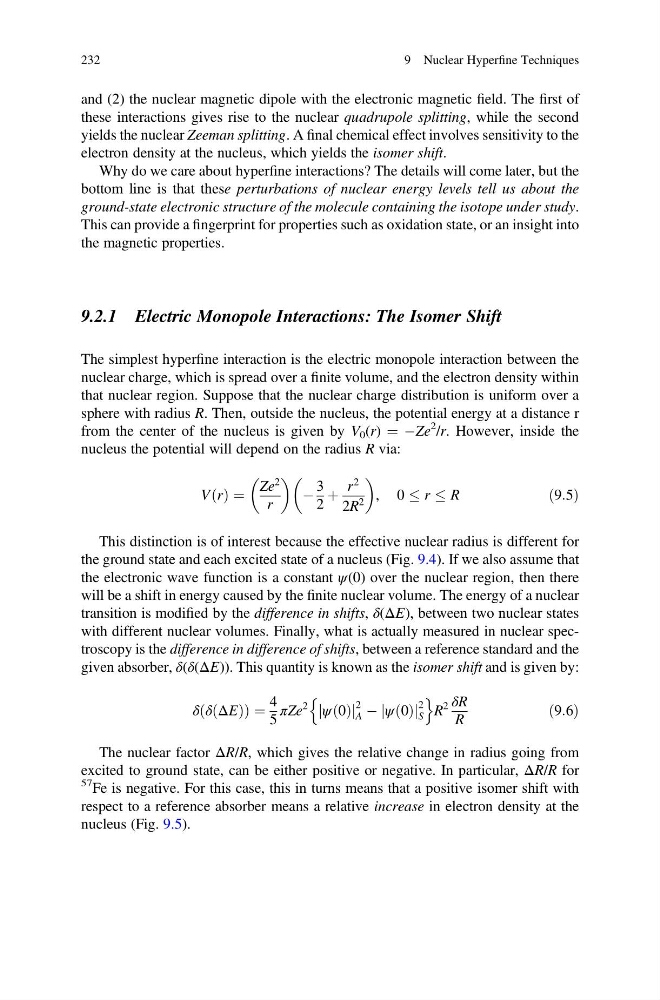
given absorber, δ(δ(ΔE)). This quantity is known as the isomer shift and is given by:
δ δ ΔE
ð Þ
ð
Þ¼
4
5
πZe
2
ψ 0
ð Þ
j
j
2
A À ψ 0
ð Þ
j
j
2
S
n
o
R
2 δR
R
ð9:6Þ
The nuclear factor ΔR/R, which gives the relative change in radius going from
excited to ground state, can be either positive or negative. In particular, ΔR/R for
57 Fe is negative. For this case, this in turns means that a positive isomer shift with
respect to a reference absorber means a relative increase in electron density at the
nucleus (Fig. 9.5).
232
9 Nuclear Hyperfine Techniques
these interactions gives rise to the nuclear quadrupole splitting, while the second
yields the nuclear Zeeman splitting. A final chemical effect involves sensitivity to the
electron density at the nucleus, which yields the isomer shift.
Why do we care about hyperfine interactions? The details will come later, but the
bottom line is that these perturbations of nuclear energy levels tell us about the
ground-state electronic structure of the molecule containing the isotope under study.
This can provide a fingerprint for properties such as oxidation state, or an insight into
the magnetic properties.
9.2.1 Electric Monopole Interactions: The Isomer Shift
The simplest hyperfine interaction is the electric monopole interaction between the
nuclear charge, which is spread over a finite volume, and the electron density within
that nuclear region. Suppose that the nuclear charge distribution is uniform over a
sphere with radius R. Then, outside the nucleus, the potential energy at a distance r
from the center of the nucleus is given by V 0 (r) ¼ ÀZe
2 /r. However, inside the
nucleus the potential will depend on the radius R via:
V r
ð Þ ¼
Ze
2
r
À
3
2
þ
r
2
2R
2
, 0 r R
ð9:5Þ
This distinction is of interest because the effective nuclear radius is different for
the ground state and each excited state of a nucleus (Fig. 9.4). If we also assume that
the electronic wave function is a constant ψ(0) over the nuclear region, then there
will be a shift in energy caused by the finite nuclear volume. The energy of a nuclear
transition is modified by the difference in shifts, δ(ΔE), between two nuclear states
with different nuclear volumes. Finally, what is actually measured in nuclear spectroscopy is the difference in difference of shifts, between a reference standard and the
given absorber, δ(δ(ΔE)). This quantity is known as the isomer shift and is given by:
δ δ ΔE
ð Þ
ð
Þ¼
4
5
πZe
2
ψ 0
ð Þ
j
j
2
A À ψ 0
ð Þ
j
j
2
S
n
o
R
2 δR
R
ð9:6Þ
The nuclear factor ΔR/R, which gives the relative change in radius going from
excited to ground state, can be either positive or negative. In particular, ΔR/R for
57 Fe is negative. For this case, this in turns means that a positive isomer shift with
respect to a reference absorber means a relative increase in electron density at the
nucleus (Fig. 9.5).
232
9 Nuclear Hyperfine Techniques