

Quadrupole moments and other properties for important nuclei can be found
in [420].
If a nucleus has a nonzero spin quantum number, then the motion of charged
protons within that nucleus is like a solenoid that leads to a magnetic dipole moment,
μ
! , with magnitude μ. In such cases, the moment in the ground state, μ g , will differ
from the excited-state moment μ e . Magnetic moments are usually tabulated in units
of the nuclear magneton μ N (μ N ¼ eh/4πm p ¼ 5.05 Â 10
À27 J T
À1 ), and values for
important nuclei are also listed in [421].
9.2 Hyperfine Interactions
Hyperfine interactions are the result of interactions in an atom between the electrons
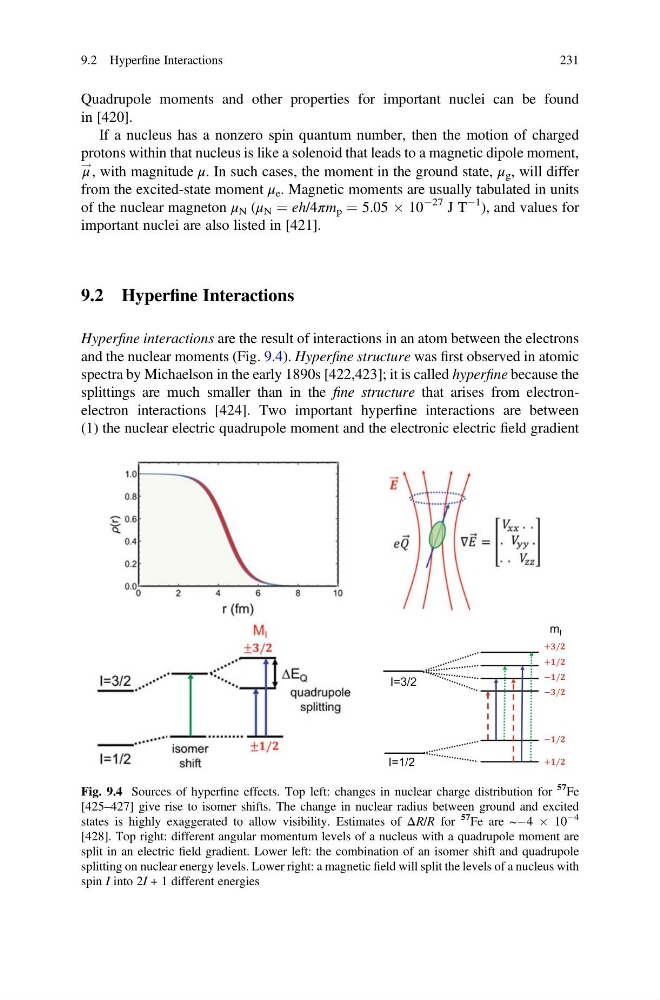
and the nuclear moments (Fig. 9.4). Hyperfine structure was first observed in atomic
spectra by Michaelson in the early 1890s [422,423]; it is called hyperfine because the
splittings are much smaller than in the fine structure that arises from electronelectron interactions [424]. Two important hyperfine interactions are between
(1) the nuclear electric quadrupole moment and the electronic electric field gradient
Fig. 9.4 Sources of hyperfine effects. Top left: changes in nuclear charge distribution for
57
Fe
[425–427] give rise to isomer shifts. The change in nuclear radius between ground and excited
states is highly exaggerated to allow visibility. Estimates of ΔR/R for
57
Fe are ~À4 Â 10
À4
[428]. Top right: different angular momentum levels of a nucleus with a quadrupole moment are
split in an electric field gradient. Lower left: the combination of an isomer shift and quadrupole
splitting on nuclear energy levels. Lower right: a magnetic field will split the levels of a nucleus with
spin I into 2I + 1 different energies
9.2 Hyperfine Interactions
231
in [420].
If a nucleus has a nonzero spin quantum number, then the motion of charged
protons within that nucleus is like a solenoid that leads to a magnetic dipole moment,
μ
! , with magnitude μ. In such cases, the moment in the ground state, μ g , will differ
from the excited-state moment μ e . Magnetic moments are usually tabulated in units
of the nuclear magneton μ N (μ N ¼ eh/4πm p ¼ 5.05 Â 10
À27 J T
À1 ), and values for
important nuclei are also listed in [421].
9.2 Hyperfine Interactions
Hyperfine interactions are the result of interactions in an atom between the electrons
and the nuclear moments (Fig. 9.4). Hyperfine structure was first observed in atomic
spectra by Michaelson in the early 1890s [422,423]; it is called hyperfine because the
splittings are much smaller than in the fine structure that arises from electronelectron interactions [424]. Two important hyperfine interactions are between
(1) the nuclear electric quadrupole moment and the electronic electric field gradient
Fig. 9.4 Sources of hyperfine effects. Top left: changes in nuclear charge distribution for
57
Fe
[425–427] give rise to isomer shifts. The change in nuclear radius between ground and excited
states is highly exaggerated to allow visibility. Estimates of ΔR/R for
57
Fe are ~À4 Â 10
À4
[428]. Top right: different angular momentum levels of a nucleus with a quadrupole moment are
split in an electric field gradient. Lower left: the combination of an isomer shift and quadrupole
splitting on nuclear energy levels. Lower right: a magnetic field will split the levels of a nucleus with
spin I into 2I + 1 different energies
9.2 Hyperfine Interactions
231