

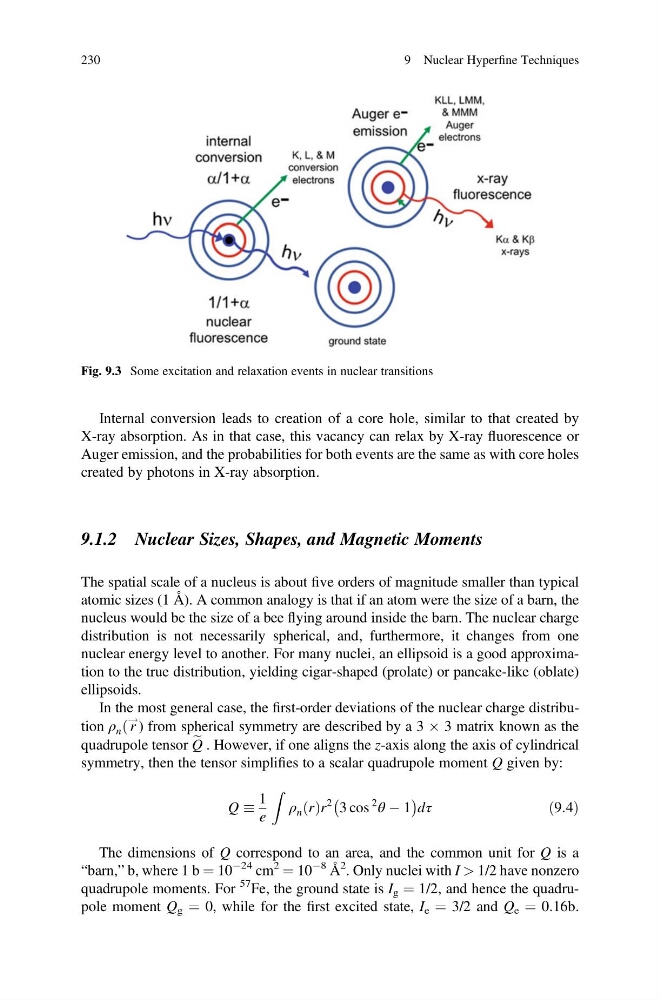
Internal conversion leads to creation of a core hole, similar to that created by
X-ray absorption. As in that case, this vacancy can relax by X-ray fluorescence or
Auger emission, and the probabilities for both events are the same as with core holes
created by photons in X-ray absorption.
9.1.2 Nuclear Sizes, Shapes, and Magnetic Moments
The spatial scale of a nucleus is about five orders of magnitude smaller than typical
atomic sizes (1 Å). A common analogy is that if an atom were the size of a barn, the
nucleus would be the size of a bee flying around inside the barn. The nuclear charge
distribution is not necessarily spherical, and, furthermore, it changes from one
nuclear energy level to another. For many nuclei, an ellipsoid is a good approximation to the true distribution, yielding cigar-shaped (prolate) or pancake-like (oblate)
ellipsoids.
In the most general case, the first-order deviations of the nuclear charge distribution ρ n ð r
! ) from spherical symmetry are described by a 3 Â 3 matrix known as the
quadrupole tensor e
Q . However, if one aligns the z-axis along the axis of cylindrical
symmetry, then the tensor simplifies to a scalar quadrupole moment Q given by:
Q
1
e
Z
ρ n r
ð Þr
2 3 cos
2
θ À 1
À
Á
dτ
ð9:4Þ
The dimensions of Q correspond to an area, and the common unit for Q is a
“barn,” b, where 1 b ¼ 10
À24 cm
2
¼ 10
À8 Å
2 . Only nuclei with I > 1/2 have nonzero
quadrupole moments. For
57 Fe, the ground state is I g ¼ 1/2, and hence the quadrupole moment Q g ¼ 0, while for the first excited state, I e ¼ 3/2 and Q e ¼ 0.16b.
Fig. 9.3 Some excitation and relaxation events in nuclear transitions
230
9 Nuclear Hyperfine Techniques
X-ray absorption. As in that case, this vacancy can relax by X-ray fluorescence or
Auger emission, and the probabilities for both events are the same as with core holes
created by photons in X-ray absorption.
9.1.2 Nuclear Sizes, Shapes, and Magnetic Moments
The spatial scale of a nucleus is about five orders of magnitude smaller than typical
atomic sizes (1 Å). A common analogy is that if an atom were the size of a barn, the
nucleus would be the size of a bee flying around inside the barn. The nuclear charge
distribution is not necessarily spherical, and, furthermore, it changes from one
nuclear energy level to another. For many nuclei, an ellipsoid is a good approximation to the true distribution, yielding cigar-shaped (prolate) or pancake-like (oblate)
ellipsoids.
In the most general case, the first-order deviations of the nuclear charge distribution ρ n ð r
! ) from spherical symmetry are described by a 3 Â 3 matrix known as the
quadrupole tensor e
Q . However, if one aligns the z-axis along the axis of cylindrical
symmetry, then the tensor simplifies to a scalar quadrupole moment Q given by:
Q
1
e
Z
ρ n r
ð Þr
2 3 cos
2
θ À 1
À
Á
dτ
ð9:4Þ
The dimensions of Q correspond to an area, and the common unit for Q is a
“barn,” b, where 1 b ¼ 10
À24 cm
2
¼ 10
À8 Å
2 . Only nuclei with I > 1/2 have nonzero
quadrupole moments. For
57 Fe, the ground state is I g ¼ 1/2, and hence the quadrupole moment Q g ¼ 0, while for the first excited state, I e ¼ 3/2 and Q e ¼ 0.16b.
Fig. 9.3 Some excitation and relaxation events in nuclear transitions
230
9 Nuclear Hyperfine Techniques