

8.5.3.1 Dynamics of Liquids
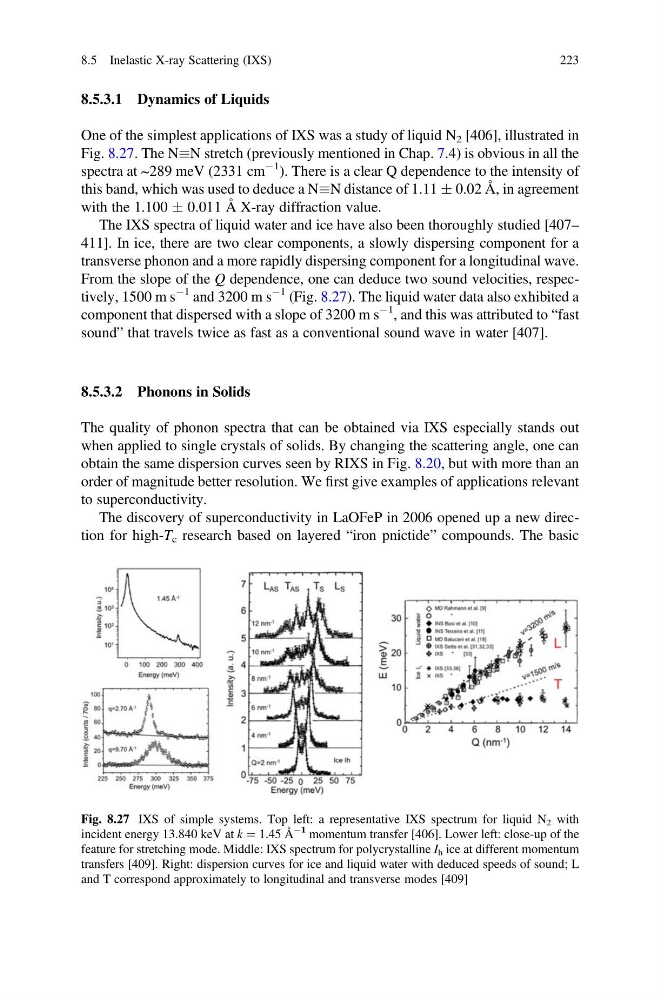
One of the simplest applications of IXS was a study of liquid N 2 [406], illustrated in
Fig. 8.27. The NN stretch (previously mentioned in Chap. 7.4) is obvious in all the
spectra at ~289 meV (2331 cm
À1 ). There is a clear Q dependence to the intensity of
this band, which was used to deduce a NN distance of 1.11 Æ 0.02 Å, in agreement
with the 1.100 Æ 0.011 Å X-ray diffraction value.
The IXS spectra of liquid water and ice have also been thoroughly studied [407–
411]. In ice, there are two clear components, a slowly dispersing component for a
transverse phonon and a more rapidly dispersing component for a longitudinal wave.
From the slope of the Q dependence, one can deduce two sound velocities, respectively, 1500 m s
À1 and 3200 m s
À1 (Fig. 8.27). The liquid water data also exhibited a
component that dispersed with a slope of 3200 m s
À1 , and this was attributed to “fast
sound” that travels twice as fast as a conventional sound wave in water [407].
8.5.3.2 Phonons in Solids
The quality of phonon spectra that can be obtained via IXS especially stands out
when applied to single crystals of solids. By changing the scattering angle, one can
obtain the same dispersion curves seen by RIXS in Fig. 8.20, but with more than an
order of magnitude better resolution. We first give examples of applications relevant
to superconductivity.
The discovery of superconductivity in LaOFeP in 2006 opened up a new direction for high-T c research based on layered “iron pnictide” compounds. The basic
Fig. 8.27 IXS of simple systems. Top left: a representative IXS spectrum for liquid N 2 with
incident energy 13.840 keV at k ¼ 1.45 Å
À1 momentum transfer [406]. Lower left: close-up of the
feature for stretching mode. Middle: IXS spectrum for polycrystalline I h ice at different momentum
transfers [409]. Right: dispersion curves for ice and liquid water with deduced speeds of sound; L
and T correspond approximately to longitudinal and transverse modes [409]
8.5 Inelastic X-ray Scattering (IXS)
223
One of the simplest applications of IXS was a study of liquid N 2 [406], illustrated in
Fig. 8.27. The NN stretch (previously mentioned in Chap. 7.4) is obvious in all the
spectra at ~289 meV (2331 cm
À1 ). There is a clear Q dependence to the intensity of
this band, which was used to deduce a NN distance of 1.11 Æ 0.02 Å, in agreement
with the 1.100 Æ 0.011 Å X-ray diffraction value.
The IXS spectra of liquid water and ice have also been thoroughly studied [407–
411]. In ice, there are two clear components, a slowly dispersing component for a
transverse phonon and a more rapidly dispersing component for a longitudinal wave.
From the slope of the Q dependence, one can deduce two sound velocities, respectively, 1500 m s
À1 and 3200 m s
À1 (Fig. 8.27). The liquid water data also exhibited a
component that dispersed with a slope of 3200 m s
À1 , and this was attributed to “fast
sound” that travels twice as fast as a conventional sound wave in water [407].
8.5.3.2 Phonons in Solids
The quality of phonon spectra that can be obtained via IXS especially stands out
when applied to single crystals of solids. By changing the scattering angle, one can
obtain the same dispersion curves seen by RIXS in Fig. 8.20, but with more than an
order of magnitude better resolution. We first give examples of applications relevant
to superconductivity.
The discovery of superconductivity in LaOFeP in 2006 opened up a new direction for high-T c research based on layered “iron pnictide” compounds. The basic
Fig. 8.27 IXS of simple systems. Top left: a representative IXS spectrum for liquid N 2 with
incident energy 13.840 keV at k ¼ 1.45 Å
À1 momentum transfer [406]. Lower left: close-up of the
feature for stretching mode. Middle: IXS spectrum for polycrystalline I h ice at different momentum
transfers [409]. Right: dispersion curves for ice and liquid water with deduced speeds of sound; L
and T correspond approximately to longitudinal and transverse modes [409]
8.5 Inelastic X-ray Scattering (IXS)
223