

desired resolution is 1 meV or better, about 10
3 -fold better than common IXS
instruments. This is achieved by working at high energies with crystals in an extreme
backscattering geometry, as described in Chap. 4. For the best sensitivity, an IXS
experiment should optimize the ratio of the Thomson-scattering cross section to the
absorption cross, as shown in Fig. 8.25, and this also favors high energies.
The quantities that are measured in an IXS experiment are as before in Fig. 8.23.
Apart from the energy change E, the momentum transfer Q
!
is also critical, because
one goal is to map the energy of a particular vibration as a function of momentum—a
so-called dispersion curve. A simplifying aspect of the IXS experiment is that energy
transfer is small compared to incident and scattered photon energies. From this it can
be shown that the magnitude of the momentum transfer, Q, is completely determined
by the photon energy (hence momentum) and the scattering angle:
ħQ ¼ 2ħ Á k i Á sin θ
ð8:22Þ
To summarize, an IXS experiment consists in measuring the intensity of scattering S Q
!
, E
or S Q
!
, ω
as a function of energy loss E and as a function of
momentum transfer Q
!
, which in turn is determined by the scattering angle 2θ.
8.5.3 IXS Applications
IXS has become one of the best techniques for characterizing the dynamic properties
of liquids and the phonon spectra of solid materials. IXS can visualize phonons in
samples that are orders of magnitude smaller than the multi-gram quantities required
for inelastic neutron scattering. It is admittedly a photon-hungry experiment that
requires the absolute state of the art in storage ring, undulator, and X-ray optics.
However, it is gradually becoming more routine as the brightness of sources
continues to improve.
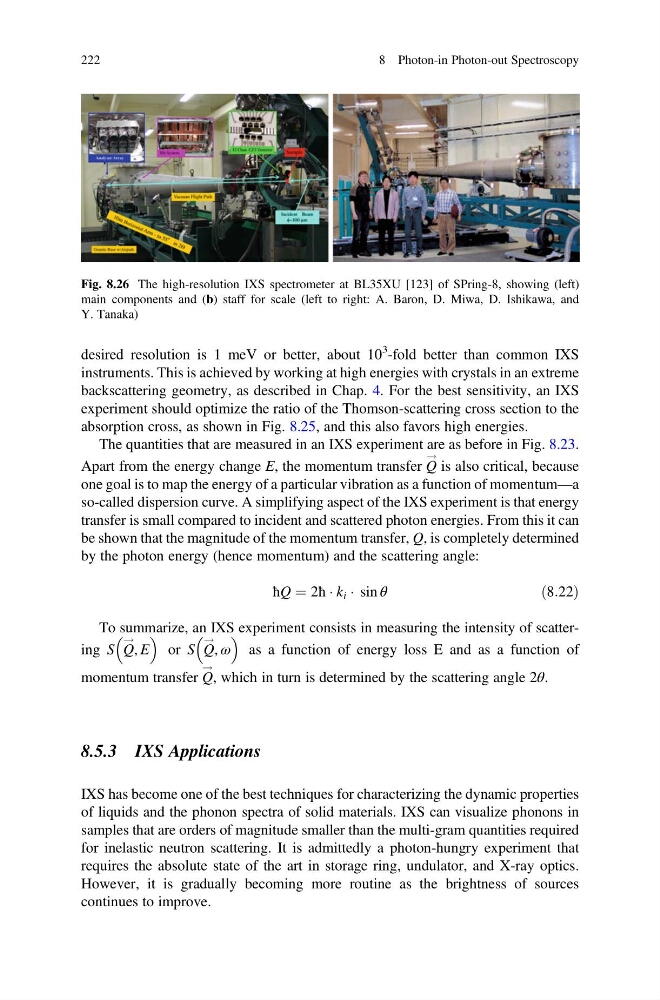
Fig. 8.26 The high-resolution IXS spectrometer at BL35XU [123] of SPring-8, showing (left)
main components and (b) staff for scale (left to right: A. Baron, D. Miwa, D. Ishikawa, and
Y. Tanaka)
222
8 Photon-in Photon-out Spectroscopy
3 -fold better than common IXS
instruments. This is achieved by working at high energies with crystals in an extreme
backscattering geometry, as described in Chap. 4. For the best sensitivity, an IXS
experiment should optimize the ratio of the Thomson-scattering cross section to the
absorption cross, as shown in Fig. 8.25, and this also favors high energies.
The quantities that are measured in an IXS experiment are as before in Fig. 8.23.
Apart from the energy change E, the momentum transfer Q
!
is also critical, because
one goal is to map the energy of a particular vibration as a function of momentum—a
so-called dispersion curve. A simplifying aspect of the IXS experiment is that energy
transfer is small compared to incident and scattered photon energies. From this it can
be shown that the magnitude of the momentum transfer, Q, is completely determined
by the photon energy (hence momentum) and the scattering angle:
ħQ ¼ 2ħ Á k i Á sin θ
ð8:22Þ
To summarize, an IXS experiment consists in measuring the intensity of scattering S Q
!
, E
or S Q
!
, ω
as a function of energy loss E and as a function of
momentum transfer Q
!
, which in turn is determined by the scattering angle 2θ.
8.5.3 IXS Applications
IXS has become one of the best techniques for characterizing the dynamic properties
of liquids and the phonon spectra of solid materials. IXS can visualize phonons in
samples that are orders of magnitude smaller than the multi-gram quantities required
for inelastic neutron scattering. It is admittedly a photon-hungry experiment that
requires the absolute state of the art in storage ring, undulator, and X-ray optics.
However, it is gradually becoming more routine as the brightness of sources
continues to improve.
Fig. 8.26 The high-resolution IXS spectrometer at BL35XU [123] of SPring-8, showing (left)
main components and (b) staff for scale (left to right: A. Baron, D. Miwa, D. Ishikawa, and
Y. Tanaka)
222
8 Photon-in Photon-out Spectroscopy