

experimental data. This theory has been extensively reviewed elsewhere [393, 402–
404], so here we merely summarize the key factors that govern IXS intensities.
As with XRS, the single phonon cross-section for scattering, ∂
2
σ/∂Ω∂E, is
proportional to S Q
!
, ω
, the “dynamic structure factor,” but in this case, S Q
!
, ω
is sensitive to fluctuations in atomic positions (phonons). Along with terms accounting for phonon population and polarization effects, S Q
!
, ω
is in turn proportional
to the “inelastic structure factor”, F in Q
!
, which involves a summation over all the
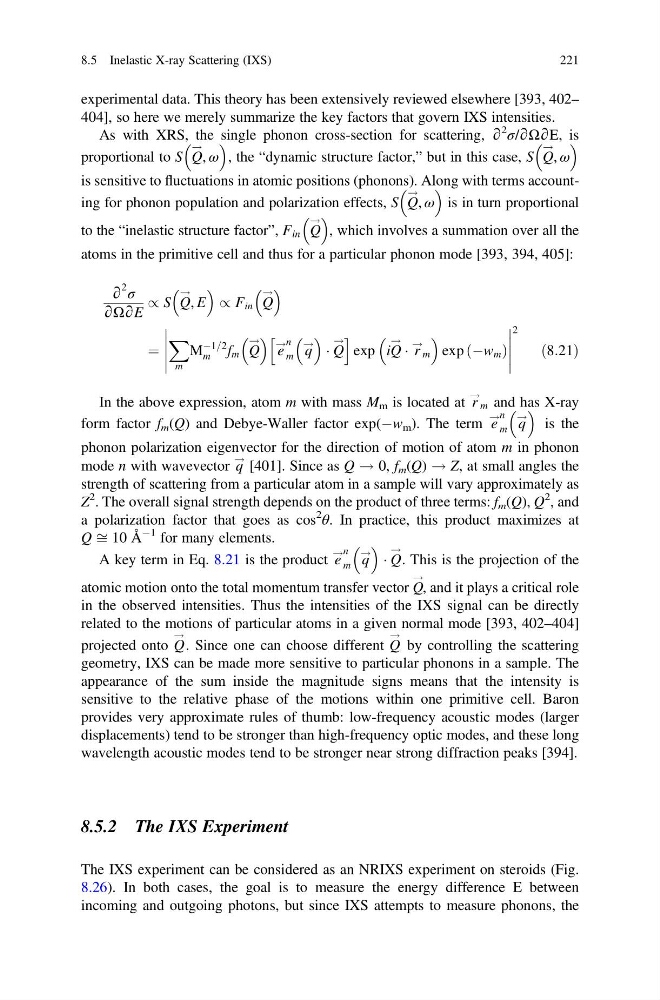
atoms in the primitive cell and thus for a particular phonon mode [393, 394, 405]:
∂
2 σ
∂Ω∂E
/ S Q
!
, E
/ F in Q
!
¼
X
m
M
À1=2
m
f m Q
!
e
! n
m q
!
Á Q
!
h
i
exp iQ
! Á r
!
m
exp Àw m
ð
Þ
2
ð8:21Þ
In the above expression, atom m with mass M m is located at r
!
m and has X-ray
form factor f m (Q) and Debye-Waller factor exp(Àw m ). The term e
! n
m q
!
is the
phonon polarization eigenvector for the direction of motion of atom m in phonon
mode n with wavevector q
! [401]. Since as Q ! 0, f m (Q) ! Z, at small angles the
strength of scattering from a particular atom in a sample will vary approximately as
Z
2 . The overall signal strength depends on the product of three terms: f m (Q), Q
2 , and
a polarization factor that goes as cos
2 θ. In practice, this product maximizes at
Q ffi 10 Å
À1 for many elements.
A key term in Eq. 8.21 is the product e
! n
m q
!
Á Q
!
. This is the projection of the
atomic motion onto the total momentum transfer vector Q
!
, and it plays a critical role
in the observed intensities. Thus the intensities of the IXS signal can be directly
related to the motions of particular atoms in a given normal mode [393, 402–404]
projected onto Q
!
. Since one can choose different Q
!
by controlling the scattering
geometry, IXS can be made more sensitive to particular phonons in a sample. The
appearance of the sum inside the magnitude signs means that the intensity is
sensitive to the relative phase of the motions within one primitive cell. Baron
provides very approximate rules of thumb: low-frequency acoustic modes (larger
displacements) tend to be stronger than high-frequency optic modes, and these long
wavelength acoustic modes tend to be stronger near strong diffraction peaks [394].
8.5.2 The IXS Experiment
The IXS experiment can be considered as an NRIXS experiment on steroids (Fig.
8.26). In both cases, the goal is to measure the energy difference E between
incoming and outgoing photons, but since IXS attempts to measure phonons, the
8.5 Inelastic X-ray Scattering (IXS)
221
404], so here we merely summarize the key factors that govern IXS intensities.
As with XRS, the single phonon cross-section for scattering, ∂
2
σ/∂Ω∂E, is
proportional to S Q
!
, ω
, the “dynamic structure factor,” but in this case, S Q
!
, ω
is sensitive to fluctuations in atomic positions (phonons). Along with terms accounting for phonon population and polarization effects, S Q
!
, ω
is in turn proportional
to the “inelastic structure factor”, F in Q
!
, which involves a summation over all the
atoms in the primitive cell and thus for a particular phonon mode [393, 394, 405]:
∂
2 σ
∂Ω∂E
/ S Q
!
, E
/ F in Q
!
¼
X
m
M
À1=2
m
f m Q
!
e
! n
m q
!
Á Q
!
h
i
exp iQ
! Á r
!
m
exp Àw m
ð
Þ
2
ð8:21Þ
In the above expression, atom m with mass M m is located at r
!
m and has X-ray
form factor f m (Q) and Debye-Waller factor exp(Àw m ). The term e
! n
m q
!
is the
phonon polarization eigenvector for the direction of motion of atom m in phonon
mode n with wavevector q
! [401]. Since as Q ! 0, f m (Q) ! Z, at small angles the
strength of scattering from a particular atom in a sample will vary approximately as
Z
2 . The overall signal strength depends on the product of three terms: f m (Q), Q
2 , and
a polarization factor that goes as cos
2 θ. In practice, this product maximizes at
Q ffi 10 Å
À1 for many elements.
A key term in Eq. 8.21 is the product e
! n
m q
!
Á Q
!
. This is the projection of the
atomic motion onto the total momentum transfer vector Q
!
, and it plays a critical role
in the observed intensities. Thus the intensities of the IXS signal can be directly
related to the motions of particular atoms in a given normal mode [393, 402–404]
projected onto Q
!
. Since one can choose different Q
!
by controlling the scattering
geometry, IXS can be made more sensitive to particular phonons in a sample. The
appearance of the sum inside the magnitude signs means that the intensity is
sensitive to the relative phase of the motions within one primitive cell. Baron
provides very approximate rules of thumb: low-frequency acoustic modes (larger
displacements) tend to be stronger than high-frequency optic modes, and these long
wavelength acoustic modes tend to be stronger near strong diffraction peaks [394].
8.5.2 The IXS Experiment
The IXS experiment can be considered as an NRIXS experiment on steroids (Fig.
8.26). In both cases, the goal is to measure the energy difference E between
incoming and outgoing photons, but since IXS attempts to measure phonons, the
8.5 Inelastic X-ray Scattering (IXS)
221