

d
2
σ
dΩdE
k
!
i ^ ε i ! k
!
f ^ ε f
¼ r
2
0
k f
k i
b ε f Á b ε i
j
j
2 S Q
!
, ω
¼ r
2
0
E f
E i
b ε f Á b ε i
j
j
2 S Q
!
, E
ð8:18Þ
where ħ k
!
i and ħ k
!
f are the incident and scattered photon momenta, b e i and b e f are
polarization unit vectors, and r 0 is the classical electron radius. The momentum and
energy transfers are, respectively, given by:
E ¼ ħω E i À E f
À
Á
ð8:19Þ
and
ħQ
! ħ k
!
i À k
!
f
ð8:20Þ
Notice that the convention is to write the dynamic structure factor as a function of
ω and to define positive energy transfer as corresponding to the sample gaining
energy—the Stokes side of the spectrum.
8.5.1 IXS and Phonons
With a known crystal structure and force field, all of the observed changes are in
principle calculable from the well-developed theory behind IXS. Thus, many IXS
investigations are designed to test agreement between proposed force fields and the
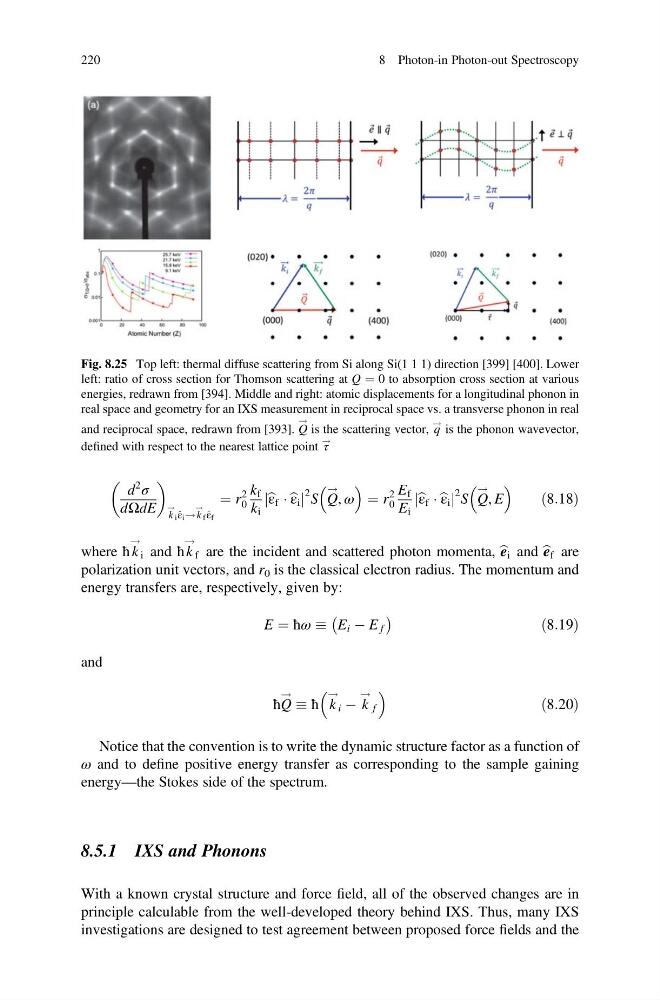
Fig. 8.25 Top left: thermal diffuse scattering from Si along Si(1 1 1) direction [399] [400]. Lower
left: ratio of cross section for Thomson scattering at Q ¼ 0 to absorption cross section at various
energies, redrawn from [394]. Middle and right: atomic displacements for a longitudinal phonon in
real space and geometry for an IXS measurement in reciprocal space vs. a transverse phonon in real
and reciprocal space, redrawn from [393]. Q
!
is the scattering vector, q
! is the phonon wavevector,
defined with respect to the nearest lattice point τ
!
220
8 Photon-in Photon-out Spectroscopy
2
σ
dΩdE
k
!
i ^ ε i ! k
!
f ^ ε f
¼ r
2
0
k f
k i
b ε f Á b ε i
j
j
2 S Q
!
, ω
¼ r
2
0
E f
E i
b ε f Á b ε i
j
j
2 S Q
!
, E
ð8:18Þ
where ħ k
!
i and ħ k
!
f are the incident and scattered photon momenta, b e i and b e f are
polarization unit vectors, and r 0 is the classical electron radius. The momentum and
energy transfers are, respectively, given by:
E ¼ ħω E i À E f
À
Á
ð8:19Þ
and
ħQ
! ħ k
!
i À k
!
f
ð8:20Þ
Notice that the convention is to write the dynamic structure factor as a function of
ω and to define positive energy transfer as corresponding to the sample gaining
energy—the Stokes side of the spectrum.
8.5.1 IXS and Phonons
With a known crystal structure and force field, all of the observed changes are in
principle calculable from the well-developed theory behind IXS. Thus, many IXS
investigations are designed to test agreement between proposed force fields and the
Fig. 8.25 Top left: thermal diffuse scattering from Si along Si(1 1 1) direction [399] [400]. Lower
left: ratio of cross section for Thomson scattering at Q ¼ 0 to absorption cross section at various
energies, redrawn from [394]. Middle and right: atomic displacements for a longitudinal phonon in
real space and geometry for an IXS measurement in reciprocal space vs. a transverse phonon in real
and reciprocal space, redrawn from [393]. Q
!
is the scattering vector, q
! is the phonon wavevector,
defined with respect to the nearest lattice point τ
!
220
8 Photon-in Photon-out Spectroscopy