

8.4.5 High-Pressure Samples
High-pressure conditions are another obvious situation where soft X-rays are out of
the question. Diamond anvil cells are the most common way to achieve high
pressures, and the walls can be penetrated by hard (but not soft) X-rays. One
illustration of their use is shown in Fig. 8.24, where Nyrow and coworkers used
NRIXS-derived Fe M-edges to observe the conversion of FeS from high-spin Fe to
low-spin Fe as pressure is increased to 10.1 GPa [397].
8.4.6 In Situ Batteries
Batteries under operating conditions are another example where the elements of
interest are low Z but soft X-ray absorption is not feasible. Nonaka and coworkers
observed beautiful changes in the C K-edge of a graphite electrode at different
voltages corresponding to different amounts of Li intercalation (Fig. 8.24) [398].
8.5 Inelastic X-ray Scattering (IXS)
There is another type of non-resonant inelastic X-ray scattering, often called just
“inelastic X-ray scattering” and abbreviated “IXS” [394], which is also quite different from X-ray fluorescence or RIXS. As with XRS, in IXS, a photon scatters
inelastically by interacting with charge density fluctuations of the system—in this
case fluctuations produced by phonons. Early on, this process was observed as
“Thermal Diffuse Scattering” (“TDS”) in X-ray diffraction patterns as seen in
Fig. 8.25, and TDS analysis is an entire field of its own [399]. However, before
the advent of synchrotron radiation sources, there were no instruments with sufficient energy resolution to resolve the small energy shifts from IXS underlying the
TDS features.
In the IXS experiment, one again measures a double differential scattering cross
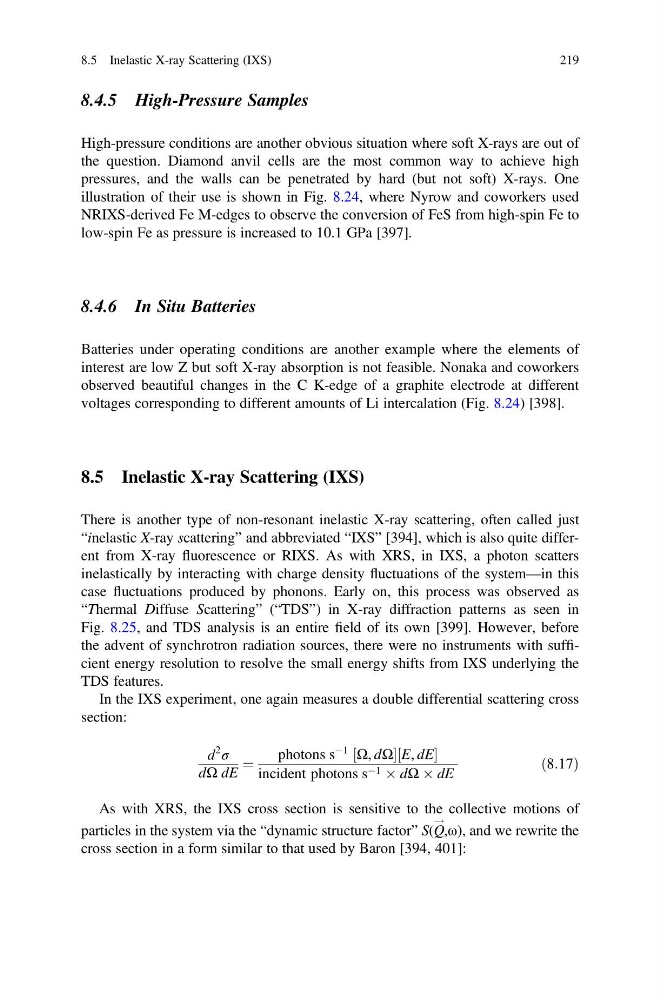
section:
d
2
σ
dΩ dE
¼
photons s
À1
Ω, dΩ
½
E, dE
½
incident photons s À1 Â dΩ Â dE
ð8:17Þ
As with XRS, the IXS cross section is sensitive to the collective motions of
particles in the system via the “dynamic structure factor” S(Q
!
,ω), and we rewrite the
cross section in a form similar to that used by Baron [394, 401]:
8.5 Inelastic X-ray Scattering (IXS)
219
High-pressure conditions are another obvious situation where soft X-rays are out of
the question. Diamond anvil cells are the most common way to achieve high
pressures, and the walls can be penetrated by hard (but not soft) X-rays. One
illustration of their use is shown in Fig. 8.24, where Nyrow and coworkers used
NRIXS-derived Fe M-edges to observe the conversion of FeS from high-spin Fe to
low-spin Fe as pressure is increased to 10.1 GPa [397].
8.4.6 In Situ Batteries
Batteries under operating conditions are another example where the elements of
interest are low Z but soft X-ray absorption is not feasible. Nonaka and coworkers
observed beautiful changes in the C K-edge of a graphite electrode at different
voltages corresponding to different amounts of Li intercalation (Fig. 8.24) [398].
8.5 Inelastic X-ray Scattering (IXS)
There is another type of non-resonant inelastic X-ray scattering, often called just
“inelastic X-ray scattering” and abbreviated “IXS” [394], which is also quite different from X-ray fluorescence or RIXS. As with XRS, in IXS, a photon scatters
inelastically by interacting with charge density fluctuations of the system—in this
case fluctuations produced by phonons. Early on, this process was observed as
“Thermal Diffuse Scattering” (“TDS”) in X-ray diffraction patterns as seen in
Fig. 8.25, and TDS analysis is an entire field of its own [399]. However, before
the advent of synchrotron radiation sources, there were no instruments with sufficient energy resolution to resolve the small energy shifts from IXS underlying the
TDS features.
In the IXS experiment, one again measures a double differential scattering cross
section:
d
2
σ
dΩ dE
¼
photons s
À1
Ω, dΩ
½
E, dE
½
incident photons s À1 Â dΩ Â dE
ð8:17Þ
As with XRS, the IXS cross section is sensitive to the collective motions of
particles in the system via the “dynamic structure factor” S(Q
!
,ω), and we rewrite the
cross section in a form similar to that used by Baron [394, 401]:
8.5 Inelastic X-ray Scattering (IXS)
219