

8.4.4.2 Hydrocarbons and Fuels
Fossil fuels contain an enormous variety of carbon and nitrogen functionalities that
could benefit from C and N K-edge analysis. Asphaltenes are a particularly nasty
fossil fuel fraction—they are an asphalt-like residue from the final stages of petroleum distillation, and UHV scientists are loath to put petroleum residues in their
pristine vacuum chambers. Using X-ray Raman, Bergmann, and coworkers collected
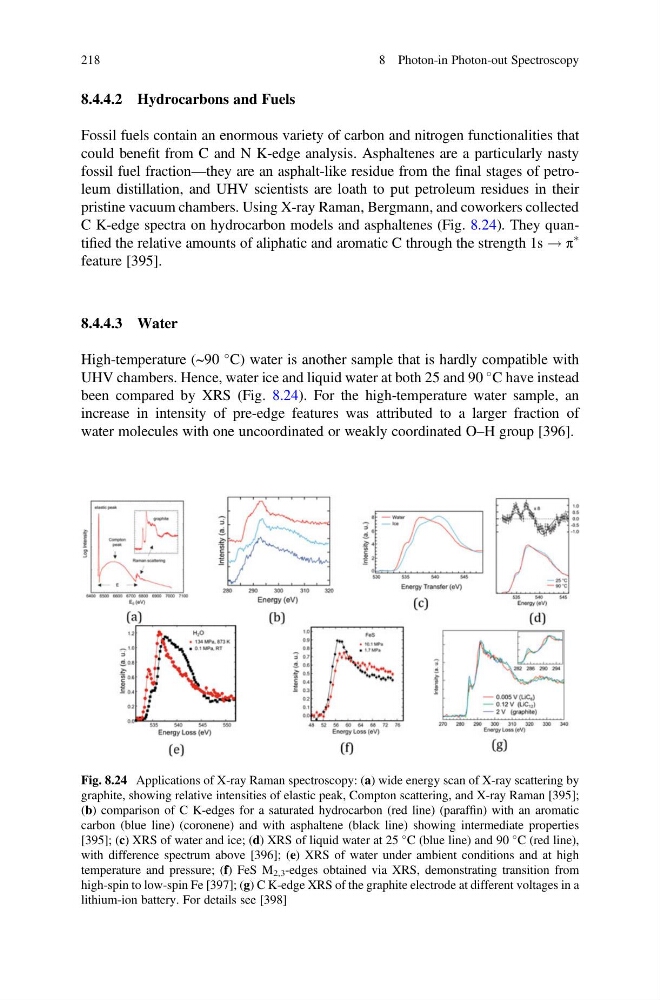
C K-edge spectra on hydrocarbon models and asphaltenes (Fig. 8.24). They quantified the relative amounts of aliphatic and aromatic C through the strength 1s ! π
Ã
feature [395].
8.4.4.3 Water
High-temperature (~90
C) water is another sample that is hardly compatible with
UHV chambers. Hence, water ice and liquid water at both 25 and 90
C have instead
been compared by XRS (Fig. 8.24). For the high-temperature water sample, an
increase in intensity of pre-edge features was attributed to a larger fraction of
water molecules with one uncoordinated or weakly coordinated O–H group [396].
Fig. 8.24 Applications of X-ray Raman spectroscopy: (a) wide energy scan of X-ray scattering by
graphite, showing relative intensities of elastic peak, Compton scattering, and X-ray Raman [395];
(b) comparison of C K-edges for a saturated hydrocarbon (red line) (paraffin) with an aromatic
carbon (blue line) (coronene) and with asphaltene (black line) showing intermediate properties
[395]; (c) XRS of water and ice; (d) XRS of liquid water at 25
C (blue line) and 90
C (red line),
with difference spectrum above [396]; (e) XRS of water under ambient conditions and at high
temperature and pressure; (f) FeS M 2,3 -edges obtained via XRS, demonstrating transition from
high-spin to low-spin Fe [397]; (g) C K-edge XRS of the graphite electrode at different voltages in a
lithium-ion battery. For details see [398]
218
8 Photon-in Photon-out Spectroscopy
Fossil fuels contain an enormous variety of carbon and nitrogen functionalities that
could benefit from C and N K-edge analysis. Asphaltenes are a particularly nasty
fossil fuel fraction—they are an asphalt-like residue from the final stages of petroleum distillation, and UHV scientists are loath to put petroleum residues in their
pristine vacuum chambers. Using X-ray Raman, Bergmann, and coworkers collected
C K-edge spectra on hydrocarbon models and asphaltenes (Fig. 8.24). They quantified the relative amounts of aliphatic and aromatic C through the strength 1s ! π
Ã
feature [395].
8.4.4.3 Water
High-temperature (~90
C) water is another sample that is hardly compatible with
UHV chambers. Hence, water ice and liquid water at both 25 and 90
C have instead
been compared by XRS (Fig. 8.24). For the high-temperature water sample, an
increase in intensity of pre-edge features was attributed to a larger fraction of
water molecules with one uncoordinated or weakly coordinated O–H group [396].
Fig. 8.24 Applications of X-ray Raman spectroscopy: (a) wide energy scan of X-ray scattering by
graphite, showing relative intensities of elastic peak, Compton scattering, and X-ray Raman [395];
(b) comparison of C K-edges for a saturated hydrocarbon (red line) (paraffin) with an aromatic
carbon (blue line) (coronene) and with asphaltene (black line) showing intermediate properties
[395]; (c) XRS of water and ice; (d) XRS of liquid water at 25
C (blue line) and 90
C (red line),
with difference spectrum above [396]; (e) XRS of water under ambient conditions and at high
temperature and pressure; (f) FeS M 2,3 -edges obtained via XRS, demonstrating transition from
high-spin to low-spin Fe [397]; (g) C K-edge XRS of the graphite electrode at different voltages in a
lithium-ion battery. For details see [398]
218
8 Photon-in Photon-out Spectroscopy