

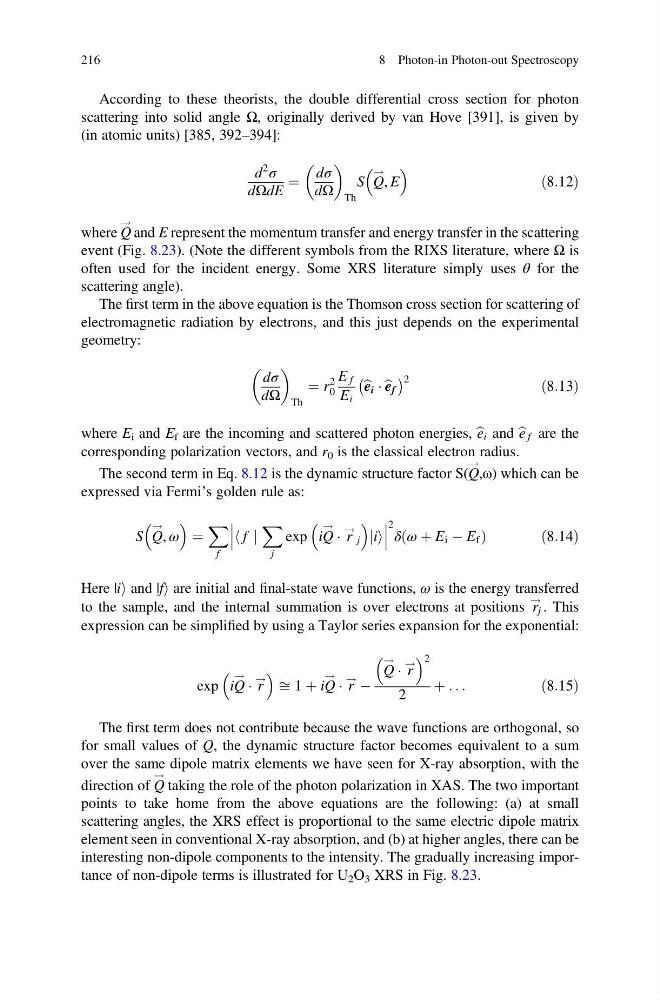
According to these theorists, the double differential cross section for photon
scattering into solid angle Ω, originally derived by van Hove [391], is given by
(in atomic units) [385, 392–394]:
d
2
σ
dΩdE
¼
dσ
dΩ
Th
S Q
!
, E
ð8:12Þ
where Q
!
and E represent the momentum transfer and energy transfer in the scattering
event (Fig. 8.23). (Note the different symbols from the RIXS literature, where Ω is
often used for the incident energy. Some XRS literature simply uses θ for the
scattering angle).
The first term in the above equation is the Thomson cross section for scattering of
electromagnetic radiation by electrons, and this just depends on the experimental
geometry:
dσ
dΩ
Th
¼ r
2
0
E f
E i
b e i Á b e f
À
Á 2
ð8:13Þ
where E i and E f are the incoming and scattered photon energies, b e i and b e f are the
corresponding polarization vectors, and r 0 is the classical electron radius.
The second term in Eq. 8.12 is the dynamic structure factor S(Q
!
,ω) which can be
expressed via Fermi’s golden rule as:
S Q
!
, ω
¼
X
f
h f j
X
j
exp iQ
! Á r
!
j
jii
2 δ ω þ E i À E f
ð
Þ
ð 8:14Þ
Here |ii and |fi are initial and final-state wave functions, ω is the energy transferred
to the sample, and the internal summation is over electrons at positions r
!
j . This
expression can be simplified by using a Taylor series expansion for the exponential:
exp iQ
! Á r
!
ffi 1 þ iQ
! Á r
! À
Q
! Á r
!
2
2
þ . . .
ð8:15Þ
The first term does not contribute because the wave functions are orthogonal, so
for small values of Q, the dynamic structure factor becomes equivalent to a sum
over the same dipole matrix elements we have seen for X-ray absorption, with the
direction of Q
!
taking the role of the photon polarization in XAS. The two important
points to take home from the above equations are the following: (a) at small
scattering angles, the XRS effect is proportional to the same electric dipole matrix
element seen in conventional X-ray absorption, and (b) at higher angles, there can be
interesting non-dipole components to the intensity. The gradually increasing importance of non-dipole terms is illustrated for U 2 O 3 XRS in Fig. 8.23.
216
8 Photon-in Photon-out Spectroscopy
scattering into solid angle Ω, originally derived by van Hove [391], is given by
(in atomic units) [385, 392–394]:
d
2
σ
dΩdE
¼
dσ
dΩ
Th
S Q
!
, E
ð8:12Þ
where Q
!
and E represent the momentum transfer and energy transfer in the scattering
event (Fig. 8.23). (Note the different symbols from the RIXS literature, where Ω is
often used for the incident energy. Some XRS literature simply uses θ for the
scattering angle).
The first term in the above equation is the Thomson cross section for scattering of
electromagnetic radiation by electrons, and this just depends on the experimental
geometry:
dσ
dΩ
Th
¼ r
2
0
E f
E i
b e i Á b e f
À
Á 2
ð8:13Þ
where E i and E f are the incoming and scattered photon energies, b e i and b e f are the
corresponding polarization vectors, and r 0 is the classical electron radius.
The second term in Eq. 8.12 is the dynamic structure factor S(Q
!
,ω) which can be
expressed via Fermi’s golden rule as:
S Q
!
, ω
¼
X
f
h f j
X
j
exp iQ
! Á r
!
j
jii
2 δ ω þ E i À E f
ð
Þ
ð 8:14Þ
Here |ii and |fi are initial and final-state wave functions, ω is the energy transferred
to the sample, and the internal summation is over electrons at positions r
!
j . This
expression can be simplified by using a Taylor series expansion for the exponential:
exp iQ
! Á r
!
ffi 1 þ iQ
! Á r
! À
Q
! Á r
!
2
2
þ . . .
ð8:15Þ
The first term does not contribute because the wave functions are orthogonal, so
for small values of Q, the dynamic structure factor becomes equivalent to a sum
over the same dipole matrix elements we have seen for X-ray absorption, with the
direction of Q
!
taking the role of the photon polarization in XAS. The two important
points to take home from the above equations are the following: (a) at small
scattering angles, the XRS effect is proportional to the same electric dipole matrix
element seen in conventional X-ray absorption, and (b) at higher angles, there can be
interesting non-dipole components to the intensity. The gradually increasing importance of non-dipole terms is illustrated for U 2 O 3 XRS in Fig. 8.23.
216
8 Photon-in Photon-out Spectroscopy