

8.4.1 The XRS Experiment
Since X-ray Raman scattering is a weak effect, most measurements employ an array
of spherically bent crystals similar to those used for high-energy resolution X-ray
fluorescence. Until recently, most of these devices had a moderate resolution of
~1 eV. A recently upgraded end-station at ESRF can achieve ~0.3 eV overall
resolution [383] while providing a phenomenal solid angle (at lower resolution)
approaching 10% of 4π steradians by using 72 individual spherically bent analyzer
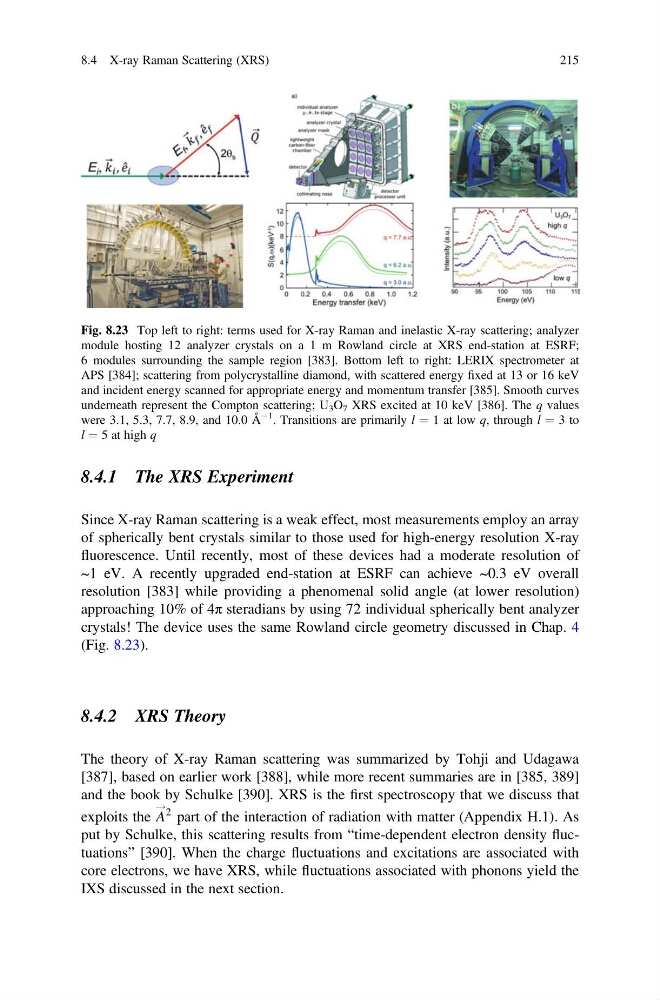
crystals! The device uses the same Rowland circle geometry discussed in Chap. 4
(Fig. 8.23).
8.4.2 XRS Theory
The theory of X-ray Raman scattering was summarized by Tohji and Udagawa
[387], based on earlier work [388], while more recent summaries are in [385, 389]
and the book by Schulke [390]. XRS is the first spectroscopy that we discuss that
exploits the A
! 2 part of the interaction of radiation with matter (Appendix H.1). As
put by Schulke, this scattering results from “time-dependent electron density fluctuations” [390]. When the charge fluctuations and excitations are associated with
core electrons, we have XRS, while fluctuations associated with phonons yield the
IXS discussed in the next section.
Fig. 8.23 Top left to right: terms used for X-ray Raman and inelastic X-ray scattering; analyzer
module hosting 12 analyzer crystals on a 1 m Rowland circle at XRS end-station at ESRF;
6 modules surrounding the sample region [383]. Bottom left to right: LERIX spectrometer at
APS [384]; scattering from polycrystalline diamond, with scattered energy fixed at 13 or 16 keV
and incident energy scanned for appropriate energy and momentum transfer [385]. Smooth curves
underneath represent the Compton scattering; U 3 O 7 XRS excited at 10 keV [386]. The q values
were 3.1, 5.3, 7.7, 8.9, and 10.0 Å
À1
. Transitions are primarily l ¼ 1 at low q, through l ¼ 3 to
l ¼ 5 at high q
8.4 X-ray Raman Scattering (XRS)
215
Since X-ray Raman scattering is a weak effect, most measurements employ an array
of spherically bent crystals similar to those used for high-energy resolution X-ray
fluorescence. Until recently, most of these devices had a moderate resolution of
~1 eV. A recently upgraded end-station at ESRF can achieve ~0.3 eV overall
resolution [383] while providing a phenomenal solid angle (at lower resolution)
approaching 10% of 4π steradians by using 72 individual spherically bent analyzer
crystals! The device uses the same Rowland circle geometry discussed in Chap. 4
(Fig. 8.23).
8.4.2 XRS Theory
The theory of X-ray Raman scattering was summarized by Tohji and Udagawa
[387], based on earlier work [388], while more recent summaries are in [385, 389]
and the book by Schulke [390]. XRS is the first spectroscopy that we discuss that
exploits the A
! 2 part of the interaction of radiation with matter (Appendix H.1). As
put by Schulke, this scattering results from “time-dependent electron density fluctuations” [390]. When the charge fluctuations and excitations are associated with
core electrons, we have XRS, while fluctuations associated with phonons yield the
IXS discussed in the next section.
Fig. 8.23 Top left to right: terms used for X-ray Raman and inelastic X-ray scattering; analyzer
module hosting 12 analyzer crystals on a 1 m Rowland circle at XRS end-station at ESRF;
6 modules surrounding the sample region [383]. Bottom left to right: LERIX spectrometer at
APS [384]; scattering from polycrystalline diamond, with scattered energy fixed at 13 or 16 keV
and incident energy scanned for appropriate energy and momentum transfer [385]. Smooth curves
underneath represent the Compton scattering; U 3 O 7 XRS excited at 10 keV [386]. The q values
were 3.1, 5.3, 7.7, 8.9, and 10.0 Å
À1
. Transitions are primarily l ¼ 1 at low q, through l ¼ 3 to
l ¼ 5 at high q
8.4 X-ray Raman Scattering (XRS)
215