

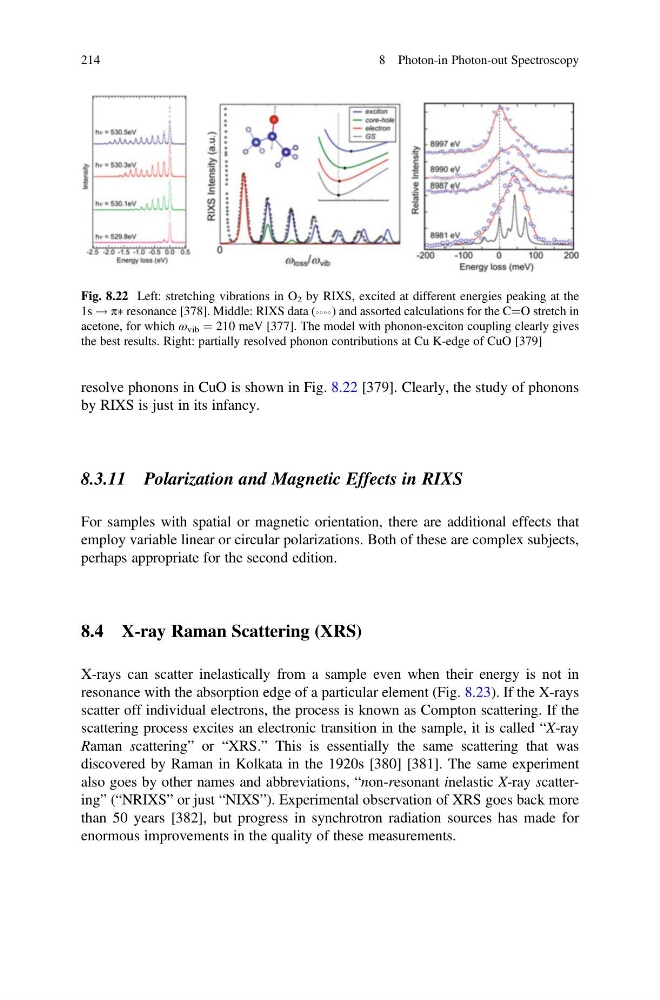
resolve phonons in CuO is shown in Fig. 8.22 [379]. Clearly, the study of phonons
by RIXS is just in its infancy.
8.3.11 Polarization and Magnetic Effects in RIXS
For samples with spatial or magnetic orientation, there are additional effects that
employ variable linear or circular polarizations. Both of these are complex subjects,
perhaps appropriate for the second edition.
8.4 X-ray Raman Scattering (XRS)
X-rays can scatter inelastically from a sample even when their energy is not in
resonance with the absorption edge of a particular element (Fig. 8.23). If the X-rays
scatter off individual electrons, the process is known as Compton scattering. If the
scattering process excites an electronic transition in the sample, it is called “X-ray
Raman scattering” or “XRS.” This is essentially the same scattering that was
discovered by Raman in Kolkata in the 1920s [380] [381]. The same experiment
also goes by other names and abbreviations, “non-resonant inelastic X-ray scattering” (“NRIXS” or just “NIXS”). Experimental observation of XRS goes back more
than 50 years [382], but progress in synchrotron radiation sources has made for
enormous improvements in the quality of these measurements.
Fig. 8.22 Left: stretching vibrations in O 2 by RIXS, excited at different energies peaking at the
1s ! πà resonance [378]. Middle: RIXS data () and assorted calculations for the C¼O stretch in
acetone, for which ω vib ¼ 210 meV [377]. The model with phonon-exciton coupling clearly gives
the best results. Right: partially resolved phonon contributions at Cu K-edge of CuO [379]
214
8 Photon-in Photon-out Spectroscopy
by RIXS is just in its infancy.
8.3.11 Polarization and Magnetic Effects in RIXS
For samples with spatial or magnetic orientation, there are additional effects that
employ variable linear or circular polarizations. Both of these are complex subjects,
perhaps appropriate for the second edition.
8.4 X-ray Raman Scattering (XRS)
X-rays can scatter inelastically from a sample even when their energy is not in
resonance with the absorption edge of a particular element (Fig. 8.23). If the X-rays
scatter off individual electrons, the process is known as Compton scattering. If the
scattering process excites an electronic transition in the sample, it is called “X-ray
Raman scattering” or “XRS.” This is essentially the same scattering that was
discovered by Raman in Kolkata in the 1920s [380] [381]. The same experiment
also goes by other names and abbreviations, “non-resonant inelastic X-ray scattering” (“NRIXS” or just “NIXS”). Experimental observation of XRS goes back more
than 50 years [382], but progress in synchrotron radiation sources has made for
enormous improvements in the quality of these measurements.
Fig. 8.22 Left: stretching vibrations in O 2 by RIXS, excited at different energies peaking at the
1s ! πà resonance [378]. Middle: RIXS data () and assorted calculations for the C¼O stretch in
acetone, for which ω vib ¼ 210 meV [377]. The model with phonon-exciton coupling clearly gives
the best results. Right: partially resolved phonon contributions at Cu K-edge of CuO [379]
214
8 Photon-in Photon-out Spectroscopy