

susceptibility as a function of temperature [367]. Although invisible by IR and
Raman spectroscopies [368], the singlet-triplet excitation can be seen directly by
inelastic neutron scattering [369].
RIXS provides another approach for direct observation of spin-flip transitions.
The processes by which L- or M-edge RIXS can cause spin flips at single sites or at a
collection of sites are sketched in Fig. 8.19. The key point is that thanks to spin-orbit
coupling, spin itself is not a “good quantum number” for the 2p or 3p vacancy. This
hole can be filled by an electron of either spin, with either ΔS ¼ 0 conservation of
spin or an overall ΔS ¼ 1 transition.
So far, magnetic RIXS has been applied primarily to solid-state systems with
extended chains of magnetic metals. In such systems, such as CuO and NiO, a simple
spin flip as described above for copper acetate will propagate through the lattice as a
wave [370]. This spin wave is often described as a quasiparticle called a magnon.
Like other quasiparticles, a magnon carries a fixed amount of energy, lattice
momentum, and angular momentum, in this case a spin of ħ.
The energies of magnetic excitations are frequently in the 1–100 meV range,
quite a bit lower than charge-transfer and d–d transitions. Magnetic RIXS thus
makes exquisite demands on the instrumental energy resolution E/ΔE, and it is
still early going for this technique. Fortunately, some of the most interesting systems
such as cuprates have large J values that make them accessible at current beamlines.
Thanks to the interest in high T c superconductors, there has been an enormous
amount of work on the spin distributions of copper oxides [371]. These can be
arranged into quasi-1D systems such as Sr 2 CuO 3 , quasi-2D systems such as
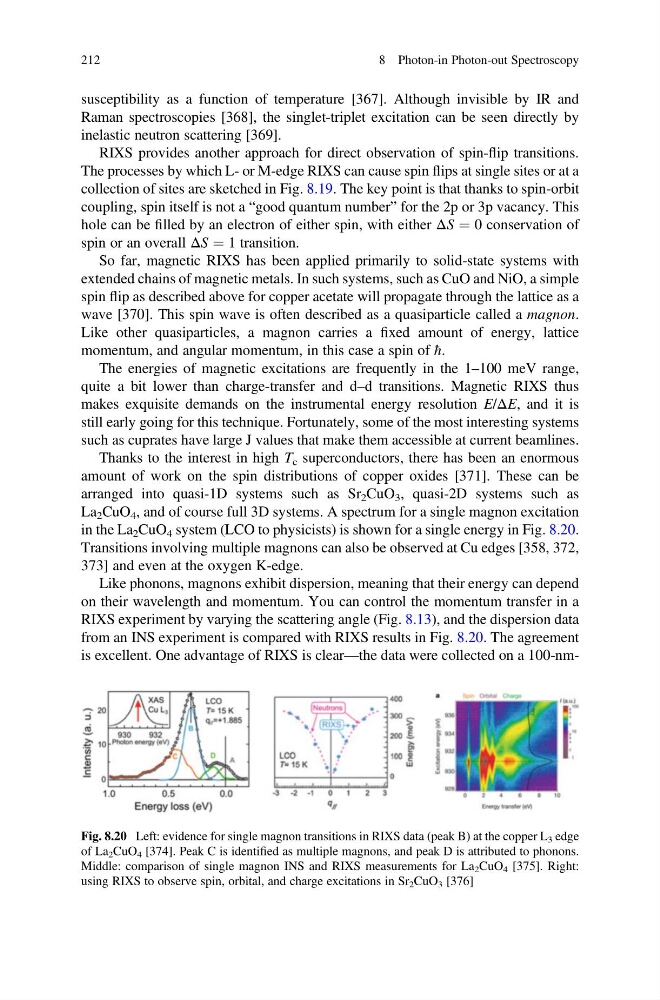
La 2 CuO 4 , and of course full 3D systems. A spectrum for a single magnon excitation
in the La 2 CuO 4 system (LCO to physicists) is shown for a single energy in Fig. 8.20.
Transitions involving multiple magnons can also be observed at Cu edges [358, 372,
373] and even at the oxygen K-edge.
Like phonons, magnons exhibit dispersion, meaning that their energy can depend
on their wavelength and momentum. You can control the momentum transfer in a
RIXS experiment by varying the scattering angle (Fig. 8.13), and the dispersion data
from an INS experiment is compared with RIXS results in Fig. 8.20. The agreement
is excellent. One advantage of RIXS is clear—the data were collected on a 100-nmFig. 8.20 Left: evidence for single magnon transitions in RIXS data (peak B) at the copper L 3 edge
of La 2 CuO 4 [374]. Peak C is identified as multiple magnons, and peak D is attributed to phonons.
Middle: comparison of single magnon INS and RIXS measurements for La 2 CuO 4 [375]. Right:
using RIXS to observe spin, orbital, and charge excitations in Sr 2 CuO 3 [376]
212
8 Photon-in Photon-out Spectroscopy
Raman spectroscopies [368], the singlet-triplet excitation can be seen directly by
inelastic neutron scattering [369].
RIXS provides another approach for direct observation of spin-flip transitions.
The processes by which L- or M-edge RIXS can cause spin flips at single sites or at a
collection of sites are sketched in Fig. 8.19. The key point is that thanks to spin-orbit
coupling, spin itself is not a “good quantum number” for the 2p or 3p vacancy. This
hole can be filled by an electron of either spin, with either ΔS ¼ 0 conservation of
spin or an overall ΔS ¼ 1 transition.
So far, magnetic RIXS has been applied primarily to solid-state systems with
extended chains of magnetic metals. In such systems, such as CuO and NiO, a simple
spin flip as described above for copper acetate will propagate through the lattice as a
wave [370]. This spin wave is often described as a quasiparticle called a magnon.
Like other quasiparticles, a magnon carries a fixed amount of energy, lattice
momentum, and angular momentum, in this case a spin of ħ.
The energies of magnetic excitations are frequently in the 1–100 meV range,
quite a bit lower than charge-transfer and d–d transitions. Magnetic RIXS thus
makes exquisite demands on the instrumental energy resolution E/ΔE, and it is
still early going for this technique. Fortunately, some of the most interesting systems
such as cuprates have large J values that make them accessible at current beamlines.
Thanks to the interest in high T c superconductors, there has been an enormous
amount of work on the spin distributions of copper oxides [371]. These can be
arranged into quasi-1D systems such as Sr 2 CuO 3 , quasi-2D systems such as
La 2 CuO 4 , and of course full 3D systems. A spectrum for a single magnon excitation
in the La 2 CuO 4 system (LCO to physicists) is shown for a single energy in Fig. 8.20.
Transitions involving multiple magnons can also be observed at Cu edges [358, 372,
373] and even at the oxygen K-edge.
Like phonons, magnons exhibit dispersion, meaning that their energy can depend
on their wavelength and momentum. You can control the momentum transfer in a
RIXS experiment by varying the scattering angle (Fig. 8.13), and the dispersion data
from an INS experiment is compared with RIXS results in Fig. 8.20. The agreement
is excellent. One advantage of RIXS is clear—the data were collected on a 100-nmFig. 8.20 Left: evidence for single magnon transitions in RIXS data (peak B) at the copper L 3 edge
of La 2 CuO 4 [374]. Peak C is identified as multiple magnons, and peak D is attributed to phonons.
Middle: comparison of single magnon INS and RIXS measurements for La 2 CuO 4 [375]. Right:
using RIXS to observe spin, orbital, and charge excitations in Sr 2 CuO 3 [376]
212
8 Photon-in Photon-out Spectroscopy