

In the resulting M-edge RIXS (Fig. 8.18), the same three d–d excitations are
clearly visible, and the elastic line from the 3p
6 3d
8
! 3p
5 3d
9
! 3p
6 3d
8 process is
also relatively strong.
The ability to excite at different energies is a powerful tool in RIXS. For example,
part of the L-edge absorption corresponds to a “spin-flip” transition to an intermediate state with primarily singlet character. This causes the final states of RIXS
excited at this energy to be dominated by the singlet final states. Thus, by changing
the excitation region, one can selectively enhance triplet or singlet final states, a
feature not available to conventional optical spectroscopy. Refer to [365] for details.
8.3.9 Magnetic Excitations Via RIXS
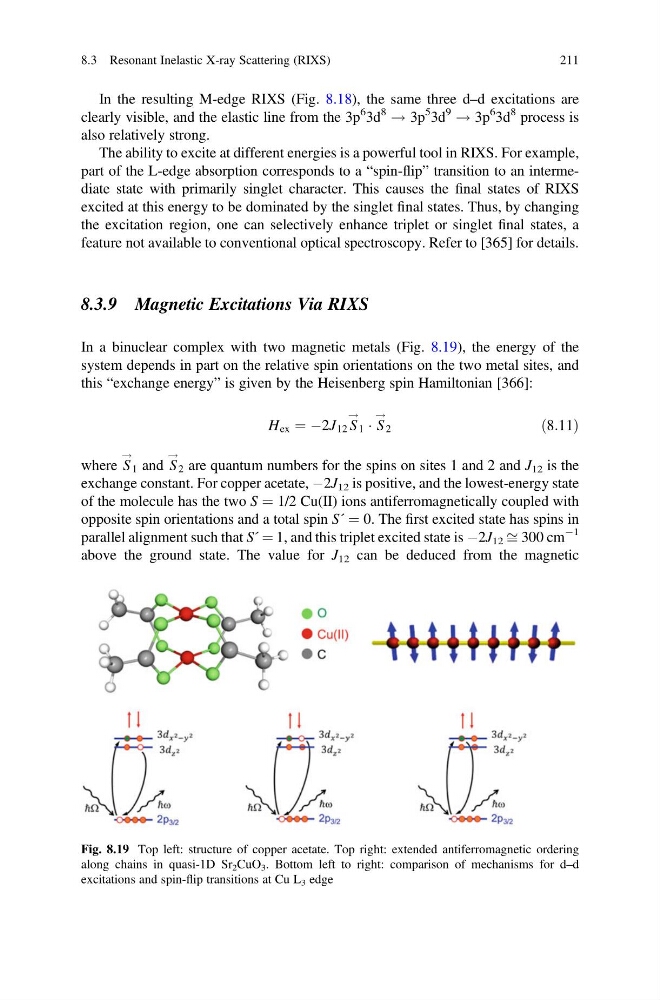
In a binuclear complex with two magnetic metals (Fig. 8.19), the energy of the
system depends in part on the relative spin orientations on the two metal sites, and
this “exchange energy” is given by the Heisenberg spin Hamiltonian [366]:
H ex ¼ À2J 12 S
!
1 Á S
!
2
ð8:11Þ
where S
!
1 and S
!
2 are quantum numbers for the spins on sites 1 and 2 and J 12 is the
exchange constant. For copper acetate, À2J 12 is positive, and the lowest-energy state
of the molecule has the two S ¼ 1/2 Cu(II) ions antiferromagnetically coupled with
opposite spin orientations and a total spin S´ ¼ 0. The first excited state has spins in
parallel alignment such that S´ ¼ 1, and this triplet excited state is À2J 12 ffi 300 cm
À1
above the ground state. The value for J 12 can be deduced from the magnetic
Fig. 8.19 Top left: structure of copper acetate. Top right: extended antiferromagnetic ordering
along chains in quasi-1D Sr 2 CuO 3 . Bottom left to right: comparison of mechanisms for d–d
excitations and spin-flip transitions at Cu L 3 edge
8.3 Resonant Inelastic X-ray Scattering (RIXS)
211
clearly visible, and the elastic line from the 3p
6 3d
8
! 3p
5 3d
9
! 3p
6 3d
8 process is
also relatively strong.
The ability to excite at different energies is a powerful tool in RIXS. For example,
part of the L-edge absorption corresponds to a “spin-flip” transition to an intermediate state with primarily singlet character. This causes the final states of RIXS
excited at this energy to be dominated by the singlet final states. Thus, by changing
the excitation region, one can selectively enhance triplet or singlet final states, a
feature not available to conventional optical spectroscopy. Refer to [365] for details.
8.3.9 Magnetic Excitations Via RIXS
In a binuclear complex with two magnetic metals (Fig. 8.19), the energy of the
system depends in part on the relative spin orientations on the two metal sites, and
this “exchange energy” is given by the Heisenberg spin Hamiltonian [366]:
H ex ¼ À2J 12 S
!
1 Á S
!
2
ð8:11Þ
where S
!
1 and S
!
2 are quantum numbers for the spins on sites 1 and 2 and J 12 is the
exchange constant. For copper acetate, À2J 12 is positive, and the lowest-energy state
of the molecule has the two S ¼ 1/2 Cu(II) ions antiferromagnetically coupled with
opposite spin orientations and a total spin S´ ¼ 0. The first excited state has spins in
parallel alignment such that S´ ¼ 1, and this triplet excited state is À2J 12 ffi 300 cm
À1
above the ground state. The value for J 12 can be deduced from the magnetic
Fig. 8.19 Top left: structure of copper acetate. Top right: extended antiferromagnetic ordering
along chains in quasi-1D Sr 2 CuO 3 . Bottom left to right: comparison of mechanisms for d–d
excitations and spin-flip transitions at Cu L 3 edge
8.3 Resonant Inelastic X-ray Scattering (RIXS)
211